[Report] Visiting Neimenggu Eerduosi Kubuqi Desert
Greening Project Accelerates... Vegetation Coverage Reaches 65%
Only Greened Desert Shown to Reporters
The Kubuqi Desert, located in Ordos City, Inner Mongolia Autonomous Region, China, is notorious among Koreans as the 'origin of yellow dust.' The sand and dust from Mongolia's Gobi Desert and the Kubuqi Desert often ride the northwest winds and affect South Korea's air quality, making it a frequent name in weather forecasts during the spring and autumn yellow dust seasons in Korea.
However, when visiting the Kubuqi Desert on the 31st of last month, it appeared somewhat unfamiliar. The widely spread Namujae (Gambong) and Gammoccho plants, along with sparsely visible low sand dunes, resembled a dry-season grassland landscape rather than a desert.
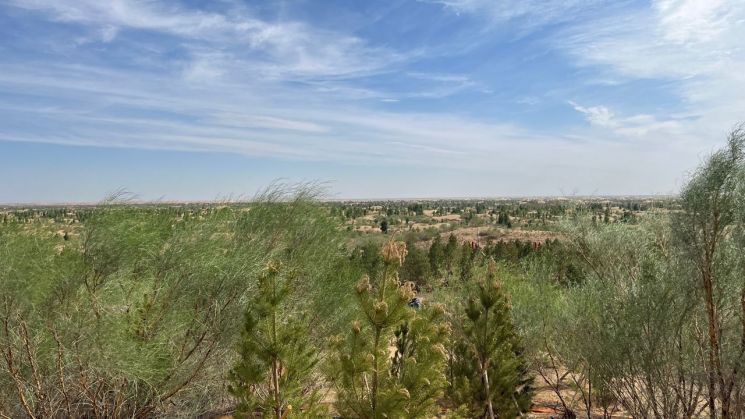 The Kubuqi Desert located in Ordos City, Inner Mongolia Autonomous Region, China. Although not dense, low and young vegetation is densely planted. (Photo by Kim Hyunjung)
The Hill of Death Returns as the 'Blue Bowstring'
Kubuqi is the seventh largest desert in China and the ninth largest in the world, covering a total area of 18,600 km². 'Kubuqi' means bowstring in Mongolian. The Yellow River, about 5 km to the north, is shaped like a bow, and the Kubuqi Desert appears to hang below it, which is said to be the origin of the name. About 200 years ago, Kubuqi was a grassland, but due to wars, reclamation, and logging that began in the early Qing Dynasty, it effectively became a 'man-made' desert. Since then, with more than 50 yellow dust events annually, it transformed into a 'desert of death' where it is difficult for people to live and plants to survive.
Since the late 1980s, the Yili Group has been engaged in greening projects in the Kubuqi Desert. Although they received some subsidies from the central and municipal governments, most of the investment was made directly by Yili Group. Li Ting, Yili Group’s construction manager, whom we met on site, said, "We are working to cover the sand dunes with vegetation using our unique technology and experience."
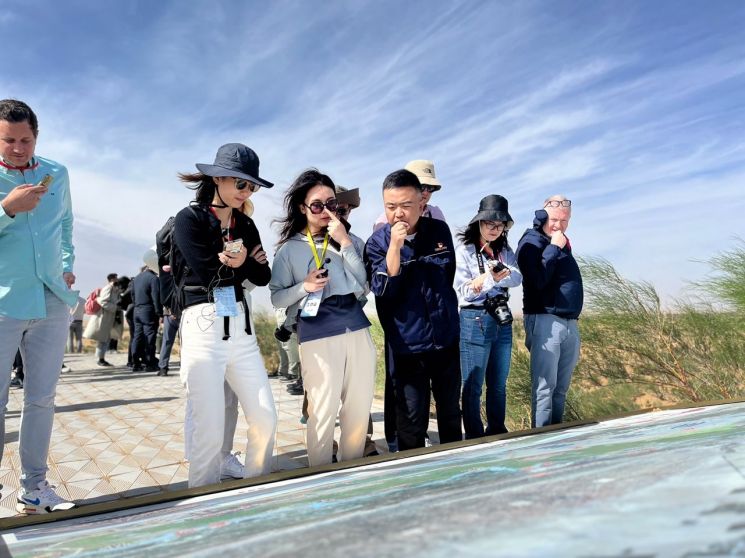 Riting, Construction Department Manager of Iri Group (third from the right in the front row), is explaining the Kubuchi Desert greening project. (Photo by Hyunjung Kim)
According to his explanation, after about 35 years of greening efforts, the average height of the sand dunes has been reduced by more than 50%, and the vegetation coverage (the proportion of the total area occupied by plants) has increased from only 3-5% in 1988 to 65% today. The proportion of mobile dunes, where sand moves with the wind, has decreased from 70% in the 1980s to about 40% currently. Manager Li pointed to various parts of the desert and explained, "Not only native tree species of Ordos but also various plants successfully cultivated from the Tibetan region are widely grown here," adding, "Biodiversity, which was about 123 species in the past, has now increased to over 530 species."
"Desertification Damage Will Come to China First... We Will Do What We Can"
The Kubuqi Desert is a famous tourist destination in Inner Mongolia, but as mentioned earlier, it carries a negative identity as the 'source of yellow dust.' Neighboring countries, including South Korea, have pointed to Kubuqi as the main culprit for deteriorating air quality and have raised criticism about neglecting desertification. Although unofficial, some analyses suggest that 40% of the yellow dust originating in Korea comes from this area.
Within China, views toward Kubuqi are also unfavorable. People from the Jingjin area (Beijing and Tianjin) have identified Kubuqi as the source of yellow dust and have complained about its effects. When a level 6 wind blows, the sandstorm from Kubuqi can reach the center of Beijing in less than a day.
A Yili Group official responded to such criticism by saying, "There may be clear domestic (within China) reasons," but emphasized, "We do not have exact causes or percentages, but what we can do is to restore nature." He continued, "If we do not do so, the situation (such as yellow dust) will come to us first," and stressed, "We will no longer allow further destruction."
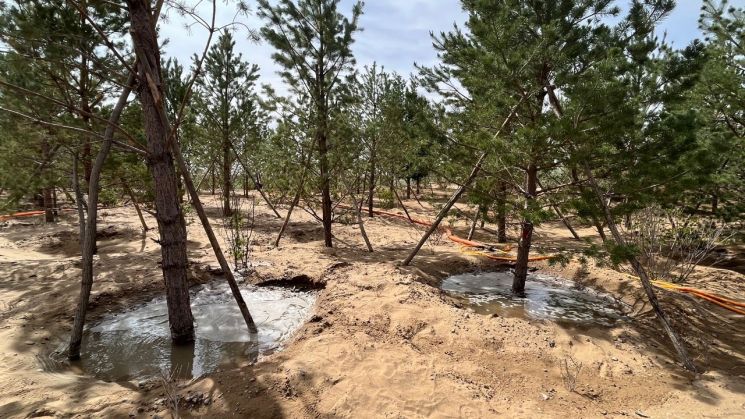 Trees planted in the Kubuchi Desert are managed by drawing groundwater. The Iri Group explained that water usable for cultivation can be obtained by digging about 3 to 22 meters into the desert.
 (Photo by Hyunjung Kim)
Advanced artificial intelligence (AI) technology is also employed in the greening efforts. Yili Group has developed its own technology to identify locations via satellite and plant seeds from the air using drones. Currently, second-generation drones are deployed to be used in deserts or marshes where it is difficult for workers to enter directly.
They are also focusing on securing water sources to sustain the vegetation. Currently, groundwater is used for plant growth, and due to proximity to the Yellow River, water can be found by digging only about 3 to 22 meters. The company explained that water sources, which were hard to find at the beginning of the project, have now been secured up to 25 billion cubic meters.
However, the desert areas where greening has not yet progressed were not disclosed to reporters during the local coverage, making it difficult to investigate the limitations and side effects of the greening project in detail. The Chinese government cites the success of the Kubuqi Desert greening project as a reason and publicly points to Mongolia as the background for yellow dust occurring domestically and in neighboring countries. At a regular press conference held at the end of last month, the Chinese Ministry of Ecology and Environment diagnosed the main causes of recent air quality deterioration and increased yellow dust frequency as "mainly the Gobi Desert in southern Mongolia and northwestern China," and many local media at the time explained that "Mongolia contributes about 70% to the dust concentration in Beijing."
© The Asia Business Daily(www.asiae.co.kr). All rights reserved.
![Clutching a Stolen Dior Bag, Saying "I Hate Being Poor but Real"... The Grotesque Con of a "Human Knockoff" [Slate]](https://cwcontent.asiae.co.kr/asiaresize/183/2026021902243444107_1771435474.jpg)


















