Since the introduction of token securities, claims have been made that a new paradigm shift in capital raising will occur.
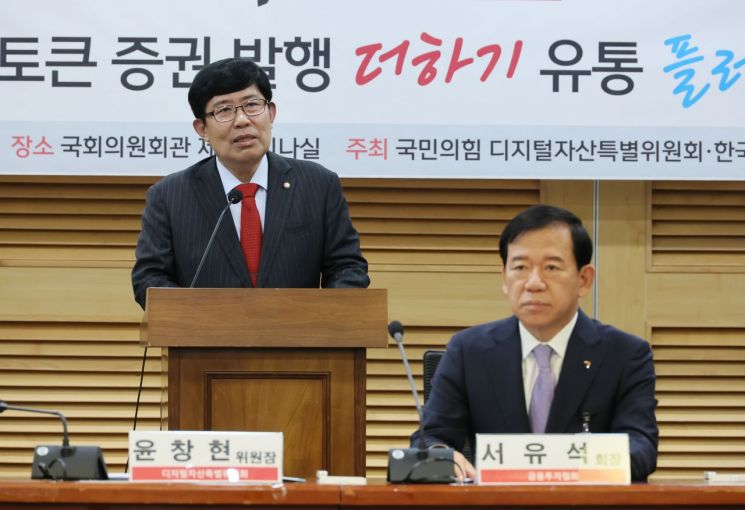 Yoon Chang-hyun, a member of the People Power Party, is delivering the opening remarks at the "STO Empowering Our Companies" forum held on the 5th at the National Assembly Members' Office Building, hosted by the People Power Party Digital Asset Committee, the Korean Society of Management Information Systems, and the Korea Corporate Law Research Institute. Photo by Yonhap News.
On the 5th, at the National Assembly Members' Office Building, during the 'STO (Security Token Offering) Discussion Forum Empowering Our Companies' hosted by the People Power Party Digital Asset Committee, the Korean Society of Management Information Systems, and the Korea Corporate Law Research Institute, Lee Yong-jae, Senior Manager of the Digital Asset TF at Mirae Asset Securities, made these remarks.
Token securities refer to securities based on blockchain technology. Unlike centralized financial companies directly intervening in securities issuance, decentralized blockchain technology is applied. Verification and storage are conducted through nodes participating in the blockchain, enhancing transparency. It also becomes possible to issue assets in fractional units, and automation of tasks such as dividends and disclosures is enabled through smart contract technology.
Manager Lee explained, "For token securities to succeed, the utilization of investment contract securities is key," adding, "It is very useful for encompassing new types of assets that traditional securities could not cover." He continued, "It is important to effectively use the requirements of investment contract securities such as 'joint business,' 'monetary investment,' and 'performance by others,' making it like a blank canvas. Previously, companies raised funds by issuing stocks or bonds at the company level, but if investment contract securities become active, token securities can be issued on a project basis."
He further asserted, "This opens a new path to raise funds based on the value of new businesses rather than company-level capital raising."
Kim Jong-seung, Team Leader of SK Telecom's Web3 Business, presented conditions for the successful market settlement of token securities, including ▲discovering products with actual market demand ▲minimizing market entry costs for issuers and distributors ▲supporting transactions based on stablecoins considering scalability ▲providing incentives for individual investors to participate in trading to expand liquidity.
Team Leader Kim stated, "As token securities become institutionalized, areas previously excluded from the market will begin to penetrate," adding, "We cautiously foresee the possibility of markets forming based on assets in non-financial sectors rather than traditional finance-centered markets."
Park Cheol-young, Executive Director of the Korea Securities Depository, argued during the discussion, "From a corporate perspective, rather than token securities based on fractional investment or asset securitization of tangible and intangible assets through investment contracts, there is a need for interest and concretization of methods for tokenizing traditional corporate capital raising instruments such as equity securities and debt securities."
He added, "Traditionally, companies have raised capital through stocks and bonds in the capital market, and the issue and challenge lie in what benefits tokenization of these can bring to companies. The existing traditional securities issuance and distribution system is legally and technically efficient and stable, so there is skepticism about the necessity of tokenization."
He continued, "For companies to issue token securities for capital raising purposes, a suitable token securities issuance platform is primarily needed. Issuers cannot do this directly, and it is difficult for securities firms or account management institutions to handle it; thus, the role of the Korea Securities Depository or a new electronic registration institution is required," adding, "These token securities should be distributed through over-the-counter trading methods for unlisted stocks and bonds, but currently, only over-the-counter trading of profit securities for fractional investment and investment contract securities is assumed. Therefore, institutional and environmental preparations for over-the-counter distribution of token securities such as stocks and bonds are necessary."
At the discussion forum, Seo Yoo-seok, Chairman of the Korea Financial Investment Association, said, "Although interest is expected to focus on fractional investment after the institutionalization of token securities issuance, as seen in overseas cases, the role of traditional corporate capital raising areas such as stocks and bonds is expected to grow," adding, "We aim to pursue innovation in the capital market using token securities while prioritizing investor protection and striving to build a sound token securities ecosystem."
Yoon Chang-hyun, Chairman of the People Power Party Digital Asset Special Committee, said, "It seems difficult for the financial market to smoothly land, for ideas to settle, be legislated, and actually operate," adding, "Various invisible tasks are needed, but if many experts join forces, good services can be provided to the public."
© The Asia Business Daily(www.asiae.co.kr). All rights reserved.

















