Starting this month, as the COVID-19 crisis level was lowered to 'caution,' effectively declaring an endemic (periodic outbreak of infectious diseases), a majority of the public perceived that daily life would involve 'coexisting with COVID-19.' To prevent a resurgence, it was seen as necessary to improve the crisis response capabilities of the healthcare system along with establishing a culture of 'resting when sick.'
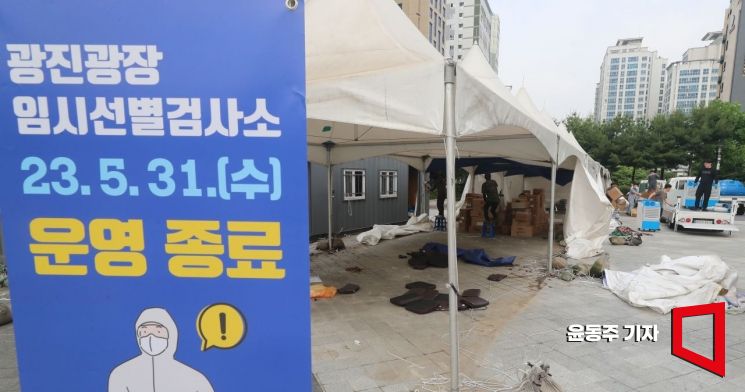 On the 1st, the temporary screening clinic installed at Gwangjin Square in Gwangjin-gu, Seoul, where the COVID-19 crisis alert level was downgraded from "Severe" to "Alert," is being dismantled. Photo by Dongju Yoon doso7@
A research team led by Professor Yum Yoosoon from the Graduate School of Public Health at Seoul National University, in collaboration with Korea Research, conducted a survey on the perception of the lowering of the COVID-19 crisis level among 1,000 adult men and women from the 26th to the 30th of last month, and announced the results on the 5th.
First, regarding the meaning of lowering the COVID-19 crisis level and lifting additional quarantine measures, 71.3% responded that it meant a daily life coexisting with COVID-19. Next, the necessary measures to prevent a COVID-19 resurgence included ▲improving the crisis response capabilities of the healthcare system (57.0%, multiple responses allowed) ▲institutional improvements to establish a culture of resting when sick (56.9%) ▲continued support for resilience in crisis response sites (42.6%) ▲improvement of infection outbreak prevention and management systems based on local governments (40.6%) ▲continued support for resilience in sites affected by livelihood damage (37.0%), among others.
When asked about future intentions to receive the COVID-19 vaccine, 51.9% answered that they would get vaccinated (34.8% probably will get vaccinated, 17.1% definitely will get vaccinated), exceeding half. Meanwhile, 36.2% expressed an intention not to get vaccinated. Among high-risk groups, the response rate for vaccination was higher at 67.9%.
Professor Yum said, "It is noteworthy that the most important aspects identified were improving the healthcare system’s crisis response capabilities to reduce severe health damage during outbreaks and improving systems so that people can rest when sick in daily settings such as workplaces and schools." He added, "Since COVID-19 vaccination is no longer being promoted on a short-term, nationwide scale as before, it seems necessary to continue to deeply understand the diverse vaccination intentions of the general public and to prepare specific communication strategies based on such understanding."
© The Asia Business Daily(www.asiae.co.kr). All rights reserved.
![Clutching a Stolen Dior Bag, Saying "I Hate Being Poor but Real"... The Grotesque Con of a "Human Knockoff" [Slate]](https://cwcontent.asiae.co.kr/asiaresize/183/2026021902243444107_1771435474.jpg)
















