Pent-Up Consumer Sentiment Explodes
Service Spending Hits $12
Stock Market Rebounds... Stability Returns
Tightening Measures May Intensify in Second Half of Year
This year, the U.S. economy is expected to emerge from the recession impact, supported by domestic demand stimulation due to revenge consumption and household savings, as well as a strong employment trend. However, there are also cautious analyses suggesting that as the economy shows strong performance, the tightening measures could intensify again from the second half of this year.
On the 5th (local time), The Wall Street Journal (WSJ) reported that despite the Federal Reserve's (Fed) interest rate hikes, major stock market indices have rebounded and new home sales have increased, indicating an overall recovery in the U.S. economy.
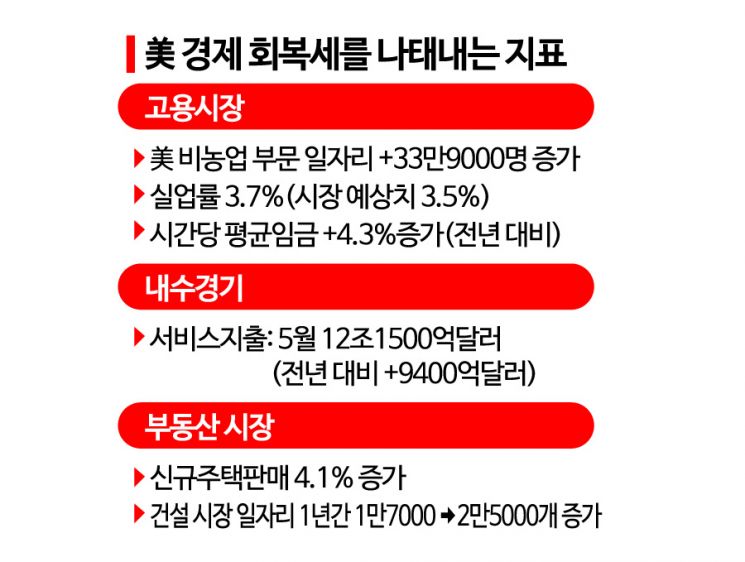
In particular, the U.S. employment market showed unexpectedly strong momentum in May, alleviating concerns about a recession. Nonfarm payrolls in the U.S. increased by 339,000 in May, significantly exceeding the market expectation of 190,000 compiled by WSJ. Average hourly earnings rose by 4.3% year-over-year. The simultaneous rise in jobs and wages indicates that the U.S. employment market has continued to grow both quantitatively and qualitatively. WSJ stated, "Workers who had left the labor force due to COVID-19 are beginning to return to jobs, keeping the employment market tight."
Consumer sentiment, which had been suppressed by COVID-19, is exploding, showing signs of domestic demand revival. Spending on delivery services reached $1.215 trillion, an increase of $94 billion compared to the previous year. Additionally, according to the Transportation Security Administration, the number of airport passengers in the U.S. during the Memorial Day holiday at the end of May surpassed the records recorded in 2019, before COVID-19.
Moreover, Americans' wallets are also healthy. According to the May report from the Federal Reserve Bank of San Francisco, the U.S. has saved over $500 billion (approximately 655 trillion KRW) since COVID-19. As Americans increase their travel spending, American Airlines has raised its revenue forecast for the second quarter of this year.
The stock market is also regaining stability. The Standard & Poor's (S&P) 500 index fell by 25% from December 2021 to October last year due to the Fed's rate hikes but has since rebounded by nearly 20%.
The housing market is also stretching out, compounded by a shortage of housing supply. New home sales in the U.S. in April increased by 4.1% from the previous month to 683,000 units, showing an upward trend since January. Although U.S. home sales plummeted last year, the shortage of housing supply this year has driven up new home prices. The number of construction jobs, which was about 17,000 per month a year ago, increased to 25,000 last month due to increased housing demand.
As the economy shows better-than-expected signs, there is a forecast that the Fed's tightening measures could intensify again in the second half of this year. WSJ particularly analyzed that the better-than-expected U.S. economic situation is complicating the Fed's decision-making ahead of this month's monetary policy meeting. Currently, the market is leaning toward the Fed holding interest rates steady this month.
WSJ stated, "U.S. economic activity and inflation have not slowed down as much as the Fed expected," adding, "The employment data released this month further strengthens the possibility that the Fed may raise interest rates in the second half of this year."
© The Asia Business Daily(www.asiae.co.kr). All rights reserved.
![Clutching a Stolen Dior Bag, Saying "I Hate Being Poor but Real"... The Grotesque Con of a "Human Knockoff" [Slate]](https://cwcontent.asiae.co.kr/asiaresize/183/2026021902243444107_1771435474.jpg)

















