Small and Medium Enterprises and Small Business Owners Claim Freeze, Engage in Daily Public Opinion Battle
As discussions for determining the 2024 minimum wage progress, labor and management have entered into a full-scale power struggle. The business community, including small and medium-sized enterprises (SMEs) and small business owners, is advocating for a freeze and is conducting a public opinion battle day after day. The labor sector is countering by arguing for an increase based on factors such as a decrease in real wages.
The Minimum Wage Commission plans to hold its third meeting on the 8th to deliberate on the minimum wage to be applied next year. The minimum wage for the following year must be decided and announced by August 5 every year. To this end, the Minimum Wage Commission must make a decision and send it to the Minister of Employment and Labor by June 29, which is within 90 days from the date the deliberation request was received. Although the legal deadline has rarely been met, fierce debates over the minimum wage are expected to unfold at least over the next month.
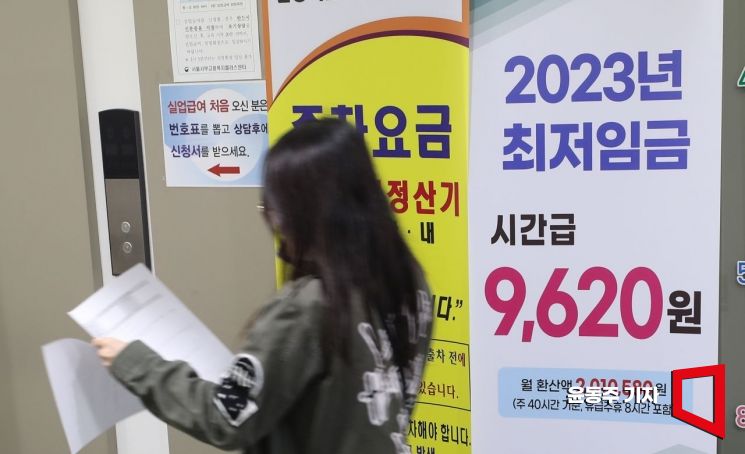 A banner informing about the minimum wage for this year is displayed at the Western Employment Welfare Plus Center in Mapo-gu, Seoul. Photo by Dongju Yoon doso7@
The SME sector argues that raising the minimum wage will rather destabilize employment. According to a survey conducted by the Korea Federation of SMEs targeting 618 SMEs employing workers at this year’s minimum wage level, 68.6% responded that they would reduce employment if the minimum wage is raised next year. Regarding the appropriate minimum wage level, the largest group, 38.3%, answered “freeze.” Lee Myung-ro, Head of the Human Resources Policy Division at the Korea Federation of SMEs, said, “Due to rising prices and interest rates, not only low-wage workers but also many SMEs and small business owners on the brink are suffering. The purpose of the minimum wage system, which is to stabilize workers’ livelihoods, can only be achieved if employment is maintained.”
Small business owners view the freezing of the minimum wage as a matter of survival. They also urgently demand differentiated application considering the characteristics of industries and their capacity to absorb increases, which small and micro enterprises have continuously raised. Oh Se-hee, President of the Korea Federation of Small and Medium Business, said, “If the minimum wage is raised, small business owners will no longer be able to endure, so it must be frozen.” He added, “Differentiated application is essential to protect small business owners who are barely surviving in an economy centered on large corporations.” According to a survey by the Federation of Korean Industries, 58.4% of self-employed nationwide responded that the minimum wage should be “frozen or lowered” next year. Additionally, 43.2% said that the current minimum wage of 9,620 won per hour is already a burden on management.
This stance from employers differs significantly from the labor sector’s demands, so painful negotiations are expected before reaching an agreement. The labor sector has requested raising next year’s minimum wage to 12,000 won, a 24.7% increase from this year. They cited the soaring inflation and shrinking real wages as reasons for the increase. According to the Ministry of Employment and Labor, the average real monthly wage per worker, reflecting inflation levels from January to March this year, was 3,773,000 won, a 2.7% decrease compared to the previous year. This is the first decrease in three years. There is also a recently released subsistence cost report from the Minimum Wage Commission. As of last year, the subsistence cost for a single, unmarried person was 2.41 million won per month. This is claimed to exceed the current minimum wage monthly amount of 2,010,580 won.
© The Asia Business Daily(www.asiae.co.kr). All rights reserved.
![Clutching a Stolen Dior Bag, Saying "I Hate Being Poor but Real"... The Grotesque Con of a "Human Knockoff" [Slate]](https://cwcontent.asiae.co.kr/asiaresize/183/2026021902243444107_1771435474.jpg)
















