"Legitimate Law Enforcement" Confident Police Demand
Ruling Party and Government Establish Police Immunity Clause
"Restoring Trust in Police-Government Relations is Priority"
The police are focusing on strengthening public authority to strictly respond to assemblies and demonstrations. The intention is to guarantee peaceful protests through proper law enforcement while suppressing illegal demonstrations. This is interpreted as a plan to expand the principle emphasized by Commissioner Yoon Hee-geun of the National Police Agency, "Compliance is profit," to form a public consensus.
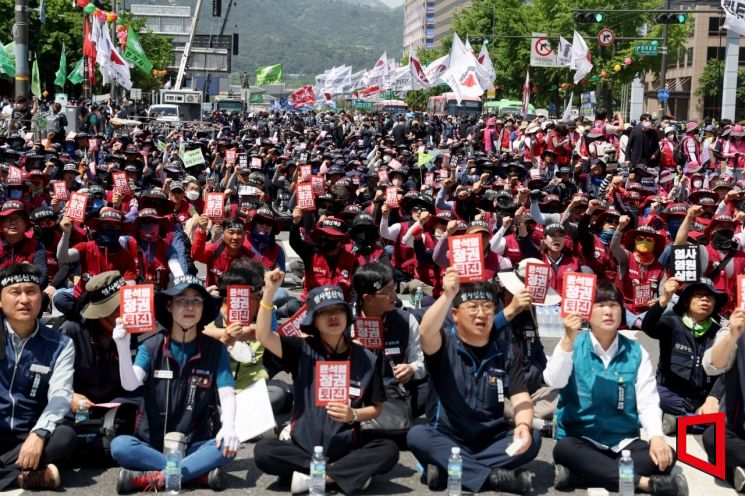 Members of the Korean Confederation of Trade Unions held a rally on the 17th around Sejong-daero in Seoul, shouting slogans calling for the resignation of the Yoon Seok-yeol administration. Photo by Heo Young-han younghan@
Proportional Response and Strengthening Public Authority
According to a comprehensive report by Asia Economy on the 6th, Commissioner Yoon held consecutive situation review meetings and security countermeasure meetings, ordering police officers nationwide, including security police and riot squads, to adhere to the "proportionality principle." The proportionality principle means reviewing the extent of damage caused to the public by labor unions and responding accordingly. Although this principle has been continuously applied in the past, it is now being analyzed and applied more clearly due to the continuation of hardline protests such as sit-in demonstrations.
Additionally, the National Police Agency submitted an opinion to the Supreme Court Sentencing Commission requesting that those convicted of assaulting or obstructing police officers performing their duties be punished with imprisonment ranging from 3 to 10 months.
Commissioner Yoon has consistently expressed his stance on strengthening public safety through "law-abiding" measures. In his New Year's address this year, he emphasized, "Respecting the law is the foundation of safety and fairness," and stated, "I will make the proposition that 'breaking the law results in loss' and 'obeying the law results in gain' become a natural belief among citizens."
The police stated that they are preparing to respond to demonstrations based on this principle. A Seoul Metropolitan Police Agency official said, "The police response has been consistent. If the illegal activities of protest groups worsen, the police have no choice but to prepare to use physical force." He added, "If there is violence beyond what can be tolerated within the law when evidence is collected, we will use capsaisin spray."
The police plan to implement measures including ▲forced dispersal ▲rapid investigation ▲arrest of those caught obstructing official duties (with a minimum sentence increased to 3 months imprisonment) ▲promising 13 special promotions for security police ▲adding six additional police riot squads in Seoul. A National Police Agency official explained, "Serious public inconvenience has been caused by illegal assemblies," and "there is an increasing demand from the public to establish law and order."
It is interpreted that the government under President Yoon Seok-yeol is strengthening public authority considering the possibility of escalating assemblies over time. The recent sit-in demonstrations causing public inconvenience also influenced this decision. In fact, last May, about 6,000 members of the Korean Confederation of Trade Unions held a rally to demand jobs, but the police only repeatedly issued dispersal orders without forcibly dispersing the crowd.
Commissioner Yoon plans to focus on strengthening police public authority alongside rapid arrests and investigations. Previously, the ruling party and government agreed to introduce an exemption clause to relax the standards for the use of physical force during police responses. The police currently expect that strengthening public authority will reduce illegal activities. Going forward, the police intend to maintain the current stance of dispersing assemblies that exceed the reported time or cause traffic congestion by occupying roads, among other illegal acts.
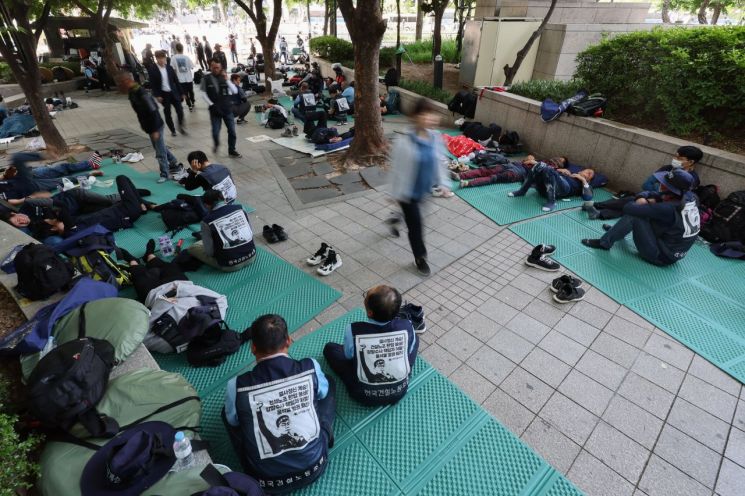
Ruling Party and Government Accelerate Amendment of Assembly and Demonstration Act... 'Restriction on Nighttime Assemblies'
In this regard, the government and ruling party, anticipating an increase in the intensity of assemblies and demonstrations, announced that they will amend related laws to guarantee only the freedom of peaceful protests. The ruling party and government have officially decided to restrict nighttime assemblies and demonstrations from midnight to 6 a.m.
Additionally, the ruling party and government plan to impose restrictions on demonstrations by groups with a history of illegal assemblies and strengthen noise standards. Furthermore, the National Assembly plans to discuss measures based on the currently proposed Assembly and Demonstration Act, including penalties for violating police warnings and including general participants among those subject to police orders.
© The Asia Business Daily(www.asiae.co.kr). All rights reserved.
![Clutching a Stolen Dior Bag, Saying "I Hate Being Poor but Real"... The Grotesque Con of a "Human Knockoff" [Slate]](https://cwcontent.asiae.co.kr/asiaresize/183/2026021902243444107_1771435474.jpg)












