Nationwide 'Oppose' 58.1% · 'Support' 41.9%
Yoon's Presidential Pledge · Gangwon-do Long-cherished Project
More than half of the public oppose the development projects for tourist sites, including the installation of the Seoraksan Osaek Cable Car. According to a survey conducted by Korea Research on behalf of the Green Korea United in April, when 1,000 people were asked about their stance on 'development projects such as the installation of cable cars to revitalize Seoraksan tourism,' 58.1% responded 'oppose' and 41.9% 'support.' This means that 6 out of 10 people are against it. The margin of error for this survey is ±3.1 percentage points at a 95% confidence level.
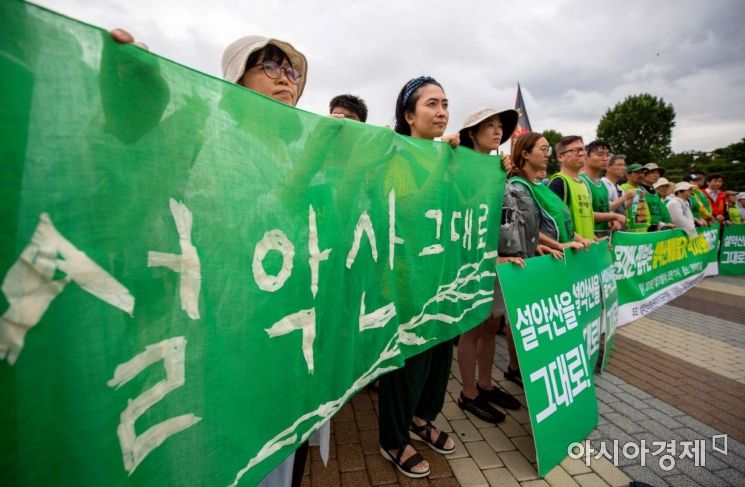 On July 31, 2019, in front of the Blue House fountain in Jongno-gu, Seoul, officials from the Seoraksan National Park Protection Citizens' Action held a press conference urging the cancellation of the installation of the Seoraksan cable car.
 [Photo by Kang Jin-hyung]
By region, opposition was highest in Busan, Ulsan, and Gyeongnam at 72.0%, followed by Daegu and Gyeongbuk (60.3%), Daejeon, Sejong, and Chungcheong (59.7%), and Seoul (57.9%). The Gangwon-Jeju region, which includes Gangwon where the Osaek Cable Car is planned to be installed, showed a higher support rate of 58.5% than opposition.
By age group, opposition was generally higher, but among those aged 20 and under, support was slightly higher at 52.8%. The opposition rate by gender was higher among women (64.7%) than men (51.8%).
The Seoraksan Osaek Cable Car project was a presidential campaign pledge of President Yoon Suk-yeol and a 40-year-long aspiration of Gangwon Province. The core plan is to install a 3.3 km cable car from the Osaek district in Yangyang County to Kkeutcheong, a peak near Daecheongbong.
The project, which began in 1982, had been stalled due to opposition from environmental groups. Although it seemed to gain momentum after receiving conditional approval in September 2015 during the Park Geun-hye administration, the project was halted again in November 2016 when the Wonju Regional Environmental Office requested Yangyang County to supplement the environmental impact assessment amid controversy. In February of this year, the Wonju Regional Environmental Office notified Yangyang County of a 'conditional agreement' opinion. While attaching several conditions such as reducing the size of the upper station, it effectively allowed the installation of the cable car.
Environmental groups have expressed concerns that this decision has effectively opened the floodgates for cable car installations in national parks. While mountain cable cars have been steadily installed and operated, cable cars in terrestrial national parks have been stalled due to environmental protection reasons. The last terrestrial national park cable car installed in Korea was the Deogyusan Resort cable car in Muju County, Jeonbuk, which was approved in 1989 and has been operating since 1997.
© The Asia Business Daily(www.asiae.co.kr). All rights reserved.

















