US Nun 'Symbol of Miracle' Attracts 15,000 Visitors
"No Bad Odor, Found Intact Upon Inspection"
News has spread that the body of a nun who died four years ago in Missouri, USA, has been preserved with almost no decomposition, drawing many pilgrims to the village to pray for blessings.
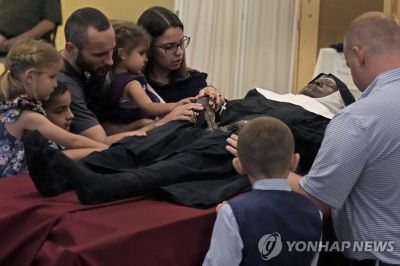
According to foreign media reports such as the British Telegraph and the US AP News on the 1st (local time), a 'miracle' has been reported where the body of a nun buried in a village in Missouri four years ago has remained almost undecomposed, attracting a flood of pilgrims.
The nun, dressed in a habit and tightly clutching a rosary in both hands, is Sister Wilhelmina Lancaster, who passed away in 2019 at the age of 95.
Although the finger bones were exposed, more than 15,000 pilgrims visited the village to see the mostly intact body, even though it had been four years since her death.
Believers regarded this as a symbol of holiness, kneeling before the body and touching the nun’s hands to pray for blessings.
According to the "Queen of the Apostles Benedictine Monastery," Sister Wilhelmina’s body was first exhumed from the grave last April to be relocated to the monastery chapel.
The nuns were puzzled when there was no characteristic foul odor from the coffin, and upon examining the body, they found it was mostly well-preserved except for one missing ear and sunken eyes.
The nuns placed a wax mask on her face and applied wax to her hands.
Sister Wilhelmina’s "miracle" spread widely among the public through a photo of a paper sign that read, "Please do not take more than a handful of soil."
Recently, it was reported that the wording was changed to "Please do not take more than a teaspoon of soil."
A souvenir shop selling a book about Sister Wilhelmina’s life was hastily established at the local convent, along with sales of nuns’ choir CDs, rosaries, postcards, and more.
Meanwhile, Sister Wilhelmina’s body is scheduled to be enshrined in the glass chapel of the Benedictine Monastery Cathedral on the 5th.
The Kansas City-St. Joseph Diocese of the US Catholic Church stated in a press release, "It is important to preserve the remains intact for thorough investigation," adding, "There have been past cases where bodies did not decompose, but these are very rare. The canonization process is well established, but in this case, such procedures have not yet begun."
According to the monastery, the canonization process requires at least five years to have passed since death.
© The Asia Business Daily(www.asiae.co.kr). All rights reserved.
![Clutching a Stolen Dior Bag, Saying "I Hate Being Poor but Real"... The Grotesque Con of a "Human Knockoff" [Slate]](https://cwcontent.asiae.co.kr/asiaresize/183/2026021902243444107_1771435474.jpg)
















