Breakthrough for Growth Stagnation
Apple is aggressively expanding its offline stores in emerging Asian markets as a breakthrough to overcome growth stagnation. In South Korea, new stores are expected to open in Hongdaeipgu and Starfield Hanam between November and December this year.
According to Bloomberg on the 1st (local time), Apple is discussing plans to open new offline stores in the Asia-Pacific region (15 stores), Europe and the Middle East (5 stores), and North America (4 stores) by 2027. A source said, "They are planning not only new store openings but also remodeling existing stores." Apple is also considering remodeling or relocating 6 stores in Asia, 9 in Europe, and 13 in North America. Through this, Apple plans to open 52 to 53 new or remodeled stores worldwide over the next four years.
Among these, Apple is focusing most on emerging Asian markets. It is reported that Apple plans to open three new stores in India alone. Following the opening of offline stores in Mumbai and New Delhi, India's largest city and capital, on April 18 and 20 respectively, Apple plans to open three additional stores.
Following India, expansion into Malaysia is also under discussion. Bloomberg analyzed that Apple's expansion into India and Malaysia is a strategy to target emerging markets such as Southeast Asia, moving away from advanced markets like the United States and China, which have been its main focus. Additionally, Apple is reportedly discussing new store openings at the remodeled Battersea Power Station, a decommissioned power plant turned into the new UK office building, as well as in Miami, USA, and Jing'an Temple Square, a tourist attraction in Shanghai, China.
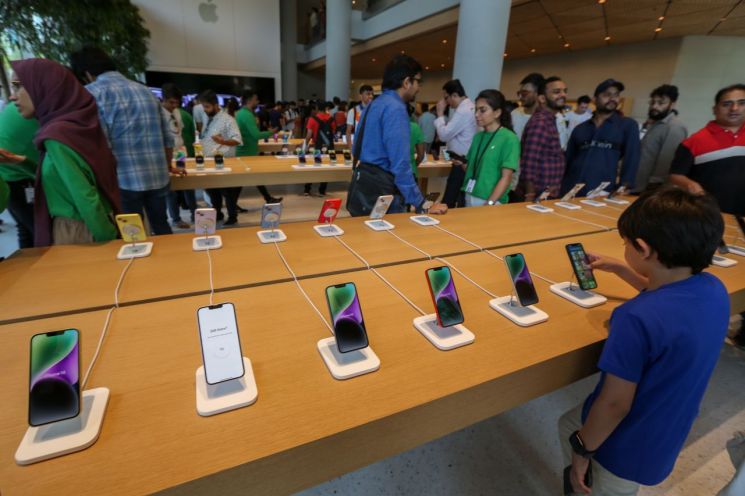
Apple appears to have set a strategy to enter emerging Asian markets as a breakthrough to overcome growth stagnation. Bloomberg reported, "As growth slows in existing key markets such as the United States and China, Apple is targeting emerging Southeast Asian markets including India, Vietnam, Malaysia, and Indonesia to expand its footprint."
Apple's revenue for the first quarter of this year (second quarter of the company's fiscal year) was $94.84 billion, down 2.5% year-over-year, and net profit was $24.16 billion, down 3.4%. This marks two consecutive quarters of decline, following the fourth quarter of last year. Apple expects this trend to continue into the second quarter, with revenue projected to decrease by about 3% year-over-year.
Apple is raising expectations for new market entries. Apple CEO Tim Cook said during the first-quarter earnings conference call, "Many countries including Indonesia, the Philippines, Saudi Arabia, T?rkiye, and the United Arab Emirates (UAE) recorded their highest-ever sales in the first quarter," adding, "The outstanding performance this quarter came from emerging markets, where we have never achieved more proud results."
Once this store expansion plan is completed, the total number of Apple stores worldwide will increase by more than 10% to 573. Apple currently operates over 520 stores in 26 countries worldwide. Apple has built a unique brand presence through four major types of specialized stores: general stores located in large shopping malls, Apple Store Plus in urban roadshop formats, flagship stores, and flagship plus stores. The average annual sales per store are approximately $40 million for general stores, $45 million for Apple Store Plus, $75 million for flagship stores, and over $100 million for flagship plus stores.
© The Asia Business Daily(www.asiae.co.kr). All rights reserved.

















