Seoul National University Bundang Hospital Professors Kwanghyun Choi and Sookyung Jeong Team
A study has found that receiving treatment for hepatitis C reduces the risk of liver cancer occurrence and death.
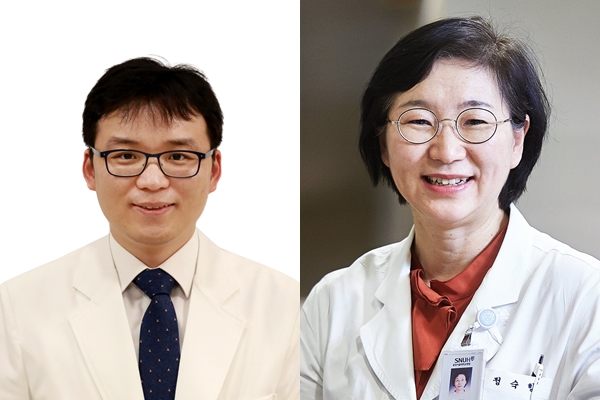 Professor Choi Kwanghyun (left) and Professor Jung Sookhyang, Department of Gastroenterology, Seoul National University Bundang Hospital.
The research team led by Professors Choi Kwanghyun and Jung Sookhyang from the Department of Gastroenterology at Bundang Seoul National University Hospital announced on the 2nd that patients treated for hepatitis C showed a significantly reduced risk of liver cancer occurrence and death compared to untreated patients.
The hepatitis C virus is one of the major causes of liver cancer and liver-related deaths. It is known that the risk of infection increases due to intravenous drug use, tattoos, piercings, shaving, and injections using improperly sterilized equipment. Most patients do not show any specific symptoms, making detection difficult except through health screenings. It can be completely cured with about 2 to 3 months of drug treatment, but if left untreated, it is highly likely to lead to severe diseases such as cirrhosis and liver cancer.
The research team followed 2,054 hepatitis C patients recruited from seven domestic hospitals between 2007 and 2019 for an average of four years. Among the subjects, 619 patients were untreated, 578 patients were treated with interferon injections, and 857 patients were treated with oral antiviral agents.
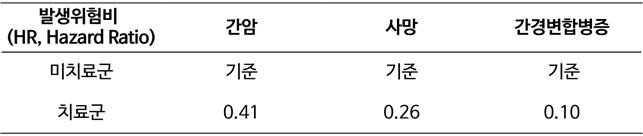 Comparison of the risk ratios for liver cancer, death, and cirrhosis complications between untreated and treated groups of hepatitis C patients. [Data provided by Bundang Seoul National University Hospital]
The study results showed that hepatitis C patients treated with oral medication had a 95.3% cure rate. Additionally, when comparing cured patients with untreated patients, the risk of liver cancer decreased by 59%, and the risk of liver-related death decreased by 74%. The risk of developing cirrhosis with complications was also 90% lower in the treated group. The cure effect of hepatitis C was similarly observed in patients who had already developed cirrhosis, and there was no significant difference in the risk of liver cancer occurrence and death between treatment with interferon injections and oral medication.
Professor Choi Kwanghyun explained, "Through a large-scale multicenter cohort in Korea, we systematically confirmed that most hepatitis C patients can be successfully treated with oral drugs, and their prognosis significantly improves." Professor Jung Sookhyang emphasized, "This study is meaningful as it supports that identifying and treating as many hepatitis C patients as possible can reduce liver cancer, liver-related mortality, and overall mortality, thereby contributing to the improvement of public health."
This study was conducted with support from the Korea Disease Control and Prevention Agency’s National Institute of Health and was published in the World Journal of Gastroenterology.
© The Asia Business Daily(www.asiae.co.kr). All rights reserved.


















