The domestic aviation industry is benefiting from delayed recovery of flights between the United States and China. This is because the number of transit passengers using domestic airports and airlines, rather than traveling through China to the US, is increasing.
On the 2nd, the number of transit passengers traveling to the US via Incheon International Airport from January to May this year was 791,341. The number of transit passengers, which recorded 1,706,393 in 2019, sharply declined to 504,911 in 2020 and 139,482 in 2021 due to COVID-19. However, it increased to 889,870 last year. The number of transit passengers has doubled compared to last year. It has also increased to a level similar to that before the pandemic.
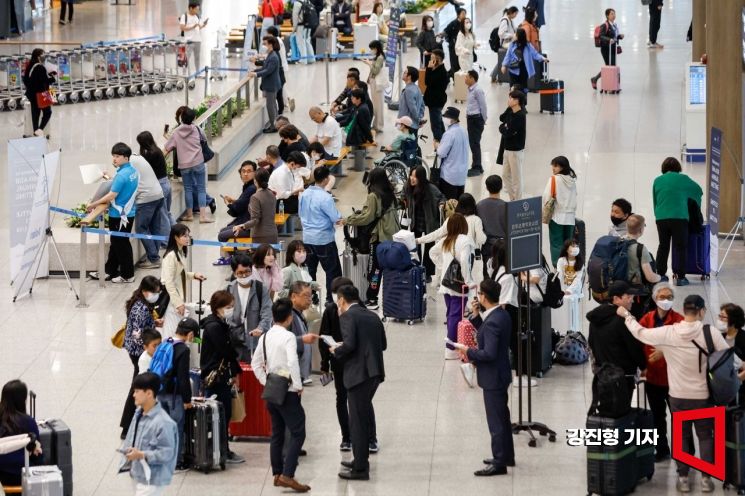 On the 3rd, tourists are arriving at Incheon International Airport Terminal 1. Photo by Jinhyung Kang aymsdream@
The increase in transit passengers is due to the delayed recovery of flights between the US and China. In the past, US and Chinese airlines operated more than 150 round-trip flights weekly. However, China has opened its borders selectively due to its COVID-19 quarantine policies. Additionally, in the early stages of the outbreak, measures such as banning US airlines from operating led to a sharp decline in flights between the two countries.
Flights between the two countries have only slowly increased this year. Last month, foreign media reported that the US Department of Transportation plans to allow Chinese airlines to increase their weekly flights from the current 8 to 12. The Chinese government allows US airlines 12 round-trip flights per week.
Meanwhile, domestic airlines have quickly increased flights to the Americas. Korean Air has been operating a total of 13 routes to the Americas with 97 weekly flights since last month. This is a 56% increase compared to 62 weekly flights on 12 routes in May last year. Asiana Airlines has also been operating 43 weekly flights since last month, adding 15 flights from 28 weekly flights in May last year. Additionally, Air Premia has been operating a regular Incheon-New York route 4 times a week since last month.
In other words, the slow recovery of flights between the two countries has worked as a favorable factor for Incheon International Airport, Korean Air, and Asiana Airlines. Seung-yoon Yang, a researcher at Eugene Investment & Securities, said, "Both Korean Air and Asiana Airlines have been rapidly increasing international passenger supply since the second quarter," adding, "Along with the effect of increased flight frequency, the seasonal peak of routes to the Americas and Europe and the increase in international transit passengers will combine to maintain solid performance in the second half of the year."
© The Asia Business Daily(www.asiae.co.kr). All rights reserved.

















