The research team led by Professor Kim Il from the Department of Applied Chemical Engineering at Pusan National University has newly developed a technology that can precisely control the structure of nanoporous organic polymers from inexpensive benzene and its derivatives.
Porous polymers have different applications depending on their structure. By finely tuning the pore size, substances can access active sites, and by modifying the structure in various ways, they can be applied in diverse fields such as gas adsorption and conversion (e.g., carbon dioxide), catalysis, environmental improvement, energy storage, and biomedical engineering.
The research team discovered a method to polymerize inexpensive benzene and its derivatives in desired directions using the well-known acid-base reaction.
By combining this method with self-assembly, they were able to easily control the structure of porous organic polymers into spherical, tubular, thin-film, hollow, and honeycomb shapes.
Existing methods face several obstacles in controlling the structure of porous organic polymers.
First, templates are used during synthesis, but removing them afterward requires highly toxic solvents. Existing methods that do not use templates require long reaction times, high temperatures and pressures, and complicated purification processes, resulting in low yields and making mass production impossible.
There is also a mechanochemical method that can produce the polymers in just a few minutes, but the short reaction time prevents precise structural control.
The ability to mass-produce structurally controlled porous organic polymers is key to commercial applications, but most of the manufacturing and modification technologies developed so far are only usable at the laboratory scale.
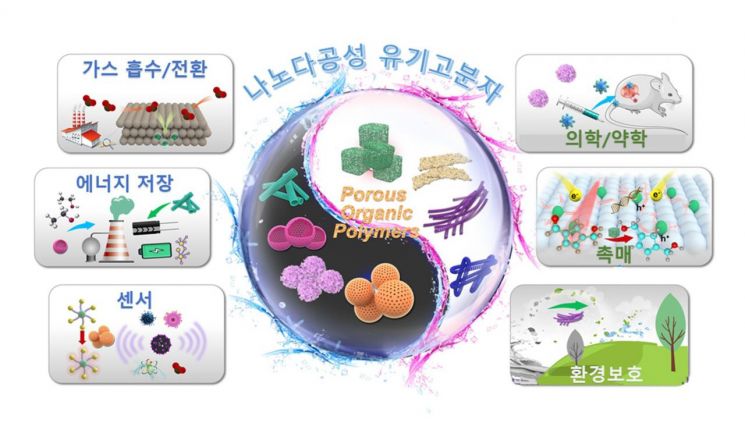
According to the research team, combining inexpensive raw materials with simple chemistry enables the efficient and scalable production of porous organic polymers with precise structures.
Although academic understanding of the relationship between the structure and function of porous organic polymers is still in its early stages, an interdisciplinary approach involving chemistry, materials science, mechanics, physics, and biology is important for selecting porous organic polymers suitable for specific applications.
The research team stated that their in-depth review of the advanced assembly methods and applications they developed reduces trial and error and enables the rational selection of approaches to control the structure of porous organic polymers, which is expected to facilitate expansion and development from laboratory to industrial and commercial applications.
The actually fabricated porous nanocapsules were able to produce biodiesel with over 90% efficiency and serve as efficient catalysts for producing glucose from cellulose, the main component of wood.
By altering the structure, they could also be used as storage media for carbon dioxide and were successfully applied to remove dyes from dye-contaminated wastewater.
In the case of this porous carbon material, it is very stable, with no loss of functional groups during reactions, allowing it to be recycled at least five times without efficiency loss, providing economic benefits.
Notably, it maintains its original shape even after calcination at temperatures above 800 degrees Celsius due to its highly stable structure.
Professor Kim Il said, “The materials developed by our research team could serve as clues for various catalysts as well as fuel cells, supercapacitors, lithium-ion batteries, transistors, aerospace and automotive composite materials, drug delivery systems, and biosensors.”
This research was conducted with support from the Ministry of Education and the Korea Research Foundation’s Mid-Career Research Support Project (Type 1), and the research results were published online on May 6 in the international journal Progress in Polymer Science.
© The Asia Business Daily(www.asiae.co.kr). All rights reserved.
![Clutching a Stolen Dior Bag, Saying "I Hate Being Poor but Real"... The Grotesque Con of a "Human Knockoff" [Slate]](https://cwcontent.asiae.co.kr/asiaresize/183/2026021902243444107_1771435474.jpg)
















