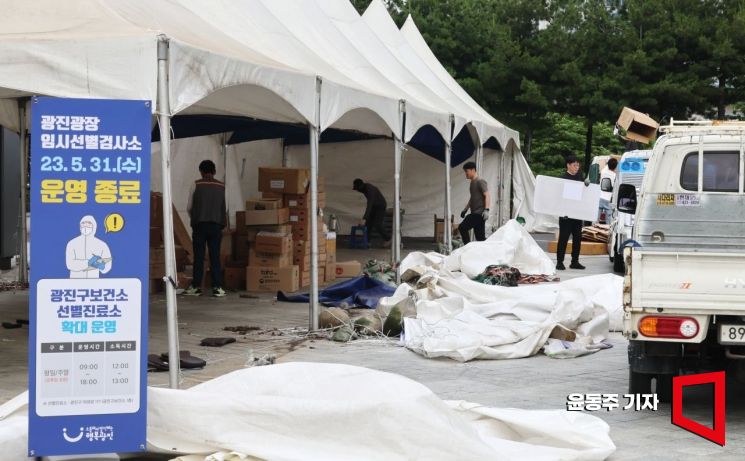
 On the 1st, the temporary screening clinic installed at Gwangjin Square in Gwangjin-gu, Seoul, where the COVID-19 crisis alert level was downgraded from 'Severe' to 'Alert,' is being dismantled. Photo by Dongju Yoon doso7@
On the 1st, the COVID-19 infectious disease crisis alert level was downgraded from 'Severe' to 'Alert.' This is the first time in 3 years and 3 months since it was raised to 'Severe' on February 23, 2020, about a month after the first confirmed case in Korea.
From this day forward, the mandatory isolation for confirmed cases, including those still within their isolation period, is lifted and replaced with a recommended isolation period of 5 days. Confirmed cases can now return to work and school. The health authorities plan to encourage workplaces, schools, and other institutions to adhere to the recommended isolation period to establish a culture of 'resting when sick.'
When a hospitalized patient tests positive, a 7-day isolation is recommended to prevent the spread of infection within the hospital. Depending on the patient's immune status and symptoms, isolation can be extended up to 20 days. For severely immunocompromised individuals, additional extensions of the isolation period are possible based on medical judgment.
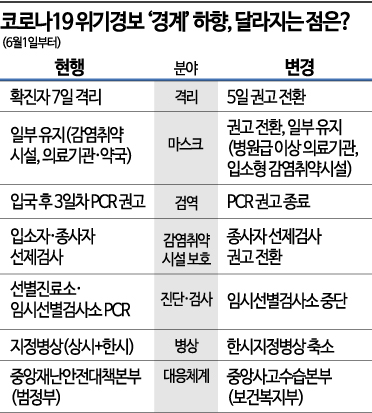
Masks can now be removed even in clinics and pharmacies where mask-wearing was still required after the indoor mask mandate was lifted in public transportation facilities. However, mask-wearing remains mandatory for hospital-level medical institutions and residential infection-vulnerable facilities for the time being. This includes places with signs labeled 'Hospital,' long-term care hospitals, long-term care institutions, and facilities for people with disabilities.
Support for treatment costs for COVID-19 confirmed patients receiving inpatient care in isolation rooms will be maintained for now. Oral antiviral treatments and vaccinations will continue to be provided free of charge. Living support funds (provided to households with income below 100% of the median income) and paid sick leave benefits (provided to companies with fewer than 30 employees) will also continue for the time being. Although the government has effectively declared an endemic phase (periodic outbreaks of infectious diseases), it has determined that the situation has not yet reached a stage where COVID-19 can be managed as a routine infectious disease like influenza.
Nevertheless, many of the quarantine measures that have become familiar over the 3 years of the COVID-19 pandemic will be removed.
First, PCR testing screening clinics will continue to operate, but temporary screening clinics will be discontinued. The PCR test recommended on the third day after entry into the country will also be abolished. Daily COVID-19 statistics, previously announced six days a week, will now be released only once a week. Temporarily permitted telemedicine will transition to a pilot project format, mainly available to patients who have prior experience with the medical institution. The Central Disaster and Safety Countermeasures Headquarters for COVID-19, which held its 691st meeting on the 31st of last month, will no longer convene, and the Ministry of Health and Welfare’s Central Accident Response Headquarters will take over disaster response management. Im Suk-young, head of the Central Disease Control Headquarters’ situation management team, said, "I feel deeply moved to be able to end the long tunnel of emergency response that has continued since February 23, 2020."
The health authorities stated, "Even in this de facto endemic era, we will maintain vigilance and do our best to prepare for resurgence and protect high-risk groups." This is because daily confirmed cases still number in the high 10,000s, with severe cases in the high hundreds and deaths around 10 per day, mainly among those aged 65 and older. Additionally, the health authorities plan to strengthen the implementation of detailed tasks in the mid- to long-term plan for responding to future pandemics and enhance international cooperation to prepare for the upcoming 'Disease X.'
© The Asia Business Daily(www.asiae.co.kr). All rights reserved.
![Clutching a Stolen Dior Bag, Saying "I Hate Being Poor but Real"... The Grotesque Con of a "Human Knockoff" [Slate]](https://cwcontent.asiae.co.kr/asiaresize/183/2026021902243444107_1771435474.jpg)

















