Law Clarifying Nurses' Scope of Work and Improving Treatment
Ruling and Opposition Parties Fail as 'Mediators' Over 2 Years of Disagreement
Possibility of Reintroducing Nursing Law Ahead of Next Year's General Election
President Yoon Suk-yeol exercised his right to request a reconsideration (veto) of the 'Nursing Act' bill, which was subsequently put to a re-vote in the National Assembly plenary session on the 30th of last month but was rejected and ultimately discarded. The Nursing Act, led by opposition parties including the Democratic Party of Korea, passed the National Assembly plenary session on April 27, but the People Power Party opposed it, citing conflicts between professional groups. As criticism arose that the ruling and opposition parties failed in their role as 'mediators,' the People Power Party proposed a 'mediation plan between professions,' while the Democratic Party suggested 're-promotion of the bill' as solutions.
The Core Issues of the Nursing Act Bill, a 77-Year-Long Aspiration of Nurses
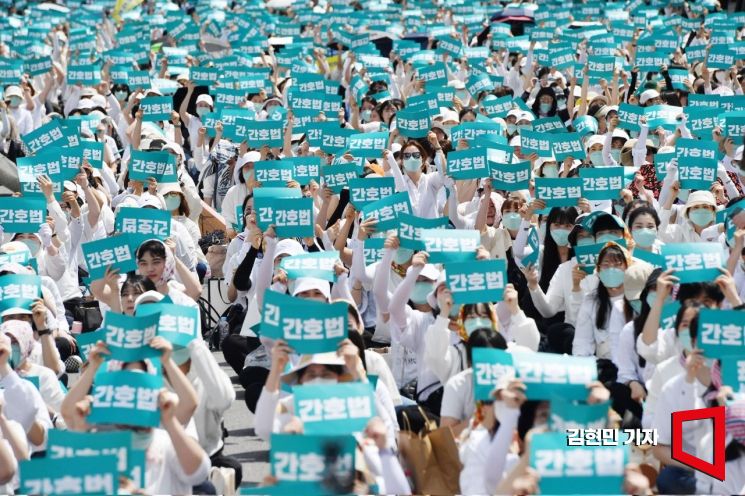 Nurses affiliated with the Korean Nurses Association and related personnel held a general rally on the 19th of last month around Sejong-daero, Seoul, condemning President Yoon Seok-yeol's veto of the Nursing Act. Photo by Hyunmin Kim kimhyun81@
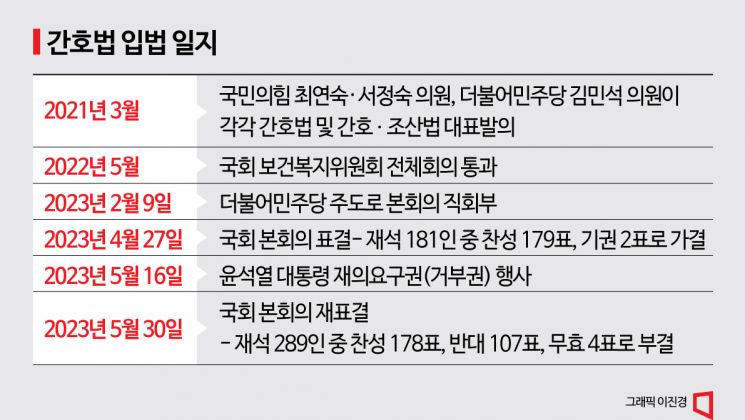
The Nursing Act bill discarded this time was a compromise bill combining the Nursing Act and the Nursing and Midwifery Act, originally introduced separately in March 2021 by Seo Jeong-sook and Choi Yeon-sook of the People Power Party, and Kim Min-seok of the Democratic Party. It separates nursing workforce-related provisions from the existing Medical Service Act and Health and Medical Personnel Support Act to establish an independent law. It clarifies the scope of nurses' duties and includes provisions for qualification and treatment improvements.
Since the Medical Service Act, which included nursing-related regulations, was enacted in 1951, there have been ongoing criticisms that it does not cover the increasingly specialized field of nursing. Starting with the 'Nurses Act' proposed by Kim Seon-mi of the then Uri Party (predecessor of the Democratic Party) and the Nursing Act by Park Chan-sook of the then Grand National Party (predecessor of the People Power Party) in 2005, and later the 'Nursing Act' by Kim Se-yeon of the Grand National Party and the 'Nursing and Midwifery Act' by Kim Sang-hee of the Democratic Party in 2019, bills have been introduced but discarded due to the expiration of the National Assembly term.
The legislative process for this Nursing Act left conflicts and divisions among medical professions. The biggest issue was the inclusion of the term 'community' in the Nursing Act. Article 1 of the Nursing Act states, "This Act stipulates necessary matters concerning nursing so that all citizens can receive high-quality nursing benefits at medical institutions and in the community."
Regarding this, the Health and Welfare Medical Solidarity, consisting of 13 organizations including the Korean Medical Association and the Korean Association of Assistant Nurses, pointed out that nursing activities could be conducted in the 'community' outside medical institutions. They claimed that nurses could open independent practices without doctors' supervision. They raised opposition voices, arguing that if nurses perform medical acts, it would cause confusion in the medical system and worsen the shortage of nursing staff as more nurses leave hospitals.
Nurses refuted this as 'fake news.' According to Article 33 of the Medical Service Act, the qualifications for opening a practice are already limited to doctors, dentists, oriental medical doctors, and midwives (midwifery centers). The Nursing Act also restricts nurses' duties to "assisting medical treatment under the supervision of doctors, dentists, or oriental medical doctors."
The educational qualification clause for assistant nurses was also problematic. Article 5 of the Nursing Act defines the qualifications for assistant nurses as "persons who graduated from nursing-related departments of specialized high schools under the Secondary Education Act," "persons who completed education at national or public assistant nurse training centers designated by the Ministry of Health and Welfare after graduating from high school," and "persons who graduated from nursing-related departments in lifelong education facilities with curricula equivalent to high school courses." The Korean Association of Assistant Nurses criticized this clause as limiting assistant nurses' qualifications to 'high school graduates or below,' calling it a 'Korean-style caste system.'
Failure of Ruling and Opposition Parties as 'Mediators'
The Nursing Act has been a focus of political attention since the last presidential election. At that time, Lee Jae-myung, the Democratic Party presidential candidate, promised to enact the Nursing Act, saying, "Nurses who always stay by the people's side, now Lee Jae-myung will protect you." Yoon Suk-yeol, then the People Power Party presidential candidate, attended an event of the Korean Nurses Association and emphasized, "Providing appropriate treatment to your dedication and sacrifice by our people and government is fairness and common sense."
After the election, the Nursing Act was handled solely by the opposition party in the Health and Welfare Committee plenary session in May last year. It was then held up in the Legislation and Judiciary Committee until February this year. The chairperson of the Legislation and Judiciary Committee was Kim Do-eup of the People Power Party, who delayed the review of the Nursing Act pushed by the opposition party with their majority seats. Consequently, Democratic Party members of the Health and Welfare Committee, leveraging their majority, directly referred the Nursing Act bill to the plenary session on February 9.
On April 11, the People Power Party held a 'Medical Issues Meeting among the People, Party, and Government' and proposed a mediation plan. It included changing the name of the Nursing Act to a law concerning nurses' treatment, deleting the term 'community,' and specifying the educational requirement for assistant nurses as specialized high school or above. The People Power Party also suggested establishing a comprehensive nursing plan and creating regulations for the Nursing Policy Deliberation Committee. The Korean Medical Association and the Korean Association of Assistant Nurses responded positively, but the Korean Nurses Association maintained an 'unacceptable' stance.
Subsequently, the Nursing Act, expected to be submitted to the National Assembly plenary session on April 13, was postponed to the next session on April 27 by the authority of Speaker Kim Jin-pyo. No agreement was reached between the ruling and opposition parties during this period, and the Nursing Act was passed in the plenary session on April 27 with 179 votes in favor out of 181 members present. Only Representatives Choi Yeon-sook and Kim Ye-ji of the People Power Party voted in favor, while other members abstained from voting.
On the 11th of last month, the People Power Party once again presented a mediation plan. It proposed renaming the bill to the 'Nurses Act,' maintaining the Medical Service Act provisions on integrated nursing and caregiving services, deleting the terms 'community' and 'medical institution,' and abolishing the high school graduation requirement for assistant nurses. However, the Democratic Party rejected this, judging it to be essentially no different from the existing government and ruling party's position.
Ultimately, on the 16th, President Yoon exercised his right to request reconsideration at the Cabinet meeting. The Nursing Act was then put to a re-vote in the plenary session on the 30th but was rejected with 178 votes in favor, 107 against, and 4 invalid votes out of 289 members present, resulting in its discard. This was the outcome of no concessions from either side.
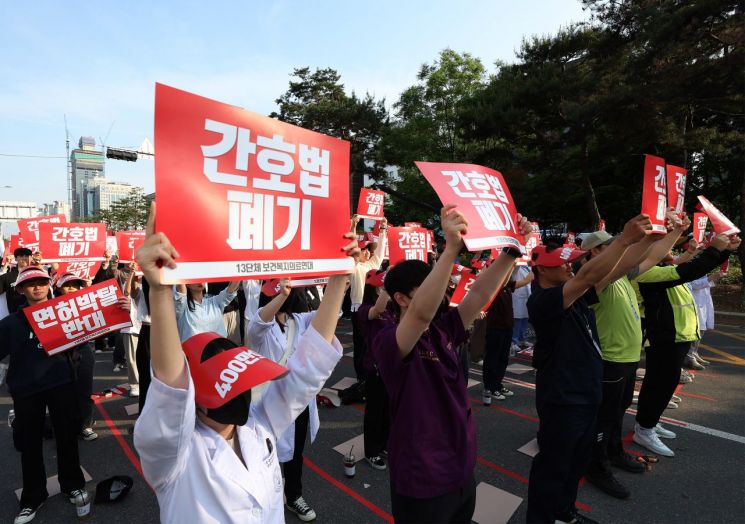 On the afternoon of the 11th of last month, when doctors and nursing assistants opposing the enforcement of the Nursing Act launched a second partial strike, participants held placards and shouted slogans at the "National Second General Strike for the Abolition of the Nursing Act and License Revocation Act" rally held near the National Assembly in Yeouido, Seoul. (Photo by Yonhap News)
Ruling and Opposition Parties Promise to Improve Nurses' Treatment... Mediation Plan vs. Re-legislation
Both ruling and opposition parties expressed regret over the discard of the Nursing Act. They also agreed to devise solutions. The People Power Party promised to prepare institutional improvements for nurses' treatment and to resolve conflicts between professional groups. Yoon Jae-ok, the floor leader of the People Power Party, emphasized at a party meeting held at the National Assembly on the 30th of last month, "It is the role of the National Assembly, responsible for legislation, to prepare a mediation plan reflecting the voices of each profession and to do our best to persuade until the end," adding, "We will not give up on mediation and persuasion between professions."
The Democratic Party announced plans to pursue follow-up legislation. However, they intend to step back from their previous hardline stance and prepare a bill that can be agreed upon with the ruling party. Kim Han-gyu, the Democratic Party floor spokesperson, told reporters immediately after the Nursing Act was rejected, "Since the bill has failed, it is necessary to prepare a new bill, so we will continue to meet with various health and medical organizations and prepare a bill that both ruling and opposition parties can agree on as much as possible this time."
Choi Yeon-sook, a nurse and member of the People Power Party, also stated on her Facebook on the 30th of last month, "The 21st National Assembly still has about a year left," and "I plan to devote myself to re-promoting the Nursing Act and improving nurses' working conditions during the remaining period so that the Nursing Act, which had reached the threshold of the National Assembly, will not be just a meaningful challenge but lead to substantial results."
Representative Choi emphasized that the most important part of the Nursing Act is the clear 'scope of duties' for nurses. In a phone interview with Asia Economy, she said, "Everyone talks about improving treatment, but treatment improvement should apply not only to nurses but to all medical staff," adding, "The core of the Nursing Act is clarifying the scope of nurses' duties." Currently, there are no clear legal regulations on the scope of duties, so many nurses work in a gray area between illegal and legal.
Democratic Party Representative Shin Hyun-young, a physician who abstained from voting against the party line in the plenary session on April 27, argues that communication and harmony between professions should come first. Shin said, "The current issue is not the content of the Nursing Act but its existence. I don't think amending the bill's provisions can immediately solve the problem," adding, "The conflict is fundamental, involving various medical professions collaborating to treat patients, so misunderstandings must be corrected and blind spots properly examined."
Shin also expressed optimism about the Nursing Act legislation, saying, "I believe the public will give more votes to parties that properly address livelihood issues, especially public health, healthcare, and medical system reform, in the general election, so these issues (Nursing Act resolution) may accelerate faster as the election approaches."
© The Asia Business Daily(www.asiae.co.kr). All rights reserved.
![Clutching a Stolen Dior Bag, Saying "I Hate Being Poor but Real"... The Grotesque Con of a "Human Knockoff" [Slate]](https://cwcontent.asiae.co.kr/asiaresize/183/2026021902243444107_1771435474.jpg)


















