Failed to Reach Expected Drop Zone and Lost
Seoul City Temporarily Issues False Alert Warning
When North Korea launched a space launch vehicle southward on the 31st, a warning alert was issued on Baengnyeongdo, the northernmost island in the West Sea. As a result, island residents hurriedly took shelter in evacuation centers.
According to Incheon City and others on the 31st, the Ministry of the Interior and Safety sent a disaster text message around 6:29 a.m. that day, announcing the issuance of a warning alert in the Baengnyeongdo area.
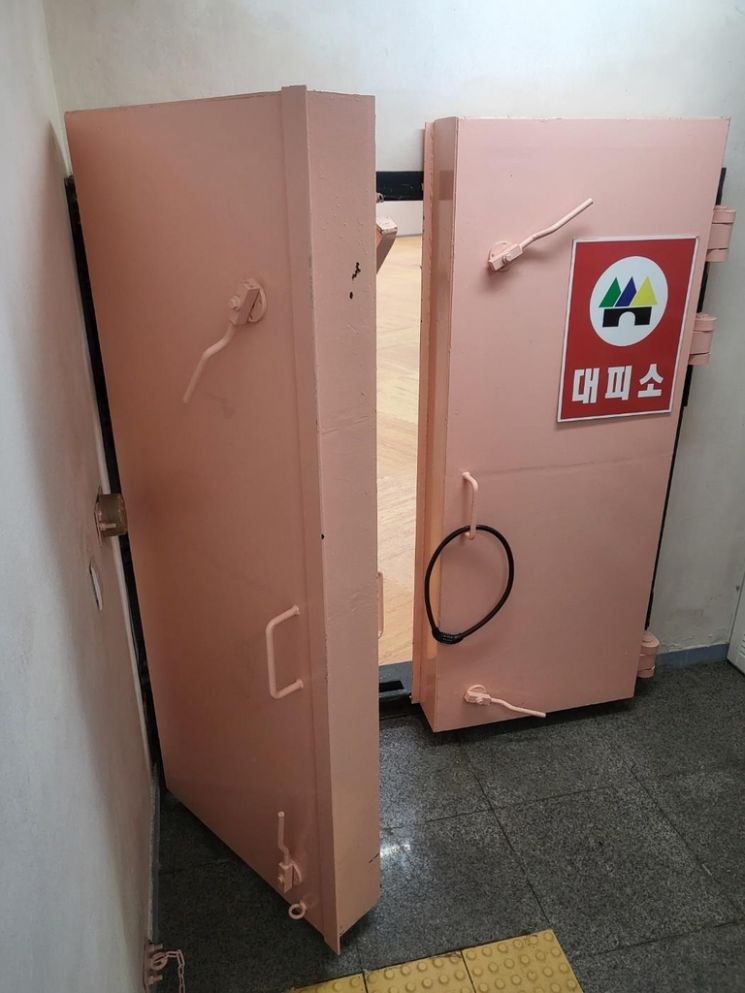
In fact, sirens sounded for more than 20 minutes in the Baengnyeongdo area that morning, and the Baengnyeong-myeon Office announced via village broadcast, "Regarding the warning alert, residents are requested to evacuate."
An official from the Baengnyeong-myeon Office stated, "We opened the doors of more than 20 evacuation centers," adding, "Many residents actually took shelter in the evacuation centers."
The nearby Daecheong-myeon Office reportedly only opened the evacuation center doors for now and is preparing for resident evacuation.
Space Launch Vehicle Presumed Destroyed Before Reaching Expected Drop Point... Under Analysis
 Residents evacuated to Jinchon 2-ri Shelter in Baengnyeongdo [Photo by Yonhap News Agency · Provided by Shim Hyo-shin, Baengnyeongdo Correspondent]
On that day, the Joint Chiefs of Staff (JCS) announced that North Korea launched what it claims to be a space launch vehicle southward.
Earlier, North Korea declared it would launch a satellite between 0:00 a.m. on the 31st of this month and 0:00 a.m. on the 11th of next month, designating the first-stage rocket drop point as "far west in the West Sea near Gunsan, Jeonbuk," and the fairing (satellite cover) drop point as "far west in the sea from Jeju Island."
However, according to military officials, the launch vehicle disappeared from radar before reaching the predicted drop points. Accordingly, the military is analyzing the situation with the possibility in mind that the launch vehicle either exploded mid-air or crashed into the sea, indicating an overall failure in the launch process.
This is the first time in seven years since February 7, 2016, when North Korea launched the 'Kwangmyongsong' satellite, that it has claimed to have launched a satellite-equipped vehicle.
Seoul City Temporarily Issues False Warning Alert... JCS States "No Relation to Capital Area"
Meanwhile, Seoul City sent an emergency disaster text message that day stating, "At 6:32 a.m. today, a warning alert was issued for the Seoul area. Citizens are advised to prepare for evacuation, prioritizing children and the elderly for evacuation." However, about 30 minutes later, a corrected message was resent by the Ministry of the Interior and Safety stating, "The warning alert issued by Seoul City was a false alarm."
In response, the JCS stated that the North Korean launch vehicle was flying over the West Sea and was unrelated to the capital area.
The JCS added, "Our military has heightened its alert posture and is maintaining full readiness while closely cooperating with the United States."
© The Asia Business Daily(www.asiae.co.kr). All rights reserved.
![Clutching a Stolen Dior Bag, Saying "I Hate Being Poor but Real"... The Grotesque Con of a "Human Knockoff" [Slate]](https://cwcontent.asiae.co.kr/asiaresize/183/2026021902243444107_1771435474.jpg)

















