Deployment of 'Over 5,000 Police Officers' in Seoul
Police: "Forced Dispersal if Necessary... Strict Response in Accordance with Proportionality Principle"
Considering Supreme Court Precedents... Difficult to Interpret as General Traffic Obstruction
The police will deploy over 5,000 officers in Seoul alone to respond to illegal activities occurring during the large-scale rally organized by the Korean Confederation of Trade Unions (KCTU) scheduled for the 31st. If the rally continues illegally in the form of overnight stays causing inconvenience to citizens, the police will disperse the crowd on-site and are also prepared to use capsaicin spray if necessary.
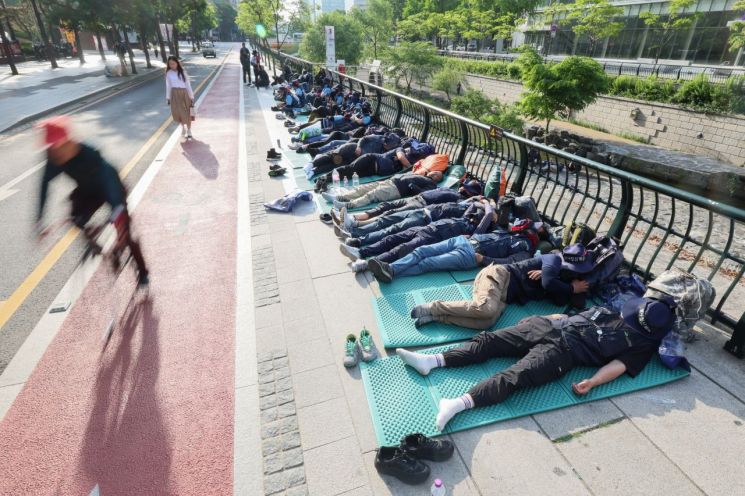
5,000 Police Officers Deployed and Capsaicin Sprays Prepared
A police official stated, "The number of officers deployed will likely be fewer than the number of KCTU rally participants," adding, "About 80 units (over 5,000 officers) will be deployed in Seoul." Nationwide, a total of approximately 120 units (around 8,400 officers) will be deployed.
According to the police, the KCTU plans to hold a warning strike rally at 4 p.m. in the Sejong-daero area of Seoul, with about 20,000 union members participating. The KCTU has reported that a total of 35,000 people will attend rallies across 14 regions nationwide, not just in Seoul. The KCTU has announced a strong struggle, claiming that the government is implementing anti-labor policies and that the police are conducting targeted investigations.
In response, Commissioner Yoon Hee-geun of the National Police Agency will preside over a security countermeasure meeting at Namdaemun Police Station in Seoul on the morning of the event. Commissioner Yoon held a situation briefing the previous day at the police agency in Seodaemun-gu, Seoul, stating, "Even though the time for the rally march has been restricted and banned, if the rally continues beyond the allowed time without dispersing and proceeds illegally under the pretext of a nighttime cultural festival or continues as an illegal overnight stay in the city center causing serious inconvenience to citizens, we will disperse the rally on-site," adding, "If necessary during the dispersal of illegal rallies, we must also be prepared to use capsaicin spray." The last time capsaicin spray was used to disperse a rally was in March 2017.
The Seoul Metropolitan Police Agency stated that while the freedom of assembly is guaranteed, they will respond in accordance with the "principle of proportionality" by reviewing the extent of harm caused to social safety and the general public. A Seoul police official said, "We plan to focus on detecting situations causing public inconvenience such as noise and road occupation," adding, "If people are forced to move from sidewalks to roads due to the rally, we will investigate whether this constitutes illegal activity."
Concerns have also been raised that the inconvenience to ordinary citizens will increase as the KCTU rally continues into rush hour.
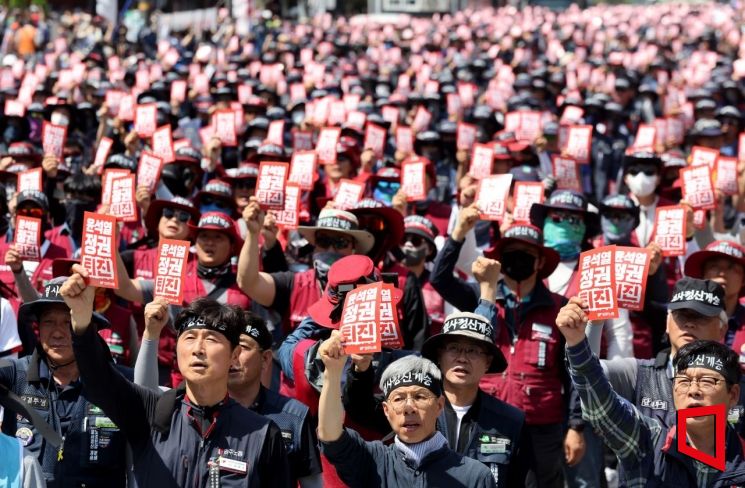 Members of the Korean Confederation of Trade Unions held a rally on the 17th around Sejong-daero, Seoul, shouting slogans calling for the resignation of the Yoon Seok-yeol administration. Photo by Heo Young-han younghan@
Limitations of Current Law... Police Analyze Precedents
As the police announce strict measures, there are criticisms that actual responses will be limited because the current Assembly and Demonstration Act is pending in the National Assembly. The police argue that improvements are needed regarding low noise standards, the absence of penalties for violations of permit conditions, and the fact that police orders apply only to organizers. A police official said, "Since the law has not been amended, there are limits to imposing sanctions," adding, "It is urgent to actively participate in the National Assembly discussions and expedite the passage of the law."
Interpretations of the general traffic obstruction law also have limitations. In 2016, the Supreme Court acquitted Mr. Yoo, who was charged with general traffic obstruction. At that time, the police had issued a summary order with a fine of 500,000 won for obstructing traffic by occupying the roadway for two hours during some unreported outdoor rallies and demonstrations, but Mr. Yoo appealed and requested a formal trial. The first trial acquitted him, and the second trial ruled that "the time occupying the tram lane was only 28 minutes, and there is no evidence to recognize that the demonstration made vehicle passage impossible or significantly difficult by obstructing road traffic." However, the police stated that they will make judgments by comprehensively considering factors such as the duration of occupation, the scope of occupation, and surrounding traffic conditions.
© The Asia Business Daily(www.asiae.co.kr). All rights reserved.
![Clutching a Stolen Dior Bag, Saying "I Hate Being Poor but Real"... The Grotesque Con of a "Human Knockoff" [Slate]](https://cwcontent.asiae.co.kr/asiaresize/183/2026021902243444107_1771435474.jpg)

















