Square-shaped Stone Materials Discovered Beneath Woldae Ruins
"Lost Function and Neglected Due to Imjin War"
Traces of diverse uses during the early Joseon period were discovered in the space in front of Gwanghwamun.
The National Research Institute of Cultural Heritage in Seoul, under the Cultural Heritage Administration, announced on the 30th that they identified some relics beneath the Gwanghwamun Woldae ruins, estimated to predate the reign of King Gojong (1863?1907). The term "relics" refers to traces that provide clues about the structure and style of ancient civil engineering and architecture.
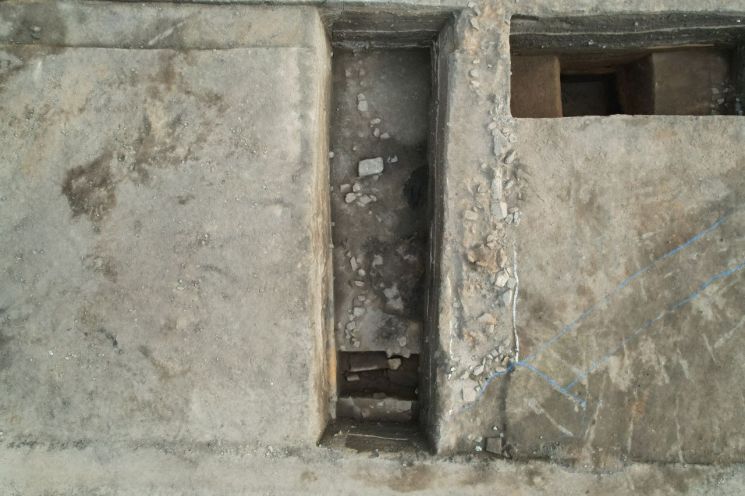
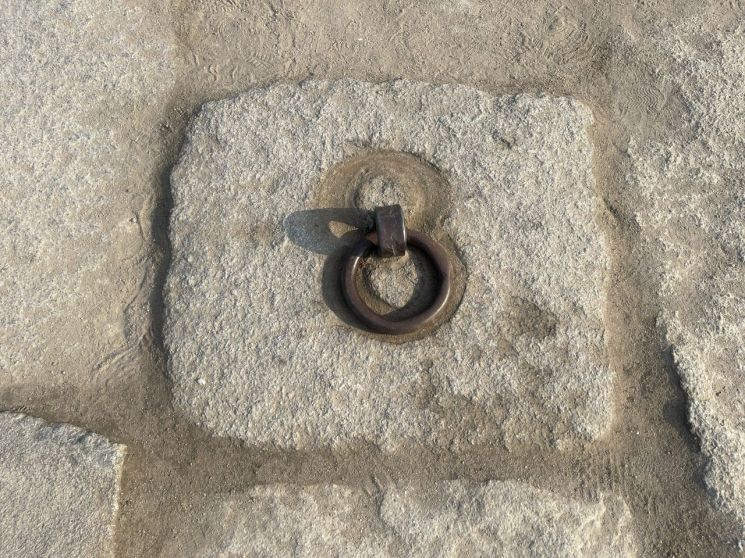
The relic found this time is a rectangular stone structure located west of the Eodo (御道, the path the king passes through). It was situated at the topmost layer of strata formed during the early Joseon period, from the 14th to 16th centuries. Stones measuring 20?30 cm in length were lined up on both sides, and a 6 cm diameter iron fixing pin was embedded in the center. A representative from the institute explained, "The device and shape are similar to those used to fix cha-il, a shade used in royal ceremonies to block sunlight," adding, "Similar cases can be found at Gyeongbokgung Geunjeongjeon and Jongmyo Shrine."
The stones extending on both sides remained about 85 cm wide, and similar relics were also confirmed on the east side of the Eodo site. The institute focuses on the fact that the relics were found beneath the Woldae constructed during King Gojong’s reign. Until now, the use of the space in front of Gwanghwamun during the early Joseon period had only been confirmed through records such as the Annals of the Joseon Dynasty. For example, the Annals of King Sejong record that "at the temporary seat outside Gwanghwamun, the king personally oversaw the military examination," and "outside Gwanghwamun, a stage was set up and various entertainments were held."
This is the first time physical evidence has been found through excavation. An institute official stated, "Although no architectural structures like the Woldae were discovered, it was confirmed that the space in front of Gwanghwamun was equipped with facilities constructed by laying stones on the ground and was used diversely from the early Joseon period."
The institute also identified the sedimentation patterns of the space in front of Gwanghwamun during this investigation. The strata in this area were formed in the order of early Joseon cultural layer (14th?16th century), mid-to-late Joseon cultural layer (17th century onward), Woldae construction layer (19th century), and modern road layer (20th century). However, relics estimated to be from the mid-to-late Joseon period were found in strata that partially destroyed the early Joseon cultural layer. The institute explained, "After the Imjin War, Gyeongbokgung lost its function and was left unmanaged, but during King Gojong’s reign, the palace was reconstructed and the Woldae was installed."
The Woldae is a broad platform installed at major buildings such as the Jeongjeon (main hall), the central building of the palace. The "Yeonggeon Ilgi (Construction Diary)," a record left during the reconstruction of Gyeongbokgung, states, "On March 3, 1866, the Woldae was built in front of Gwanghwamun." Although the Woldae was dismantled during the Japanese colonial period, its old traces were recently discovered through excavation.
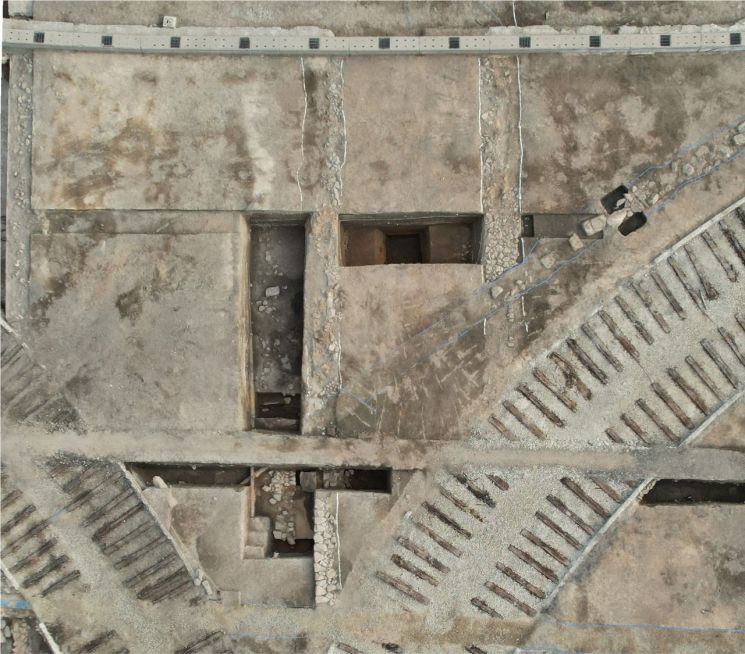
Based on the investigation results, the Cultural Heritage Administration plans to complete the restoration work by October this year. The work will reuse components such as the balustrade stones and hayeopseok (荷葉石, lotus leaf-shaped support stones placed at intervals under the balustrade stones), which are believed to have been dismantled in the 1920s and relocated to Donggureung in Guri, Gyeonggi Province. A Cultural Heritage Administration official said, "We plan to restore the Woldae authentically by applying traditional materials and techniques," adding, "We expect to showcase its former appearance at this autumn’s Royal Culture Festival."
© The Asia Business Daily(www.asiae.co.kr). All rights reserved.



















