Japanese On-Site Verification Inspection Team Releases Key Activity Results on 31st
Government: "Top Experts Who Have Studied Contaminated Water Discharge"
85.4% Oppose Contaminated Water Ocean Discharge... Concerns Remain
The government inspection team, which completed on-site verification of contaminated water at the Fukushima Daiichi Nuclear Power Plant in Japan, will announce the results of their activities on the 31st. Earlier, during the Korea-Japan summit, the two leaders agreed to dispatch a Korean inspection team to Japan, and the team, composed of 21 experts in nuclear power plants, radiation, and marine environmental radioactivity, completed a 5-night, 6-day schedule and returned home.
According to the Office for Government Policy Coordination, Yu Guk-hee, chairman of the Nuclear Safety and Security Commission and head of the government inspection team, will hold a briefing on the 31st titled "Key Activity Results of the Fukushima Nuclear Power Plant Contaminated Water Expert On-site Inspection Team."
Previously, the inspection team stated that they examined the multi-nuclide removal facility (ALPS), which treats radioactive contaminated water at the Fukushima nuclear power plant, the 'K4' tank facility for measuring and confirming treated contaminated water, contaminated water transfer facilities, dilution facilities, the operation control room, emergency shutdown devices, and the radioactivity chemical analysis laboratory.
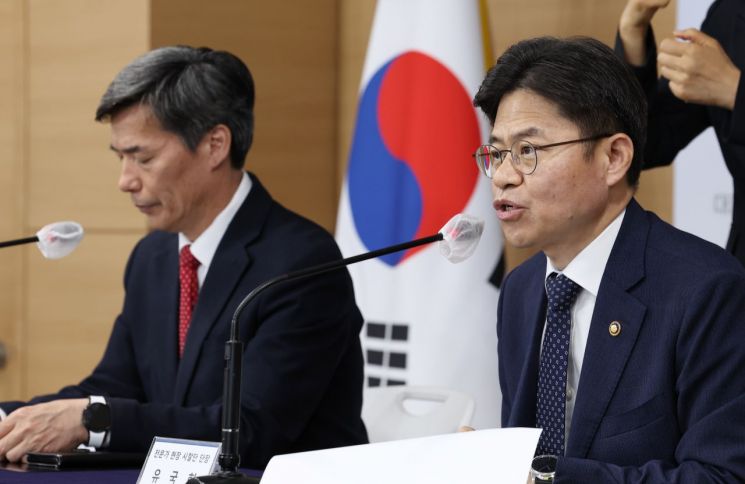 On the morning of the 19th, at the Government Complex Seoul, Yoo Guk-hee, chairman of the Nuclear Safety and Security Commission and head of the expert inspection team, is speaking at a press conference regarding the formation of an expert inspection team for the Fukushima nuclear wastewater. Photo by Yonhap News Agency
The government ordered the inspection team to provide transparent and detailed reports. Prime Minister Han Duck-soo said in his opening remarks at the Cabinet meeting held at the Government Complex Seoul on the 30th, "The inspection team dispatched this time consists of the top experts in this field who have continuously studied the safety of contaminated water discharge," adding, "Please organize the results directly observed and confirmed on-site in Japan well and report transparently and in detail to the public."
He also reiterated the scientific safety regarding contaminated water disposal. Prime Minister Han said, "Our government has strictly responded to the Japanese government's contaminated water discharge plan based on the absolute principle that the health and safety of the people are the most important," and added, "Contaminated water must be disposed of in a way that guarantees scientific safety and complies with international law and international standards. This is a consistent position that our government has maintained unwaveringly, and a principle that will not be shaken under any circumstances."
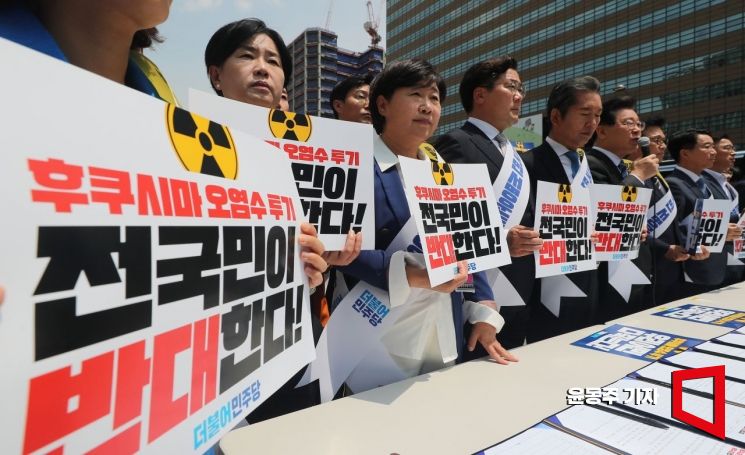 On the 26th, at Gwanghwamun Square in Seoul, Lee Jae-myung, the leader of the Democratic Party of Korea, and other lawmakers attending the "Launch Ceremony of the National Signature Campaign Against the Ocean Dumping of Fukushima Nuclear Power Plant Contaminated Water and the Import of Seafood" shouted slogans opposing the discharge of contaminated water from the Fukushima nuclear power plant. Photo by Yoon Dong-joo doso7@
However, concerns remain despite the government inspection team's on-site verification. The opposition party pointed out that "Can the public trust the conclusions the inspection team will present?" and criticized that the team only saw what the Japanese government showed them.
Jang Cheol-min, deputy floor leader of the Democratic Party of Korea, said in his remarks at the party's countermeasure meeting on the 30th, "They failed to clearly disclose the transparency and cross-verification possibility of the most important data in any part. It must be investigated whether the inspection team conducted monitoring activities on behalf of the people or merely played a supporting role that gave a clean bill of health to Japan and returned."
Public opposition to the marine discharge of contaminated water is also high. According to a survey commissioned by the Korea Federation for Environmental Movements to the polling agency Research View, conducted nationwide from the 19th to the 22nd of this month targeting 1,000 adults aged 18 and over, 85.4% responded that they 'oppose' marine discharge, while 10.8% 'support' it. Regarding the government's response to the Fukushima nuclear power plant contaminated water marine discharge issue, 64.7% evaluated it as 'doing poorly.'
Meanwhile, with International Oceans Day approaching on June 8, environmental civic groups' opposition is expected to intensify. Civic groups including the Korea Federation for Environmental Movements and fishermen plan to hold a rally in Seoul. The Democratic Party has formed the 'Comprehensive Countermeasures Team for Fukushima Contaminated Water Dumping' and announced nationwide outdoor protests starting with a rally in Busan early next month.
© The Asia Business Daily(www.asiae.co.kr). All rights reserved.


















