Without Self-Regulation, Eradication Is Difficult Despite Crackdowns
Recently, a Japanese YouTuber visiting a local festival venue was surprised by the price of "10,000 won for a bowl of fish cake," and the video went viral, reigniting controversy over the "price gouging" at local festivals.
On the 28th, a Japanese YouTuber living in Korea named 'Yuippyang' released a video documenting a trip to the Jeolla-do region. The concept of the broadcast was to travel to three locations within Jeolla-do by rolling dice within a set budget.
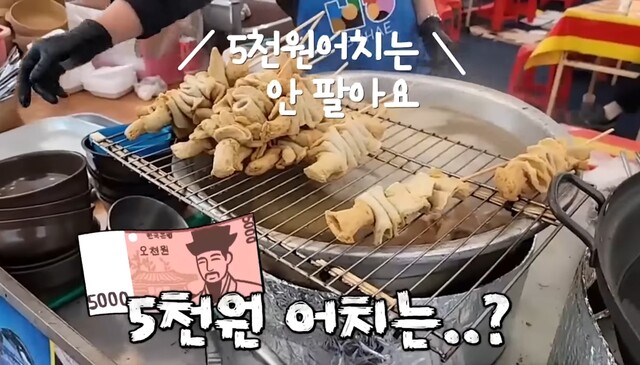 A part of the Hampyeong Butterfly Festival video released by YouTuber 'Yuippyeong' on the 28th. [Photo source=YouTube video capture]
The first place he visited was Hampyeong-gun in Jeollanam-do. At that time, the local representative festival, the 'Hampyeong Butterfly Festival,' was underway. This festival was held from April 28 to May 7.
Yuippyang had 8,000 won to spend here. Since the festival admission fee was 7,000 won, he decided to skip entering the festival and instead eat at the food market set up outside.
He wandered around the market looking for food but was taken aback by the high prices. A cup of sea snails was 5,000 won, and whole pig barbecue was priced at 40,000 won.
Yuippyang said, "I thought I could at least eat fish cake," and asked a vendor about the price of fish cake. The vendor replied, "10,000 won for a bowl of fish cake," and when Yuippyang asked, "Can't I buy 5,000 won worth?" the vendor firmly refused, saying, "We don't sell for 5,000 won."
In the end, he purchased a cup of silkworm pupae for 4,000 won and one sausage, concluding his trip to Hampyeong.
Netizens who saw this criticized, saying, "Price gouging never disappears," "Even if it's seasonal business, this is too much," and "This is why I don't travel domestically."
In response to price gouging controversy... "Exclusion from participation," "Focused crackdowns"
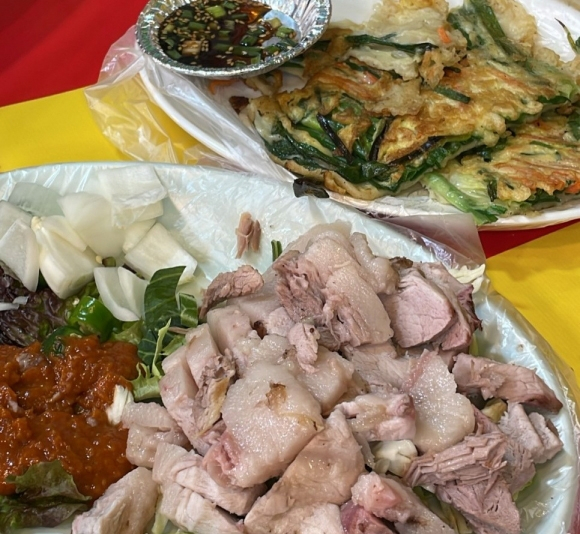 Foods revealed by a netizen who visited the Jinhae Gunhangje Festival.
 [Photo source=Captured from Naver Blog]
Similar controversies arose at the Jinhae Gunhangje Festival held from March 25 to April 3.
A netizen posted photos on a blog of whole pig barbecue (50,000 won) and seafood pancake (20,000 won) eaten at the festival night market, writing, "I knew I was going to be overcharged, but isn't this too much?" The post became a hot topic.
In response, the Jinhae Gunhangje Committee, which organizes the festival, apologized on March 30, stating, "We apologize for the recent reports about the high prices and poor quality of food at the Gunhangje market due to inadequate management." They added, "Businesses violating related standards will face closure and forced expulsion, and will be permanently excluded from participating in future Jinhae Gunhangje food stalls."
At the Gwangyang Maehwa Festival held from March 11 to 19, focused crackdowns were implemented to eradicate such price gouging. The main enforcement measures included ▲eliminating price gouging ▲addressing failure to display price tags and overcharging ▲crackdowns on unregistered food sales and food trucks.
Additionally, a complaint center for price gouging was operated during the festival to receive reports of unfair charges, conduct on-site inspections, and take corrective actions.
Without self-regulation, eradication is difficult in reality
Setting excessive prices and colluding with surrounding restaurants can be subject to punishment.
Article 40 of the Monopoly Regulation and Fair Trade Act (Fair Trade Act) stipulates that "business operators shall not agree to unfairly restrict competition jointly with other business operators through contracts, agreements, resolutions, or any other means." Violations can result in imprisonment of up to three years or fines up to 200 million won.
However, it is difficult to prove collusion among small-scale merchants in tourist areas, so enforcement often remains at the level of guidance.
Also, under current law, lodging and food service industries apply a voluntary pricing system, making it practically difficult to eradicate price gouging without self-regulation by tourist area businesses. If merchants do not demand prices different from those presented to customers in advance, local governments reportedly find it difficult to take corrective actions.
© The Asia Business Daily(www.asiae.co.kr). All rights reserved.


















