The debt ceiling negotiations to avoid a U.S. default were dramatically resolved just three days after Congress went into recess. The '3-day drama' of the debt ceiling talks, which had escalated to the brink by extending the default deadline, was incredibly dramatic, and the decisive role of hidden key players was also established.
The Hidden Key Players in the 3-Day Debt Negotiation Drama
On the 25th (local time), a week before the 'X-Day'?the date Treasury Secretary Janet Yellen identified as when available funds would run out?Congress went into recess for Memorial Day. This was a time when both sides of the negotiation were sharply at odds with the default deadline looming. Both sides stubbornly stuck to their proposals without any concessions, and as negotiations failed to progress and went in circles, the conflict showed no signs of narrowing, with both sides blaming each other.
In particular, there was disagreement until the very end over the scale and items of 'government budget cuts.' The person who played a decisive role in the biggest challenge of the negotiations?reducing fiscal spending?was none other than Shalanda Young, Director of the White House Office of Management and Budget (OMB). The New York Times (NYT) called the 45-year-old Young "the central figure dominating the debt ceiling debate that has controlled Washington politics and Wall Street," and named her the main contributor to this negotiation's resolution. She continued difficult coordination among Republicans who linked the debt ceiling issue to fiscal spending cuts until the very end. Both Democratic and Republican lawmakers praised her as "the person who found all the answers regarding government spending policy during the tough negotiation process."
While conducting final working-level negotiations with Republican lawmakers over the spending bill, Director Young advised Democratic lawmakers by tapping her fingers on the table. Democratic Representative Nita Lowey, a member of the House Appropriations Committee, said, "Young has a natural instinct for negotiation," and "her talent was extremely valuable in this negotiation."
Even Kevin McCarthy, Speaker of the House and the opposing negotiator, praised her during the talks, saying, "Everyone here knows and respects her." Speaker McCarthy described the White House negotiation team, including her, as "professional, smart, and tough." She is regarded as a figure who has secured a strong fan base even among hardline right-wing Republicans in the divided and confrontational U.S. political environment.
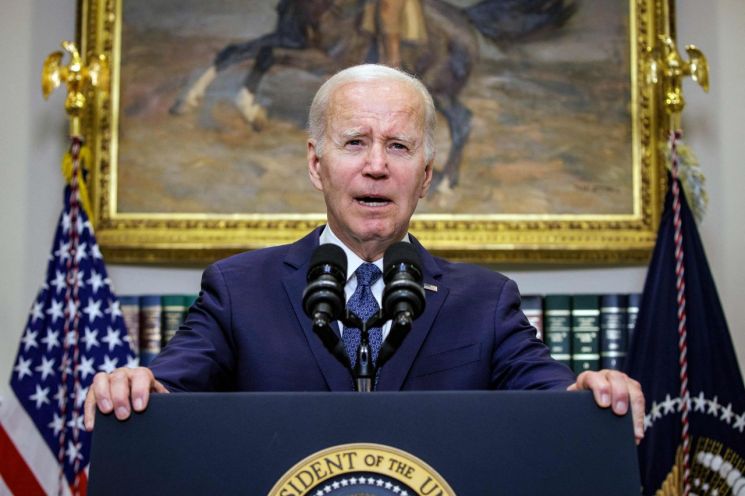 U.S. President Joe Biden is speaking on the 28th (local time) in the Roosevelt Room of the White House in Washington, D.C., regarding the final agreement on raising the debt ceiling.
 [Image source=AFP Yonhap News]
'Rules of the Game' Seen Through the Debt Negotiations
The negotiations between U.S. President Joe Biden and Speaker McCarthy went through twists and turns before reaching an agreement, but considering the interests of both sides, the negotiation was bound to be resolved. The outcome of the agreement inevitably would have led to an extreme result where both sides would lose due to the collapse of global financial markets and the resulting political damage.
However, the Republicans politicized the debt ceiling issue by demanding fiscal spending cuts as a price for raising the debt ceiling, continuing a game of chicken. The Republicans, as the majority party in the House with budget authority, held the key to the negotiations, and time was on their side. President Biden applied pressure using the default deadline, but gained little.
In this situation, Director Young revealed the opponent’s cards early in the negotiations and engaged in an all-out battle. In an interview with Bloomberg last March, Young directly criticized, "Linking spending cuts to raising the debt ceiling is purely a political debate," urging Republican cooperation. James Rousier, founding partner of Capital Alpha Partners based in Washington, said, "Ultimately, the main protagonist of this negotiation will be Director Shalanda Young, who knows the rules of the game."
Will Debt Ceiling Legislation Be Finalized?
The U.S. House will hold a Rules Committee meeting on the 30th to begin the process of handling the debt ceiling agreement-related bill. With Speaker McCarthy announcing plans for a full House vote on the 31st, the Rules Committee?dominated by hardline Republicans?is the first hurdle the debt ceiling increase bill must pass quickly before the default deadline on the 5th of next month.
The Rules Committee will discuss the 'Fiscal Responsibility Act,' which contains the results of the debt ceiling negotiations, at 3 p.m. on the 30th. The bill includes raising the debt ceiling through 2025 while imposing limits on government spending during the same period.
Hardliners from both the Republican and Democratic parties have expressed opposition or dissatisfaction with this agreement. The Rules Committee, composed of nine Republicans and four Democrats, includes these hardline members. For this reason, The Washington Post (WP) predicted the day before that the House Rules Committee might sink the negotiation plan.
However, Speaker McCarthy expressed confidence in a broadcast interview the day before, saying, "More than 95% of Republican members are encouraged by the negotiation results." The White House is also conducting internal persuasion efforts. The Wall Street Journal (WSJ) reported that on the night of the negotiation's conclusion, White House aides made over 60 phone calls to individual Democratic House members to reach out to them.
© The Asia Business Daily(www.asiae.co.kr). All rights reserved.
![Clutching a Stolen Dior Bag, Saying "I Hate Being Poor but Real"... The Grotesque Con of a "Human Knockoff" [Slate]](https://cwcontent.asiae.co.kr/asiaresize/183/2026021902243444107_1771435474.jpg)
















