The Constitutional Court has ruled that the current law allowing administrative authorities to revoke the qualifications of daycare center directors or childcare teachers when they are criminally punished for child abuse-related crimes does not violate the Constitution.
The petitioners argued that even if they were convicted of child abuse charges in a criminal trial, the provision allowing administrative authorities to revoke their qualifications at their discretion without any restrictions, even when the court did not issue an employment restriction order, violates the principle of proportionality and infringes on the freedom to choose one's occupation. However, this argument was not accepted.
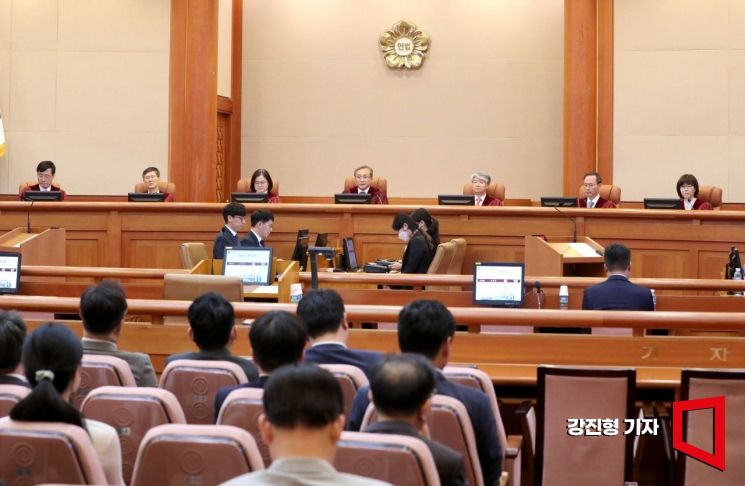
According to the legal community on the 30th, the Constitutional Court unanimously ruled constitutional the part of Article 48, Paragraph 1, Subparagraph 3 of the Infant Care Act, which allows the Minister of Health and Welfare to revoke the qualifications of daycare center directors or childcare teachers if they have been punished for child abuse-related crimes under the Child Welfare Act, specifically regarding cases punished for 'emotional abuse acts' that harm the mental health and development of children.
The Constitutional Court stated, "Child abuse crimes committed by daycare center directors or teachers can have a fatal impact on the physical and emotional development of infants and young children," and added, "there is a significant need to revoke their qualifications and exclude them from childcare settings."
It further explained, "The provision under review is discretionary, allowing administrative authorities to revoke qualifications at their discretion," and "the degree of restriction cannot be considered severe compared to the public interest that the provision aims to achieve," as the reason for its constitutional ruling.
Jung Mo and Choi Mo, who worked at a daycare center in Dalseo-gu, Daegu, were prosecuted in June 2017 for showing a video containing anti-LGBTQ+ hate content to 18 elementary school students who came for volunteer work (violating the Child Welfare Act). They were each sentenced to eight months in prison with a two-year probation period. However, the court did not issue any employment restriction orders under Article 29-3, Paragraph 1 of the Child Welfare Act (employment restrictions for child-related institutions) against them.
Nevertheless, the Dalseo-gu Office in Daegu revoked Jung's qualifications as both daycare center director and childcare teacher, and Choi's qualification as a childcare teacher, on the grounds that they had been punished for child abuse-related crimes.
While contesting the validity of the qualification revocation orders issued by the Dalseo-gu Office through administrative litigation, the two requested the court to refer the relevant provisions of the Infant Care Act for a constitutional review. However, after the court dismissed some provisions and rejected others, they filed a constitutional complaint with the Constitutional Court.
Although they requested a constitutional review of the entire Article 48, Paragraph 1, Subparagraph 3 of the Infant Care Act, the Constitutional Court limited the scope of review to the part concerning punishment for 'emotional abuse acts.' This is because, unlike general constitutional complaints, constitutional complaints filed after the dismissal of a constitutional review request require the 'premise of the trial' condition, similar to constitutional review requests.
In other words, only the legal provisions that can directly affect the outcome of the ongoing litigation to cancel the qualification revocation orders (such as the judgment or main reasoning) can be subject to review.
In their constitutional complaint, Jung and Choi argued that ▲ allowing administrative authorities to revoke daycare center director or childcare teacher qualifications and restrict employment at daycare centers despite criminal rulings exempting employment restriction orders under the Child Welfare Act violates systemic legitimacy; ▲ it infringes on their legitimate trust that they could work as directors or childcare teachers without any restrictions following the criminal rulings; ▲ it infringes on the freedom to choose one's occupation; and ▲ it nullifies the results of the criminal trial and infringes on the right to request a trial.
However, the Constitutional Court stated, "Violation of systemic legitimacy is only a sign of unconstitutionality, and unconstitutionality can only be recognized when principles such as proportionality or equality are violated," and examined whether the provision infringes on the freedom to choose one's occupation. The claim of infringement on the right to request a trial was considered essentially the same as the argument that allowing administrative authorities to revoke qualifications at their discretion despite the court exempting employment restriction orders violates the principle of proportionality and infringes on the freedom to choose one's occupation, so it was not separately judged.
The Constitutional Court concluded that the provision does not violate the principle of proportionality, which limits constitutional rights, and is constitutional.
The Court's judgment recognized all criteria for assessing violation of the principle of proportionality: legitimacy of purpose, suitability of means, minimal infringement, and balance of interests.
The Court stated, "The legislative purpose is legitimate as it aims to enhance the ethics and reliability of daycare centers and to provide healthy childcare in a safe environment for infants and young children. Allowing administrative authorities to revoke the qualifications of daycare center directors or childcare teachers punished for child abuse-related crimes is an appropriate means to achieve this legislative purpose."
Furthermore, the Court noted, "Daycare center directors or childcare teachers form close living relationships with infants and young children under six years old who are not yet in school, and child abuse-related crimes committed by them can have fatal effects on the physical and emotional development of infants and young children," adding, "Therefore, to maintain social trust in the safety of daycare centers and promote the complete and harmonious personality development of infants and young children, it is necessary to revoke the qualifications of daycare center directors or childcare teachers punished for child abuse-related crimes and exclude them from childcare settings."
Moreover, the Court explained, "The provision under review is discretionary, allowing administrative authorities to consider the nature of the child abuse-related crime committed by the daycare center director or childcare teacher, the type and degree of the sentence imposed, and the risk of recidivism, and revoke qualifications at their discretion. The exercise of such discretion can be subject to subsequent judicial review."
This means that revocation of qualifications is not mandatory upon committing child abuse-related crimes, and there is room to contest the appropriateness of the revocation after the fact, so it is not an excessive restriction.
Finally, the Court stated, "The public interest realized by the provision under review is to provide healthy and safe childcare for infants and young children. Even if a person who obtained qualifications as a daycare center director or childcare teacher is restricted from working at a daycare center until the reissuance period of the qualification expires due to revocation, the degree of this restriction cannot be considered more severe than the public interest," concluding, "Therefore, the provision under review does not violate the principle of proportionality and does not infringe on the freedom to choose one's occupation."
A Constitutional Court official said, "This decision is the first time the Constitutional Court has ruled on the constitutionality of the Infant Care Act provision allowing administrative authorities to revoke the qualifications of daycare center directors or childcare teachers punished for child abuse-related crimes."
© The Asia Business Daily(www.asiae.co.kr). All rights reserved.

















