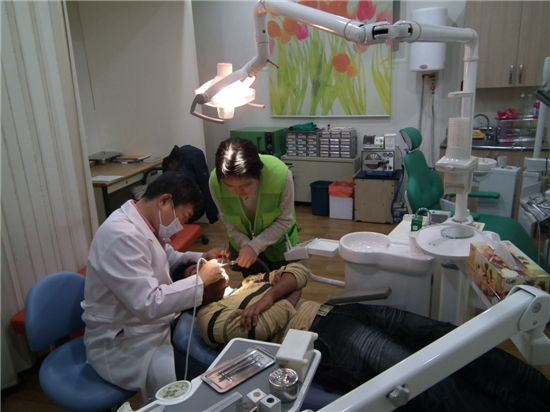
 A foreign patient receiving medical treatment
As the government enters a de facto endemic phase (periodic outbreaks of infectious diseases), it plans to ease immigration procedures and institutionalize non-face-to-face medical consultations for foreigners to attract 700,000 foreign patients by 2027. The global medical tourism market is expected to grow at an average annual rate of 9.7%, from 109 trillion won (82 billion dollars) in 2020 to 240 trillion won (182 billion dollars) in 2025. Given that medical tourism is highly value-added, the goal is to leap forward as a central Asian medical tourism country through active foreign patient attraction policies.
On the 29th, the Ministry of Health and Welfare announced the "Foreign Patient Attraction Activation Strategy" jointly prepared with related ministries. This is to increase the number of foreign patients visiting again after the World Health Organization (WHO) lifted the international public health emergency (PHEIC) for COVID-19. Last year, 248,000 foreign patients visited Korea, a 70% increase compared to the previous year (146,000), but it is still only about 50% of the 497,000 patients in 2019 before the COVID-19 outbreak. A Ministry of Health and Welfare official said, "We have set a goal to attract 700,000 foreign patients by 2027 by achieving four major sectoral strategies: improving immigration procedures, alleviating regional and medical department concentration, strengthening the competitiveness of the attraction industry, and enhancing the global recognition of Korean medical care."
Easing Immigration Procedures, Allowing Non-Face-to-Face Medical Consultations for Foreigners
First, strict immigration procedures will be improved exclusively for foreign patients. The scope of caregivers and guardians for foreign patients will be expanded from spouses and immediate family to siblings, and the obligation to submit financial capability documents for companions will be waived.
The number of excellent institutions designated by the Ministry of Justice, where foreign patients can obtain visas online without visiting overseas diplomatic missions, will be expanded from the current 27 to 50. In addition, the Ministry of Health and Welfare announced that certified attraction institutions (KAHF) and tertiary general hospitals applying will be designated as excellent institutions without separate screening.
The institutionalization of non-face-to-face medical consultations for foreign patients will also be promoted. Currently, the Medical Overseas Advancement Act only allows remote consultations between domestic and overseas medical staff, but through legal amendments, domestic medical staff and patients overseas will be able to meet via digital devices.
A strategy to alleviate the concentration of foreign patients in specific fields such as plastic surgery and dermatology was also presented. The Ministry of Health and Welfare plans to actively attract foreign patients in severe and complex diseases as well as Korean medicine fields. To this end, customized strategies by country will be established considering major diseases prevalent in specific countries and preferred Korean medical fields. Furthermore, the plan is to link medical care and tourism by hosting the Korea Medical Tourism Expo, participating in fairs, and utilizing so-called "K-Culture" such as K-POP and dramas.
The international recognition of Korean medical care will also be enhanced. A Ministry of Health and Welfare official said, "Although the level of Korean medical care is high, relatively few foreigners are aware of it." Therefore, a permanent consultative body will be formed with overseas diplomatic missions and Korean cultural centers to activate public-private cooperation projects, and promotion will be pursued using international events such as Medical Korea. There are also plans to invite patients from neighboring countries in medical blind spots free of charge for treatment and to expand training for foreign medical personnel to spread excellent Korean medical technology.
On the 30th, Park Min-su, the 2nd Vice Minister of Health and Welfare, will visit Chosun University Hospital in Gwangju to gather field opinions for revitalizing the regional foreign patient attraction industry. Chosun University Hospital was registered as the first foreign patient attraction medical institution in Jeonnam Province and Gwangju City in 2009 and has attracted a total of 8,992 patients until last year. Vice Minister Park said, "Attracting foreign patients is an industry with significant economic ripple effects in other fields such as tourism," and added, "We plan to speedily implement the foreign patient attraction activation strategy so that the policy effects can be felt on the ground and continuously communicate to supplement the policy."
© The Asia Business Daily(www.asiae.co.kr). All rights reserved.
















