This week, the National Assembly will discuss a bill to ease the reconstruction excess profit recoupment (재초환) and abolish the residency requirement for housing under the price ceiling system. Following the passage of a special law to support victims of jeonse fraud last week, other real estate-related bills that had been sidelined have now been put on the agenda.
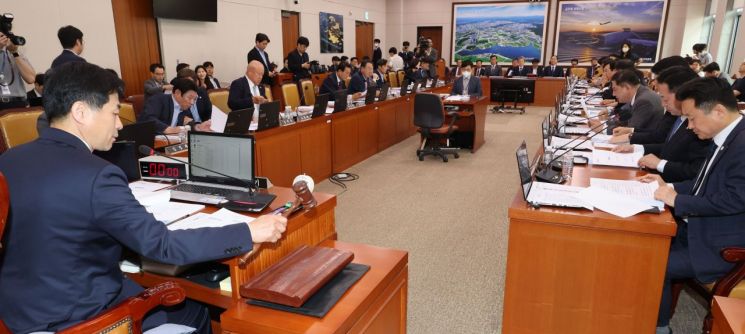 Kim Min-ki, Chairman of the National Assembly Land, Infrastructure and Transport Committee, is striking the gavel at the plenary meeting of the Land, Infrastructure and Transport Committee held at the National Assembly in Yeouido, Seoul, on the morning of the 24th. / Photo by Yonhap News
According to the National Assembly and the Ministry of Land, Infrastructure and Transport (MOLIT) on the 29th, the Land, Infrastructure and Transport Committee of the National Assembly will hold a subcommittee meeting on the 30th to review key contentious bills.
The subcommittee will consider the amendment to the "Act on the Recoupment of Excess Reconstruction Profits," which includes measures to ease reconstruction charges, the amendment to the "Housing Act" aimed at abolishing the residency requirement for housing under the price ceiling system, and the "Special Act on the Maintenance and Support of Aging Planned Cities," which contains redevelopment plans for first-generation new towns.
Particular attention is focused on whether the amendment to the reconstruction excess profit recoupment law will pass the subcommittee. Representative Kim Jeong-jae of the People Power Party introduced the amendment last November, incorporating MOLIT's "Rationalization Plan for Reconstruction Charges," but the National Assembly's review has been delayed.
The amendment aims to ease the exemption criteria for reconstruction charges per association member from the current KRW 30 million or less to KRW 100 million or less and expand the charge application range from KRW 20 million to KRW 70 million.
It also proposes postponing the start date for calculating excess profits from the "approval date of the promotion committee formation" to the "approval date of the association establishment," and includes provisions to grant an additional 10-50% reduction in charges based on the holding period for long-term single-homeowners, calculated retroactively from the housing completion date.
The opposition party expressed some objections at the first subcommittee meeting held at the end of last month. However, since they do not oppose the charge reduction itself, it is expected that the amendment's passage is not impossible. Some lawmakers even argue that "benefits should be expanded for those who have held properties for more than 20 years."
In this regard, the National Reconstruction Maintenance Association Coalition held rallies in front of the National Assembly on the 18th and 25th, urging the prompt passage of the amendment. A coalition official said, "Reconstruction charges are imposed on unrealized profits and lack fairness compared to other laws, which is problematic," adding, "Since it is the biggest obstacle to reconstruction progress, it must be amended."
The agenda to abolish the residency requirement for housing subject to the price ceiling system will also be discussed in the subcommittee. The government shortened the resale restriction period for apartment pre-sale rights in the metropolitan area from a maximum of 10 years to 3 years on the 7th of last month. However, since the Housing Act imposing the residency requirement has not been amended, its effectiveness is being questioned.
In the case of Olympic Park Foreon in Gangdong-gu, Seoul (Dunchon Jugong reconstruction), the resale restriction period has been reduced to one year, allowing pre-sale rights to be traded from the end of this year. However, if the residency requirement is not abolished by then, resale will effectively be impossible. Nonetheless, since the residency requirement provision was introduced not long ago and there are concerns that its abolition could trigger speculative demand such as gap investment, difficulties are expected during the legislative process.
The special law for the redevelopment of first-generation new towns such as Bundang and Ilsan will also be submitted to the subcommittee for the first time. It includes provisions granting safety inspection exemptions or relaxations, land use changes, and floor area ratio benefits to 49 aging residential districts nationwide, including first-generation new towns. However, as it is a newly proposed law with extensive content, its immediate passage is unlikely.
© The Asia Business Daily(www.asiae.co.kr). All rights reserved.

















