With the downgrade of the COVID-19 crisis alert level on the 1st of next month, the temporarily permitted non-face-to-face medical consultations will come to an end. Although non-face-to-face consultations are expected to continue through pilot projects, the operational principles will change significantly, focusing mainly on follow-up visits compared to the previously unrestricted practice. As the government prepares to announce the final plan for the non-face-to-face medical consultation pilot project, the medical community, pharmaceutical sector, and platform industry have clashed over key implementation measures until the last moment.
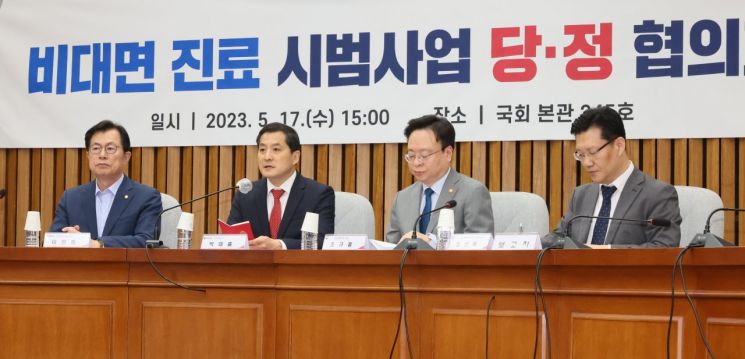 The non-face-to-face medical consultation pilot project meeting held on the 17th.
 [Image source=Yonhap News]
"Non-face-to-face consultations are auxiliary measures" vs "No initial consultation is a death sentence"
The biggest area of debate between the medical community and the industry was the scope of non-face-to-face consultation eligibility. In February, the government and the Korean Medical Association agreed on the principle of focusing on follow-up visits during medical-government consultations. However, the platform industry has continuously argued that initial consultations should also be allowed, given the convenience and safety of non-face-to-face consultations confirmed over the past three years. They particularly emphasized that excessive regulation of non-face-to-face medical services is unwarranted, even going so far as to call it a "death sentence" for non-face-to-face consultations.
On the 17th, the conflict intensified when the basic plan for the pilot project was presented during a meeting between the People Power Party and the government. Initially, there was a proposal to allow initial consultations only for pediatric and adolescent departments on weekends and holidays, but this was excluded following opposition from the medical community. The medical community argued that "since pediatric and adolescent patients often have difficulty expressing themselves and exhibit atypical symptoms, face-to-face consultations prioritizing patient safety must be conducted." Furthermore, the Korean Medical Association, Korean Dental Association, and Korean Pharmaceutical Association jointly issued a statement demanding specific criteria for initial consultation eligibility, a ban on non-face-to-face consultations at hospital level, and strengthened management and supervision of platforms.
The platform industry immediately pushed back. The Remote Medical Industry Council (Wonsanhyeop) released an analysis of non-face-to-face consultation policies in G7 countries including Japan, France, Germany, the UK, Italy, and Canada, excluding the U.S. where policies vary by state. According to this investigation conducted through local law firms, all countries except Italy allow initial non-face-to-face consultations. Jang Ji-ho, co-chairman of Wonsanhyeop, stated, "Major global countries are minimizing regulations and developing non-face-to-face consultations by prioritizing the professional capabilities of medical personnel." He added, "The Ministry of Health and Welfare should not be satisfied with superficial discussions with medical associations for immediate benefits but should strive to build a healthcare system that truly benefits all citizens."
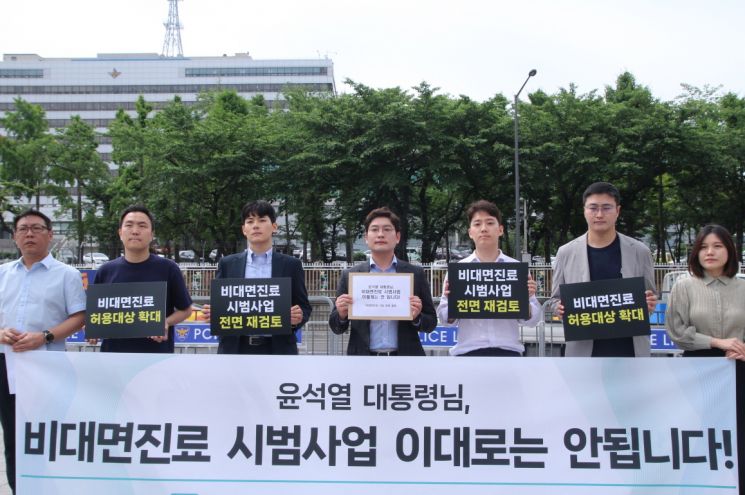 The Remote Medical Industry Council is urging a full reconsideration of the non-face-to-face medical pilot project currently being promoted by the Ministry of Health and Welfare, by publicly releasing an "Appeal to the President" in front of the Presidential Office in Yongsan-gu, Seoul.
 [Photo by Wonsanhyeop]
'Prohibition of Medicine Delivery' Also Controversial... Will an Optimal Implementation Plan Emerge?
Among the pilot project implementation plans announced earlier through the government-party consultations, the most controversial issues alongside the eligibility for initial consultations were medicine delivery. At the time of the consultations, the principle was confirmed that medicines must be collected directly at the pharmacy by the patient, their guardian, or an acquaintance. The government and party stated, "We will devise supplementary measures for elderly or disabled individuals with mobility difficulties and confirmed infectious disease patients." As a result, whether medicine delivery will be allowed even in a limited way in the final plan has become a focus of attention.
The Korean Pharmaceutical Association proposed "minimum principles" on the 24th of last month, emphasizing the patient's autonomy in choosing pharmacies and that the delivery of medicines should be conducted by pharmacists and patients. They insisted that pharmacists must be able to designate the delivery method only after consultation with the patient. They also demanded a ban on pharmacies dedicated solely to non-face-to-face consultations and appropriate supervision and penalties for the pilot project. Conversely, the platform industry directly raised the issue of medicine delivery and argued for expanding the eligible recipients. Wonsanhyeop stated, "Forcing even chronic patients who repeatedly receive the same medicine to collect it face-to-face undermines the essence of non-face-to-face consultations, which aim to improve medical accessibility." They criticized, "Excluding non-face-to-face options only at the stage of medicine receipt and intake appears to represent vested interests of the pharmaceutical industry rather than the public interest."
Ultimately, the clash between the medical community and the industry stems from differing perspectives on non-face-to-face consultations. The medical community, responsible for direct medical acts and accountability, must prioritize patient safety, whereas the platform industry places relatively more emphasis on improving medical accessibility and patient convenience. Although both share the common goal of "promoting public health," their approaches differ. For the government, it is time to reflect these differing viewpoints and derive the optimal pilot project implementation plan. The final pilot project plan is expected to be confirmed at the Health Insurance Policy Deliberation Committee meeting scheduled for the morning of the 30th.
© The Asia Business Daily(www.asiae.co.kr). All rights reserved.
![Clutching a Stolen Dior Bag, Saying "I Hate Being Poor but Real"... The Grotesque Con of a "Human Knockoff" [Slate]](https://cwcontent.asiae.co.kr/asiaresize/183/2026021902243444107_1771435474.jpg)

















