Carrying Bank up 23.6%, K-Bank up 67% YoY
Delinquency rate more than doubled from a year ago
Industry: "Focusing on additional provision accumulation and CSS advancement"
Internet-only banks KakaoBank, K Bank, and Toss Bank are making steady progress toward their target proportions of loans to medium- and low-credit borrowers this year. The supply amount itself has also increased significantly compared to a year ago, following orders from financial authorities. However, as borrowers' repayment ability decreases due to high interest rates, managing asset quality remains a challenge.
According to the Bankers Association disclosure on the 28th, the proportion of credit loans to medium- and low-credit borrowers (based on outstanding balance) was 25.7% for KakaoBank, 23.9% for K Bank, and 42.06% for Toss Bank. Loans to medium- and low-credit borrowers refer to loans to borrowers in the lower 50% credit score bracket based on KCB standards. These banks must achieve loan proportions of 32%, 30%, and 44%, respectively, by the end of this year.
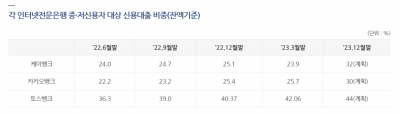 Proportion of credit loans for medium- and low-credit borrowers among internet-only banks (based on outstanding balance). Source: Provided by the Korea Federation of Banks
The loan amounts themselves have also increased sharply. KakaoBank issued loans totaling 770.8 billion KRW to medium- and low-credit customers in the first quarter of this year alone, a 23.6% increase from 623.5 billion KRW in the first quarter of last year. By the end of the first quarter of this year, their loan balance reached 3.4774 trillion KRW, accounting for 25.7% of total credit. K Bank's loan balance to medium- and low-credit borrowers was 2.0622 trillion KRW in the first quarter of this year, up 67% from 1.2332 trillion KRW in the same period last year. During the same period, Toss Bank's loan balance was around 3.1 trillion KRW.
The expansion of the loan proportion to medium- and low-credit borrowers is in response to financial authorities' orders, but concerns about asset quality deterioration at these banks are growing. This is due to the increased repayment burden on vulnerable borrowers amid high interest rates. In fact, the delinquency rates of these banks are rising rapidly. KakaoBank's delinquency rate in the first quarter of this year was 0.58%, more than double the 0.26% recorded in the first quarter of last year. K Bank's rate also rose from 0.48% to 0.82% during the same period. The ratio of non-performing loans classified as fixed or below, meaning loans overdue by more than three months, also increased by 0.18 percentage points to 0.43% for KakaoBank and by 0.3 percentage points to 0.94% for K Bank as of the first quarter of this year compared to the same period last year.
In response, the industry has significantly increased loan loss provisions to manage asset quality amid rising delinquency rates. Toss Bank added 76 billion KRW in the first quarter of this year, securing a total provision of 260 billion KRW. KakaoBank's loan loss provision charge was 35 billion KRW in the first quarter of last year, but it added 55.2 billion KRW in the first quarter of this year, 20.2 billion KRW more than the previous year. K Bank's provision charge also more than tripled from 20.7 billion KRW to 61.2 billion KRW during the same period.
They also plan to continue discovering healthy medium- and low-credit borrowers by advancing credit scoring models (CSS). KakaoBank stated, "In line with the implementation of the 'loan transfer system (refinancing loan platform),' we will develop and apply a specialized refinancing loan model for other banks and enhance the credit scoring model to include more medium- and low-credit customers." Toss Bank said, "We will further advance our proprietary credit scoring model 'TSS (Toss Scoring System)' and discover healthy credit borrowers through alternative information analysis and utilization." A K Bank official also said, "We will strive to manage risks through CSS advancement and other measures."
© The Asia Business Daily(www.asiae.co.kr). All rights reserved.


















