Trends of Foreign Visitors to Korea Change After COVID-19
US Tourists Lead Recovery Rate
Japanese and US Tourists Surge as Chinese Group Tours Delay
Bank of Korea: "Government Must Strengthen Efforts to Attract Tourists"

Before COVID-19, Chinese tourists consistently ranked first among foreign visitors to Korea, but Americans are now rapidly closing the gap. This is attributed to the early easing of COVID-19 restrictions in the United States, while China delayed its relaxation measures and postponed the allowance of group tours for Chinese tourists.
According to the Bank of Korea on the 28th, the number of foreign tourists visiting Korea in April reached 900,000, recovering about 55% compared to April 2019, before the pandemic. By nationality, Americans showed a recovery rate of 106%, fully regaining the number of tourists from the pre-pandemic period. Thai tourists had the second-highest recovery rate at 77%, followed by Vietnamese tourists at 69%, with most countries showing significant recovery in tourist numbers.
US Tourist Recovery Rate at 106%... China Lags at 24%
On the other hand, the recovery rate of Chinese tourists, who previously accounted for the largest share before the pandemic, remained at only 24%, limiting the overall improvement in the number of foreign tourists. The delay in Chinese tourist recovery is due to the slow rebound of outbound travel from China, which was only about 18% of pre-pandemic levels as of March. Since the spread of COVID-19 in 2020, China had virtually closed its borders for nearly three years with mandatory quarantine measures upon entry and only began reopening in early January. According to immigration statistics from the Ministry of Justice, the number of arrivals by nationality in April was highest for Japan at 130,000, followed by China (117,000) and the United States (108,000).
In Japan, the recovery rate of foreign tourists was 66% as of March, about 14 percentage points higher than Korea. Although the recovery rate of Chinese tourists in Japan was low at 11% as of March, the recovery rates from other countries including Korea, Hong Kong, and Taiwan were generally high. Notably, the number of Japanese tourists to Korea surged, with a recovery rate reaching 80%.
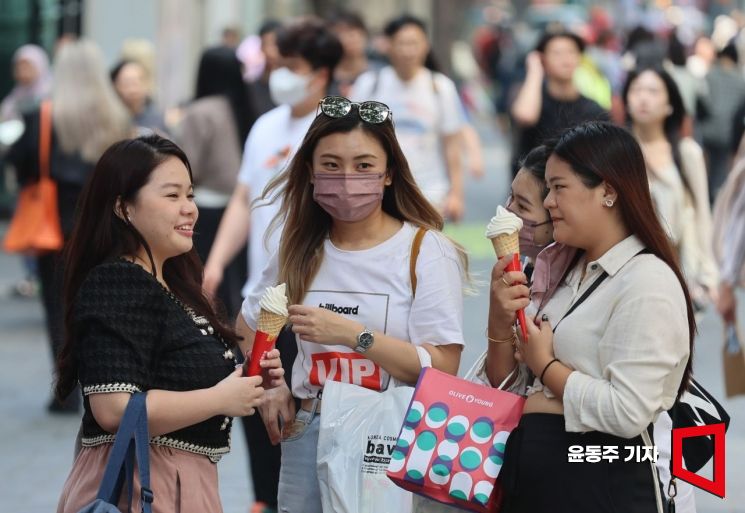
Until the late 1990s, Japan focused on managing outbound travel of its nationals, but since declaring tourism promotion in 2003, it shifted its policy toward attracting foreign tourists. Consequently, the number of foreign visitors to Japan, which was 6.79 million in 2009?less than Korea's 7.82 million?reached a record high of 31.88 million in 2019 before the pandemic. This far exceeded Korea's 17.5 million foreign visitors. According to the World Economic Forum (WEF) Travel & Tourism Competitiveness Index, Japan's ranking rose significantly from 25th in 2009 to 1st in 2021, while Korea's ranking improved from 31st to 15th during the same period. In March this year, the Japanese government announced and is promoting the 4th Tourism Nation Promotion Plan to accelerate the recovery of the tourism industry after the pandemic.
Weak Yen and Japanese Government's Tourist Attraction Policies Greatly Improve Travel Balance
The relatively rapid recovery of tourists in Japan is attributed to the weak yen and the Japanese government's active policies to attract tourists. The swift recovery of tourists has positively impacted the Japanese economy by improving the travel balance. In fact, Japan's travel balance recorded a surplus of 740.8 billion yen in the first quarter of this year, a significant improvement compared to surpluses of 78.9 billion yen in the third quarter and 525.8 billion yen in the fourth quarter of last year. In contrast, Korea's travel balance showed a deficit of 3.24 billion dollars in the first quarter, worsening from deficits of 2.3 billion dollars in the third quarter and 2.38 billion dollars in the fourth quarter of last year.
Experts advise that, amid delayed effects of IT sector recovery and China's reopening, a surge in foreign tourists could contribute to growth by improving the business conditions of related service industries, and thus recommend active tourism policies. The Bank of Korea stated, "Assuming that inbound tourists to Korea recover at the same pace as in Japan (an increase of 1.5 million), it is estimated that there would be an annual growth boost effect of about 0.12 percentage points through improvements in service industry conditions," emphasizing, "Efforts to attract tourists should be strengthened not only from China but also from other countries."
© The Asia Business Daily(www.asiae.co.kr). All rights reserved.
![Clutching a Stolen Dior Bag, Saying "I Hate Being Poor but Real"... The Grotesque Con of a "Human Knockoff" [Slate]](https://cwcontent.asiae.co.kr/asiaresize/183/2026021902243444107_1771435474.jpg)

















