Jogye Order Holds Ceremony for the Return of 32 Buddhist Cultural Heritage Items
Some Buddhist Cultural Properties Still Missing
"I hope that the sacred Buddhist artifacts that have not yet returned will soon 'hwanjibonche (還至本處, a Buddhist term meaning returning to their original place)."
This was the regret expressed by Ven. Jinwoo, the Chief Abbot of the Jogye Order of Korean Buddhism, during the Buddhist cultural heritage (sacred artifacts) restitution ceremony held on the 23rd at the Korean Buddhist History and Culture Memorial Hall, where the police returned 32 recovered artifacts.
The restituted sacred cultural properties were confirmed to have been stolen from Jogye Order-affiliated temples such as Bokyungsa Temple in Pohang, Hwaeomsa Temple in Gurye, and Seogosa Temple in Jeonju between 1988 and 2004. They had been kept in the storage of the National Palace Museum of Korea, but following the court's final ruling on the suspects, the prosecution decided to return them to their original temples.
However, as Ven. Jinwoo revealed, the whereabouts of other stolen sacred artifacts remain unknown. According to a letter sent to the media in 2015 by a grave robber named A, these criminals operate meticulously to avoid leaving evidence from the theft to the handling of cultural properties. Although some view the criminal’s statements as unreliable, the reports at the time provide insight into the process through which sacred artifacts are dealt with.
According to Mr. A, among professional cultural property thieves and grave robbers, there are brokers called 'nakama' and 'gaidashi.' These brokers connect thieves with buyers and have the expertise to assess the value of sacred artifacts. They even specify temples and give orders to thieves to steal treasures. During the transaction of stolen cultural properties, receipts and contracts are falsified or use aliases to evade investigation. Thieves, brokers, and buyers all operate with great caution.
The so-called 'action squad' thieves employ ingenious methods. According to police and media reports on apprehended thieves, some criminals disguise themselves as devout Buddhists and enter the temple halls. They pretend to pray and, when no one is around, steal the Buddha statues. There have also been cases where thieves cut anti-theft wires with cutters, drilled through temple walls, and tore off Buddhist paintings. In one instance, a thief entered inside a Buddha statue over 5 meters tall and stayed there for two nights and three days to steal the relics inside. These relics refer to sarira (Buddhist relics), sutras, and other items placed inside the statue during its creation.
Because these sacred cultural properties are historically significant, Buddhist devotees strongly condemned the thefts. On the 24th, the day after the restitution ceremony, Kim Taewon (52), a Buddhist devotee met at Jogyesa Temple in Jongno-gu, Seoul, said, "This is an act deserving of divine punishment. It is fortunate that the artifacts have been found now." Another devotee in his 60s, Choi Hyungkuk, said, "It is fortunate that they have been found, but there are still many that remain missing. I hope they all return to the Buddha’s embrace."
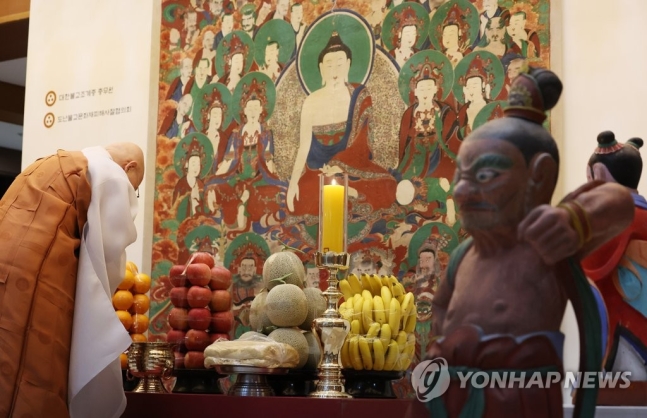 On the 23rd, Jinwoo Sunim, the Chief Executive of the Jogye Order, offered incense in front of the 'Yeongsan Hoesangdo' (靈山會上圖) of Bokyeongsa Temple in Pohang, which was stolen in 1999 and later returned, at the ceremony for the return of stolen Buddhist cultural assets held at the Korean Buddhist History and Culture Center in Jongno-gu.
 [Photo by Yonhap News]
Meanwhile, according to the Jogye Order, the existence of the missing sacred cultural properties was revealed in 2020. After two pieces, 'Yeongsan Hoesangdo' and 'Jijang Bosaldo' from Bokyungsa Temple, were listed at an auction in Seoul, a seven-month investigation led to the discovery of 32 long-hidden Buddhist cultural heritage items.
Ven. Deokmun, the head monk of Hwaeomsa Temple and representative of the Association of Temples Affected by Stolen Buddhist Cultural Properties, said, "It has been 22 years since the theft of the Hwaeomsa Temple’s Sijangdo. I have always felt heavy-hearted, but now I can finally put that burden down." Ven. Deokmun emphasized, "We will do our utmost to ensure that such incidents never happen again." The Jogye Order plans to initiate cultural property designation procedures for cultural heritage with high cultural and academic value.
The Buddhist cultural heritage items returned this time include 11 Buddhist paintings and 21 Buddha statues: △ Samjang Bosaldo from Baekryeonsa Temple in Gangjin △ Yeongsan Hoegwaebuldo from Yugasa Temple in Dalseong, Daegu △ Yeongsan Hoesangdo and Jijang Bosaldo from Bokyungsa Temple in Pohang △ Seokgamoni Bulhoedo from Donghwasa Temple in Suncheon △ Jijang Siwangdo from Daejeonsa Temple in Cheongsong △ Siwangdo from Hwaeomsa Temple in Gurye △ Yeorae Hoedo from Byeoksongsa Temple in Hamyang △ Jesuk Cheonsang and Nahan statues from Cheoneunsa Temple in Gurye △ Dongja statues from Mihwangsa Temple in Haenam and Cheonggoksa Temple in Jinju △ Geumgang Yeoksasang from Donghwasa Temple in Suncheon.
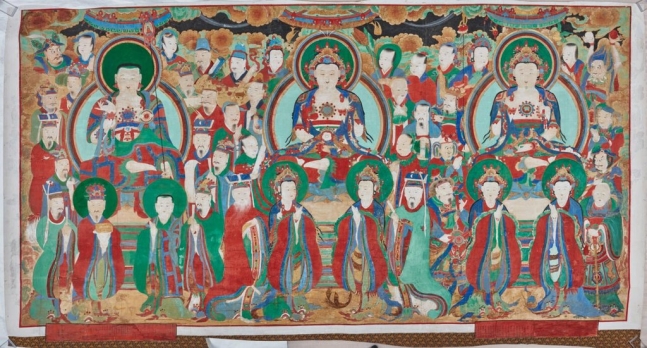 The Cultural Heritage Administration announced on the 22nd that it returned all 32 Buddhist cultural heritage items, including the 'Pohang Bogyeongsa Yeongsanhwesangdo,' which were stolen from various temples between 1988 and 2004 and later recovered, to the Jogye Order of Korean Buddhism last month. The photo shows the Samjang Bosaldo (三藏菩薩圖) of Baekryeonsa Temple in Gangjin. [Image source=Yonhap News]
Some of the Buddha statues among the restituted Buddhist cultural heritage were severely cracked or damaged after being stolen, and some Buddhist paintings were repainted arbitrarily, damaging their original form.
Choi Eungcheon, Commissioner of the Cultural Heritage Administration, stated, "We will do our best to support and help many unknown stolen cultural heritages return to their original places," adding, "We will establish cooperative systems and improvement measures with related institutions."
© The Asia Business Daily(www.asiae.co.kr). All rights reserved.



















