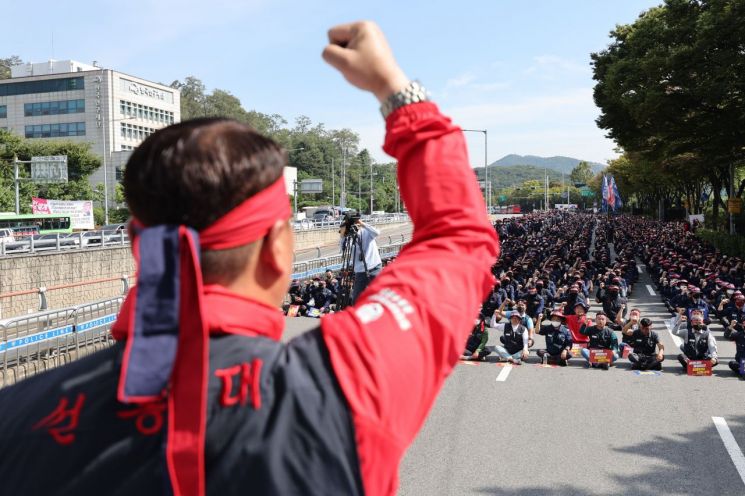
 Members of four branches of the Metal Workers' Union Hyundai Steel irregular workers (Dangjin, Suncheon, Suncheon Forging, Ulsan) held a general strike rally in front of Hyundai Motor Company's headquarters in Seocho-gu, Seoul, on the afternoon of September 28 last year, condemning illegal dispatch and demanding job security. [Image source=Yonhap News]
This year as well, intense discussions are underway between the business sector and labor unions to determine next year's minimum wage. Due to high inflation and growing concerns over an economic downturn, the gap in positions regarding the minimum wage increase rate is larger than ever, and with rising fears of clashes between the government and labor groups, the discussions are expected to be even more challenging.
According to labor groups on the 27th, the Korean Metal Workers' Union (Metal Union) under the Korean Confederation of Trade Unions (KCTU) will launch a general strike on the 31st. All union members will strike for more than four hours each during both day and night shifts, and after the strike, they will participate in branch-level rallies. Metropolitan area branches will hold a general strike rally in front of the Seoul Metropolitan Police Agency on the same day.
Since the government has continuously declared a principle of "strict response" to labor protests, there are significant concerns that clashes between labor groups and the police will occur during this general strike. The police have already decided to increase equipment support for riot units and respond actively, while labor groups have stated they will not back down in the face of government repression.
The Metal Union plans to demand the resignation of the Yoon Seok-yeol administration, a substantial increase in the minimum wage, the abolition of labor regressions such as the 69-hour workweek system, and a halt to all-out union suppression during this general strike. The extent of conflict during this strike is expected to be a crucial turning point in resolving issues related to minimum wage discussions and labor reforms going forward.
The Minimum Wage Commission held its second plenary meeting on the 25th at the Government Complex Sejong to deliberate on next year's minimum wage but only confirmed their differences. The labor side argued that the minimum wage must be sufficiently raised due to inflation caused by public utility fee hikes, while the business sector countered that the burden on small business owners and the economic downturn must be taken into account.
Lee Myeong-ro, Head of the Human Resources Policy Division at the Korea Federation of SMEs, pointed out, "Due to increases in public utility fees, inflation, and interest rates, not only workers but also small and medium-sized enterprises, small business owners, and self-employed individuals are facing great difficulties."
On the other hand, Ryu Gi-seop, Secretary-General of the Federation of Korean Trade Unions (FKTU), emphasized, "According to the Statistics Korea announcement on the 22nd, the price index for electricity, gas, and other utilities rose 30.5% compared to the same period last year, the highest increase since the foreign exchange crisis." He stressed, "The solution to prevent the collapse of the working-class economy is a substantial increase in the minimum wage."
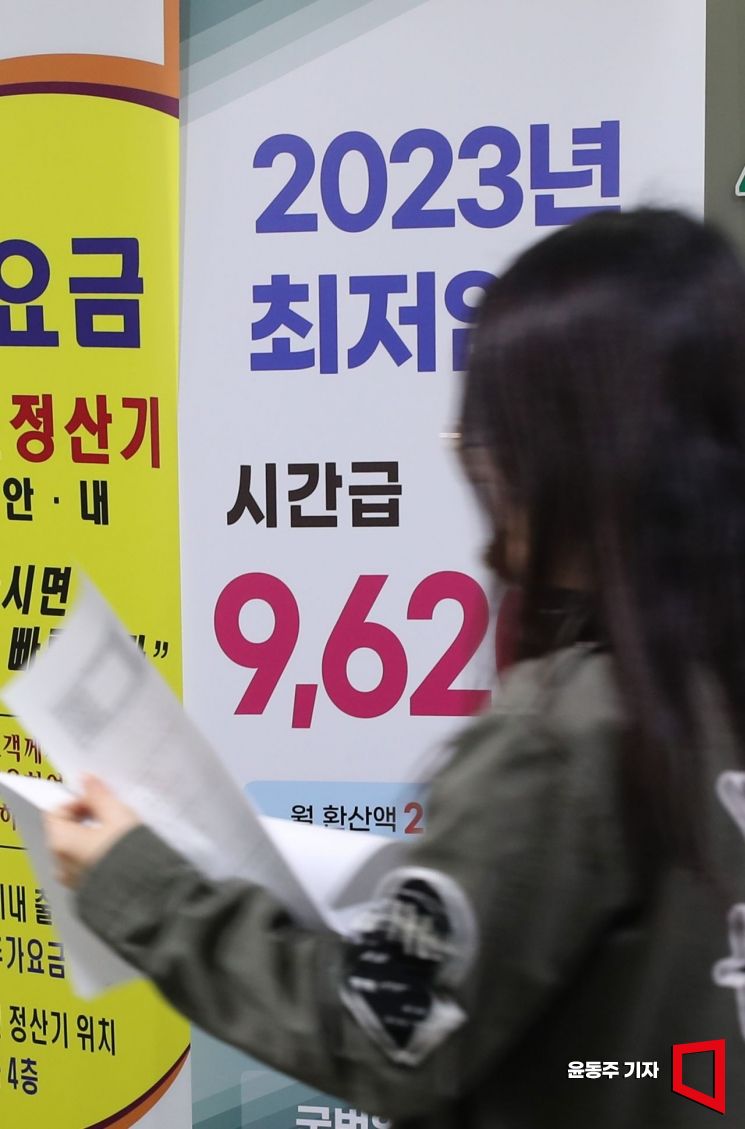
In particular, on this day, tensions also arose over the "living expenses of single, unmarried workers," which serve as basic data for minimum wage deliberations. According to the Minimum Wage Commission's living expenses expert committee, the average monthly living expenses of unmarried workers living alone as of last year were surveyed at 2.41 million KRW.
This amount is close to the monthly equivalent of the minimum wage for next year demanded by the labor side, which is 2.508 million KRW (12,000 KRW per hour). In response, Park Hee-eun, Vice Chairperson of the KCTU, said, "This year's minimum wage is far below the living expenses of single, unmarried workers," adding, "There is sufficient basis for a substantial increase in the minimum wage."
However, Ryu Ki-jung, Executive Director of the Korea Employers Federation, pointed out that the statistics include consumption expenditures of high-income groups and emphasized, "It is reasonable to use the living expenses of low-wage workers, who are the policy target, for minimum wage deliberations. This year's deliberations must consider companies' payment capacity and must implement differentiated application by industry."
The third plenary meeting is scheduled for the 8th of next month. At this meeting, fierce debates between labor and management are expected over whether to apply differentiated minimum wages by industry, which is one of the agenda items of the Minimum Wage Commission. The labor side maintains a strong opposition to differentiated application by industry.
The deadline for announcing the minimum wage is August 5th every year. Considering objection procedures, deliberations must be completed by mid-July at the latest. Given the recent differences in positions among the government, labor, and business sectors, reaching an agreement is not easy. The KCTU is preparing for the largest general strike in recent years during the second week of July.
© The Asia Business Daily(www.asiae.co.kr). All rights reserved.


















