Jinhaksa Admission Strategy Research Institute Presents Methods for Establishing Learning Strategies
The Korea Institute for Curriculum and Evaluation (KICE) will conduct the June mock exam, held annually to assess students' academic levels and to help adjust the difficulty of the College Scholastic Ability Test (CSAT), on the 1st of next month.
With a record low of approximately 460,000 test takers, the number of graduates taking the exam has slightly increased, and the proportion of repeat test takers is expected to reach its highest level. Students should use this exam as an evaluation tool to prepare for the CSAT by understanding the test's intent and direction as set by the institute, as well as their own academic level. Together with JinHakSa Admission Strategy Research Institute, we have examined how to utilize the June mock exam to establish future study strategies.
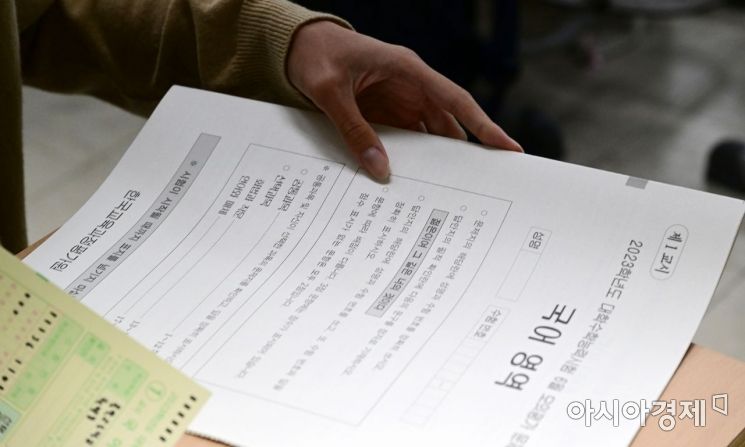 On the 9th, the day the June mock test for the 2023 College Scholastic Ability Test was held, third-year students at Yongsan High School in Seoul are preparing for the exam. Photo by Kim Hyun-min kimhyun81@
Identifying the Causes of Wrong Answers Is Essential for Learning Improvement
Although the importance of analyzing wrong answers is often emphasized, many students do not know why it is important or how to analyze their mistakes. The reason why analyzing wrong answers is crucial is that without understanding the root cause, the problem cannot be solved. Even mistakes often attributed to 'carelessness' have clear reasons. For example, if a calculation error was made, students should practice carefully writing down the problem-solving and calculation process to improve.
Another example is if a student made mistakes by reading passages incorrectly due to rushing caused by lack of time. Since time shortage is the issue, practicing solving problems within a set time limit during regular study sessions can help. Accurately analyzing the causes of wrong answers is the most important task for future learning improvement.
To analyze the reasons for wrong answers more specifically, it is also helpful to categorize them by subject units or types of wrong questions. Ideally, students should analyze their mistakes from previous mock exams in March, April, or earlier in the same way to clearly identify their weak areas, which will aid in planning future study. If time is limited, at least analyzing wrong answers from the March and June exams is recommended.
It Is Important to Categorize Causes of Wrong Answers by Type
After analyzing the causes of wrong answers, students should develop response strategies based on weak subjects, units, question types, and reasons.
Measures to address wrong answers should be prioritized in regular study. If a mistake was due to forgetting learned content, reviewing should be prioritized. If time was insufficient, practicing solving review problems with a time limit per question is advisable.
If mistakes occur frequently in specific question types, watching online lectures that teach strategies for those types or reviewing concepts followed by practicing question books categorized by type can be effective. If a particular unit is frequently mistaken, concept learning for that unit should be conducted.
Once an overall study strategy based on the causes of wrong answers is established, the necessary efforts to improve should be specified in terms of study volume. For example, to supplement a specific unit, students should determine which pages of which textbook to study for concept learning, which question books to use, how many problems to solve, and how many days are needed. Additionally, to prevent forgetting what has been learned, setting a study volume for periodic review such as problem-solving is recommended.
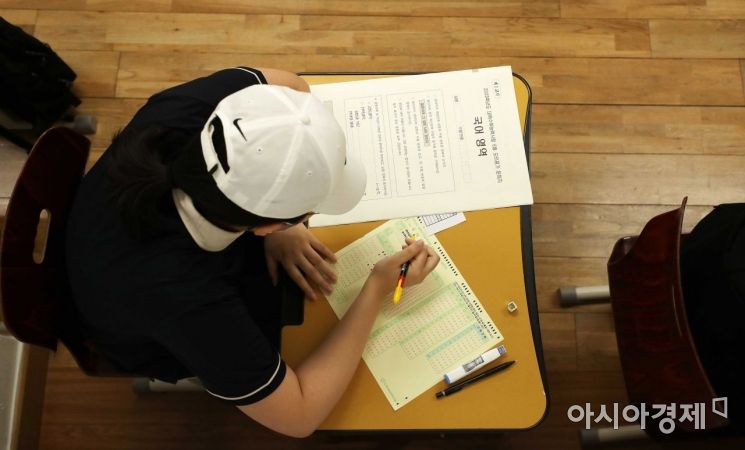 On the 9th, the day of the June mock exam for the 2023 College Scholastic Ability Test, high school seniors are preparing for the exam at Yeouido Girls' High School in Yeongdeungpo-gu, Seoul. Photo by Jinhyung Kang aymsdream@
Establishing and Implementing a Concrete Study Plan
Creating an implementation plan for the target study period is also important. If the goal is to study until the next mock exam in September, the study volume identified earlier should be concretely planned to be completed within that period. To do this, students should secure a schedule that allows full CSAT preparation study, excluding periods for performance assessments and final exam preparations, and divide the study volume accordingly.
For example, if 3 days are needed to study a specific unit and 2 days are needed to study a certain question type, the unit study can be scheduled for the third week of June, and the question type study can be allocated to the weekend before final exam preparation. It is best to break down the plan by month, week, day, and time slots. The important point is to plan by study volume rather than by time. Time-based plans can be completed simply by the passage of time even if the student is distracted or dozing off, but volume-based plans require actual completion of the study material.
Finally, students should consistently implement the plan and record their progress. After taking the September mock exam, they should evaluate the effectiveness of the previous study plan. If it was effective, they should maintain it; if not, they should revise and supplement the plan to use more effective methods.
The June and September mock exams administered by KICE are important not only for establishing early admission strategies but also as study tools to set and implement future study plans. Therefore, rather than simply reacting to whether the scores were good, students need to reflect on what areas are still lacking and how to improve them moving forward.
© The Asia Business Daily(www.asiae.co.kr). All rights reserved.
![Clutching a Stolen Dior Bag, Saying "I Hate Being Poor but Real"... The Grotesque Con of a "Human Knockoff" [Slate]](https://cwcontent.asiae.co.kr/asiaresize/183/2026021902243444107_1771435474.jpg)

















