Village Bus Operation Frequency Reduced by Up to 37%
Seoul City "Limited Budget, Additional Support Difficult"
"I increasingly feel that the bus intervals are getting longer, which is very inconvenient. But I can't just stop taking the village bus. It takes only 5 to 10 minutes to get to the subway station by bus, but walking takes over 20 minutes because of the steep uphill," complained Kim (60, female), who lives in Geumho-dong, Seongdong-gu, Seoul, located at the foot of Daehyeonsan Mountain, saying that taking the village bus is becoming more difficult day by day.
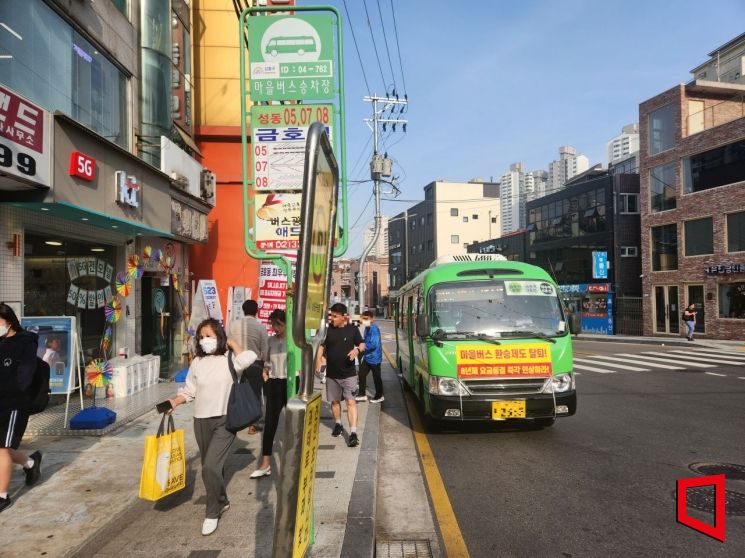 On the 26th at around 5 p.m., citizens who used the village bus are getting off at a bus stop in Geumho-dong, Seoul.
 Photo by Taewon Choi skking@
Village bus companies are struggling with financial difficulties, exacerbating the inconvenience for residents living in high-altitude areas with low public transportation accessibility. Village buses operate in so-called gap areas, such as regions far from subway stations or steep highlands that are difficult to climb. They serve as a means of transportation connecting general buses or subway lines in areas with low public transportation accessibility.
Village bus companies have recently faced a crisis of extinction. According to Seoul City on the 29th, village bus revenue last year was 173.8 billion won, a sharp drop of 27.6% compared to 2019. The number of deficit companies supported by Seoul City and the amount of support surged from 59 companies and 19.2 billion won in 2019 to 118 companies and 49.5 billion won.
As deficits increased, wages for village bus drivers stagnated, and the number of drivers steadily declined. The number of village bus drivers, which was 3,496 in 2019, dropped to 2,756 last year. Consequently, the frequency of village bus operations also sharply decreased. Currently, in the 25 autonomous districts within Seoul, the number of village bus operations has decreased by at least 7% and up to 37%.
As the number of operations decreased, citizens' inconvenience has intensified. On the afternoon of the 26th, Lee (56, female), whom we met at a bus stop in Geumho-dong, said, "I didn't know the number of operations had decreased, but recently the bus intervals seem to have gotten longer. Since my home is on a steep uphill, I can't avoid taking the bus, so I hope the problem is resolved quickly."
Jang (29, male), who commutes from Geumho-dong to near Seoul Station, also said, "I use the village bus not only for commuting but also when going to appointments or exercising. Previously, I was dissatisfied with the service spirit of village bus drivers, but now I am grateful just that they are operating."
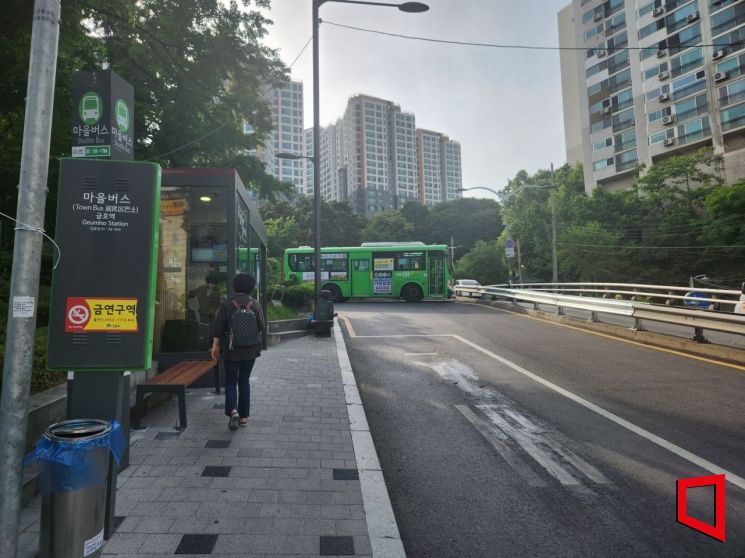 Citizens are moving to a bus stop in Geumho-dong, Seoul, around 4:30 p.m. on the 26th to board a village bus.
 Photo by Tae-won Choi skking@
In this situation, village bus companies say that additional financial support from local governments is urgent. Currently, the transportation cost for village bus financial support is 457,040 won per bus. If the deficit exceeds this amount, Seoul City injects subsidies to compensate up to 230,000 won. The Seoul Village Bus Transportation Association is requesting an increase in transportation costs to 515,842 won.
Village bus driver Bae (52, male) said, "Financial support is directly linked to safe operation. Because the treatment is poor, there are no applicants even when recruiting drivers. Operating hours are getting longer, and holidays have to be reduced. Drivers are struggling, and passengers complain about why the bus is late. Improvement is urgent."
However, Seoul City says that additional financial support is difficult due to limited resources. A city official said, "Since the budget is limited, additional financial support is difficult. Starting as early as August, village bus fares will increase by 300 won from 900 won to 1,200 won based on transportation cards. As the number of passengers, which decreased due to the COVID-19 pandemic, recovers, the deficit problem of village bus companies is expected to ease."
Experts suggest that village buses need to be approached from the concept of ‘welfare’ in this crisis. Professor Yoo Jeong-hoon of the Department of Transportation Systems Engineering at Ajou University said, "Village buses play a role like capillaries of transportation in areas with low public transportation accessibility where relatively disadvantaged people live. Fundamentally, it is necessary to approach this from the perspective of welfare for transportation-vulnerable groups." He added, "If a social consensus is reached to save village buses, discussions are needed to find efficient support methods beyond simple financial support or quasi-public operation. Various measures should be considered, such as rationalizing public transportation fares and selectively providing transportation vouchers to economically disadvantaged citizens."
© The Asia Business Daily(www.asiae.co.kr). All rights reserved.
![Clutching a Stolen Dior Bag, Saying "I Hate Being Poor but Real"... The Grotesque Con of a "Human Knockoff" [Slate]](https://cwcontent.asiae.co.kr/asiaresize/183/2026021902243444107_1771435474.jpg)

















