Success of Nuriho 3rd Launch Downplayed by Some
"Could Be Overtaken Like This" Concerns Raised
Japan's Next-Gen H3 Rocket Fails Test Launch
Japan's media also quickly reported the success of the third launch of the domestically produced space launch vehicle 'Nuriho'. Reactions from Japanese netizens who received this news were mixed. While some made disparaging remarks such as "more space debris has been added," others expressed caution, saying "Japanese space technology could be outpaced by Korea."
On the 26th (local time), numerous articles related to the third launch of Nuriho were posted on the Japanese Yahoo Japan portal. However, the reactions of Japanese netizens in the comment sections and online communities were divided.
Some criticized, saying things like, "Calling yourself a space power after a few test launches of rockets made with old Russian designs and parts?" and "There’s more trash in space now."
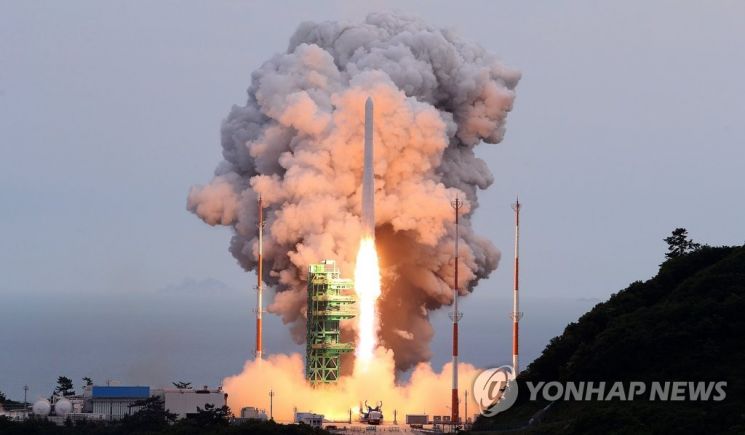 The Korean launch vehicle Nuriho (KSLV-II), developed with domestic proprietary technology, is being launched on the afternoon of the 25th at Naro Space Center in Goheung-gun, Jeollanam-do. [Image source=Yonhap News]
There was also sarcasm about the term "Space G7" (the seventh country to successfully launch a satellite with a domestically produced launch vehicle), which is frequently mentioned domestically. One netizen pointed out, "They praise themselves using terms they made up."
However, there were also those who expressed concern about Korea's rapidly advancing space technology catching up with developed countries. One netizen noted, "Japan failed, but Korea succeeded in launching the rocket," adding, "Japan is already behind the US and China, and could be overtaken by India; soon, it might even have to compete with Korea."
Japan, traditionally regarded as a space power, is struggling with the development of next-generation launch vehicles. On March 7th, the first H3 rocket was launched from the Tanegashima Space Center in Kagoshima Prefecture, but the ignition of the second-stage engine was not confirmed during ascent, resulting in mission failure.
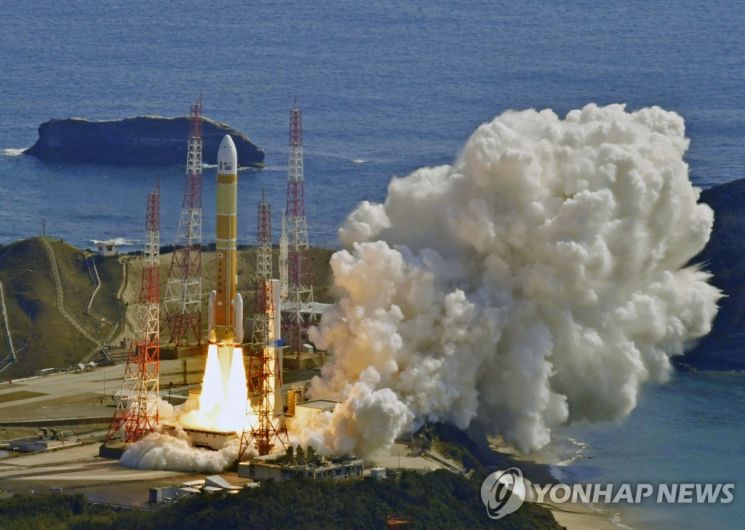 The next-generation Japanese launch vehicle H3 rocket failed due to the ignition failure of the two-stage engine. [Image source=Yonhap News]
Ultimately, the Japan Aerospace Exploration Agency (JAXA), which oversaw the experiment, issued an order to destroy the vehicle 15 minutes after launch. The destroyed rocket debris reportedly fell into the sea east of the Philippines.
Additionally, JAXA attempted to launch the small solid-fuel rocket 'Epsilon No. 6' in October last year but failed. This was the first rocket launch failure by Japan since the H2A rocket No. 6 in November 2003, marking a 19-year gap.
Regarding this, the Nihon Keizai Shimbun expressed concern, stating, "Both large and small rockets have failed. The outlook for future rocket launch plans is uncertain."
Meanwhile, the Nuriho, which succeeded in its third launch, plans to conduct three additional launches by 2027 to increase the rocket's reliability. Afterwards, Hanwha Aerospace will take over the role of 'system integrator' by receiving the manufacturing know-how.
Similar to how NASA selected the private company SpaceX as a partner and transferred core technologies, this appears to be an intention to shift the space business to a private-sector-centered model.
© The Asia Business Daily(www.asiae.co.kr). All rights reserved.
![Clutching a Stolen Dior Bag, Saying "I Hate Being Poor but Real"... The Grotesque Con of a "Human Knockoff" [Slate]](https://cwcontent.asiae.co.kr/asiaresize/183/2026021902243444107_1771435474.jpg)

















