Gallup "President Yoon's Approval Rating Drops 1%p to 36%"
Democratic Party Falls 2%p to 31%
People Power Party Rises 4%p
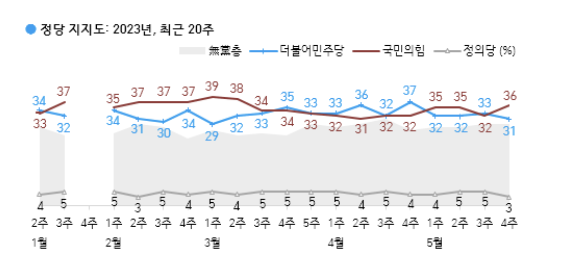
The Democratic Party of Korea's approval rating dropped to the low 30% range following the controversy over lawmaker Kim Nam-guk's virtual asset investment allegations. While the ruling People Power Party showed a significant increase in support, President Yoon Suk-yeol's approval rating for his administration, which had been rising for the past three weeks, saw a slight decline.
According to Gallup's regular survey conducted from the 23rd to the 25th (a telephone interview survey of 1,000 adults aged 18 and over nationwide), the party support ratings showed the People Power Party rising 4 percentage points from the previous week to 36%, while the Democratic Party fell 2 percentage points to 31%.
Notably, among the centrist voters who hold the casting vote, 26% supported the People Power Party, 30% supported the Democratic Party, and 39% responded that they did not support any particular party. Looking at the monthly indicators, the People Power Party's support showed an upward trend. Combining the results of four surveys conducted in May, the People Power Party recorded 34%, up 2 percentage points from April, while the Democratic Party dropped 2 percentage points to 32%. In May, allegations related to lawmaker Kim Nam-guk's coin investments, who had left the Democratic Party, surfaced.
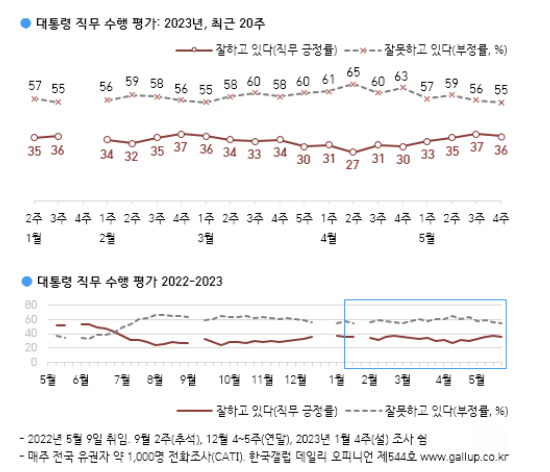
President Yoon's approval rating for his administration fell by 1 percentage point from the previous week to 36%. Negative evaluations also decreased by 1 percentage point to 55%.
The main reason for both positive and negative evaluations of President Yoon's administration was diplomacy. Gallup explained, "For three consecutive months, diplomatic issues have ranked highest among reasons for positive and negative evaluations." Among those who gave positive evaluations (363 respondents), 42% cited diplomacy and 5% cited the economy and livelihood issues. Among those who gave negative evaluations (547 respondents), 34% cited diplomacy, 10% cited economy, livelihood, and inflation, 8% cited unilateral and autocratic behavior, and 6% cited lack of communication.
In the favorability survey by party, the People Power Party had a favorability rating of 33% and an unfavorability rating of 58%. The Democratic Party had a favorability rating of 30% and an unfavorability rating of 60%, while the Justice Party had a favorability rating of 19% and an unfavorability rating of 67%. Gallup explained that compared to the survey results from early February, unfavorability toward the Democratic Party and Justice Party increased, but there was no change for the People Power Party.
For detailed survey methodology and results related to the opinion poll, please refer to the website of the Central Election Survey Deliberation Commission.
© The Asia Business Daily(www.asiae.co.kr). All rights reserved.
![Clutching a Stolen Dior Bag, Saying "I Hate Being Poor but Real"... The Grotesque Con of a "Human Knockoff" [Slate]](https://cwcontent.asiae.co.kr/asiaresize/183/2026021902243444107_1771435474.jpg)

















