World Meteorological Organization: 60% Chance of El Ni?o from May to July
Past El Ni?o Events Raised Prices of Wheat, Corn, Soybeans
Production Facility Disruptions and Decline in Tourism and Consumer Sentiment
Disaster Victims Cause Budget Needs for Recovery and Support
"El Ni?o This Year Could Cause $3 Trillion Losses by 2029"
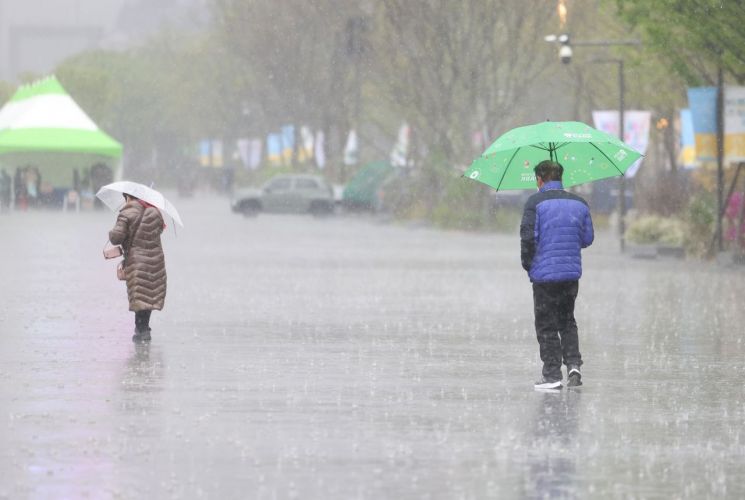
As scientific research suggests the possibility of a super El Ni?o occurring this summer, attention is turning to its potential impact on the South Korean economy. Heavy rainfall could undermine the government's efforts to stimulate domestic demand and stabilize prices. If flood damage and displaced residents occur, additional budget allocations may be required for recovery projects and support policies.
According to the Korea Meteorological Administration's recent "3-month forecast," the average sea surface temperature in the Pacific El Ni?o monitoring zone is currently more than 0.5 degrees Celsius above normal. El Ni?o refers to the phenomenon where sea water temperatures in the eastern and central equatorial Pacific remain elevated for several months. South Korea designates the El Ni?o monitoring zone as between 5 degrees south and 5 degrees north latitude, and 170 to 120 degrees west longitude; if the 3-month average sea surface temperature in this area remains 0.5 degrees above normal, it is considered an El Ni?o event.
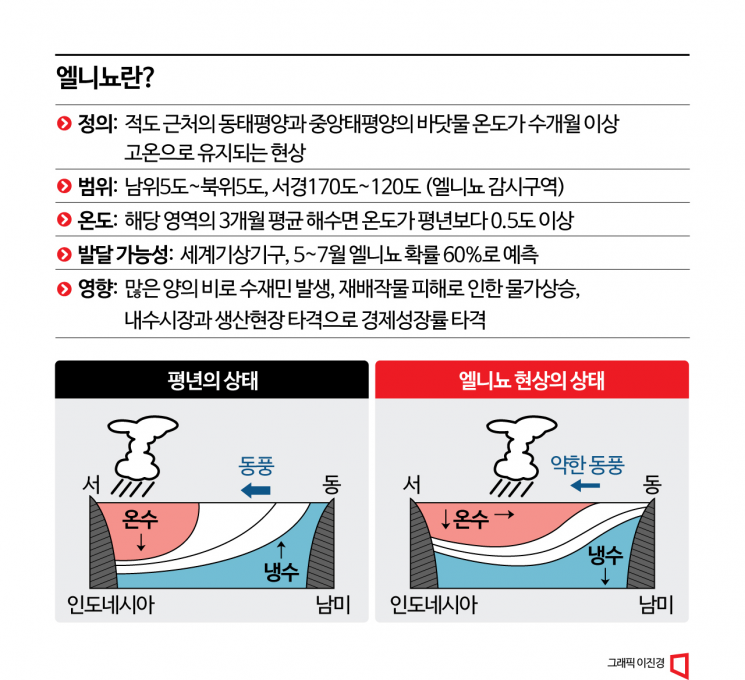
The World Meteorological Organization estimates a 60% chance of El Ni?o development between May and July. Typically, when El Ni?o occurs, South Korea experiences heavy rainfall mainly in the southern regions. The Korea Meteorological Administration also anticipates that rainfall in July will exceed the average due to El Ni?o development this summer. Jo Kyung-sook, head of the Climate Prediction Division at the Korea Meteorological Administration, explained, "Due to El Ni?o, there is a possibility of concentrated heavy rain mainly in the southern regions from mid-July to mid-August," adding, "We must be fully prepared."
Looking Back at Past El Ni?os... Heavy Rain, Soaring Prices, and Damage to Production Facilities
Typically, El Ni?o causes a sharp rise in food prices. The cultivation of major crops is disrupted, leading to an increase in so-called "table prices." During the 2002?2003 El Ni?o, reduced sunlight caused prices of wheat, corn, soybeans, and rice to surge significantly. Notably, fresh vegetable price inflation reached 25.2% in the fourth quarter of 2002 and 43.7% in the first quarter of 2003. During the 2009 El Ni?o, palm oil prices from Southeast Asia soared by 57%.
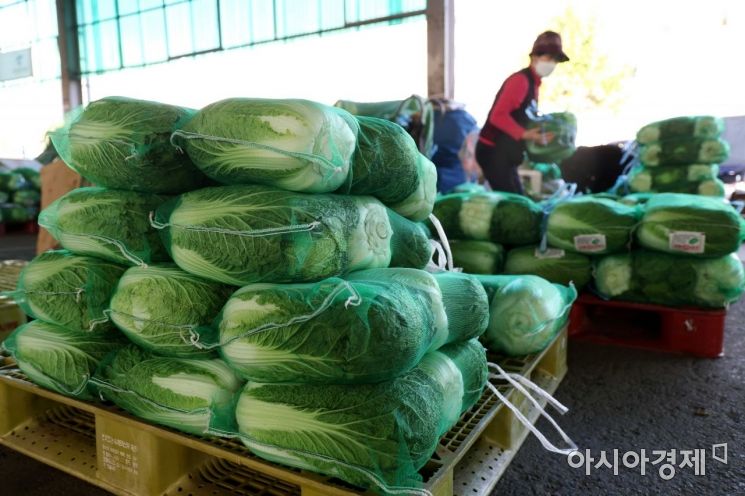 Last September, workers were sorting napa cabbages at Garak Market in Songpa-gu, Seoul. At that time, the combination of rising cultivation costs and heavy rain led to poor napa cabbage yields, significantly reducing supply and causing prices to soar.
For the current government, which prioritizes price stabilization, El Ni?o represents a negative factor. South Korea's consumer price index rose 3.7% year-on-year as of April this year. Entering the 3% inflation range is the first time in 14 months since February last year. Inflation, which peaked at 6.3% in July last year, has begun to trend downward thanks to central bank interest rate hikes and government price stabilization policies. Although there is hope for inflation to fall to the 2% range by year-end, the climate phenomenon has emerged as an unexpected obstacle.
El Ni?o also adversely affects domestic industries. Heavy rainfall disrupts operations in industries sensitive to external conditions, such as manufacturing and construction. During the 2002?2003 and 2009 El Ni?o events, industrial production growth rates were sluggish due to decreased operational rates at industrial sites. Last year, POSCO's Pohang Steelworks suffered flooding damage from Typhoon Hinnamnor. The tourism and service sectors are also inevitably impacted. Heavy rain during peak seasons and holidays, considered lucrative periods by the industry, can dampen consumer sentiment and reduce tourist numbers. This is unwelcome news for the government, which is currently investing 60 billion won in fiscal measures to stimulate domestic demand as of late March.
Additional Budget Required if Flood Victims Occur... "This Year's El Ni?o Could Cause $3 Trillion Losses by 2029"
If heavy rains cause flood victims, government spending will increase. The government provides tax, health insurance, electricity, and communication fee reductions in areas designated as special disaster zones. The national treasury's support ratio for public facility restoration budgets?including rivers, roads, railways, water and sewage systems, and forest roads?is increased, and disaster relief funds are distributed to residents depending on the damage scale. When Typhoon Hinnamnor caused damage last year, restoration costs alone amounted to 780.2 billion won. A government official stated, "There is criticism that being conservative with budget execution during disasters does not help the public," adding, "To ensure swift recovery, we focus on budget spending such as contingency funds."
The scientific community has analyzed that El Ni?o causes enormous economic losses. According to a recent paper published in the scientific journal Science by Dartmouth College in the United States, the global economic losses induced by this year's El Ni?o are projected to reach $3 trillion (3,994 trillion won) by 2029. The El Ni?o events of 1982?1983 and 1997?1998 caused economic losses of $4.1 trillion (5,460 trillion won) and $5.7 trillion (7,592 trillion won), respectively. For the entire 21st century, economic losses due to El Ni?o are estimated at $84 trillion (11,829 quadrillion won).
Professor Ha Jun-kyung of Hanyang University's Department of Economics explained, "In past abnormal climate events, prices of lettuce and onions rose significantly," adding, "As cooling demand increases and electricity bills rise, production costs in various industries also increase, naturally affecting prices."

© The Asia Business Daily(www.asiae.co.kr). All rights reserved.



















