This summer, as the likelihood of abnormal weather events such as prolonged heatwaves accompanied by global warming and El Ni?o increases, concerns are rising over a so-called 'cooling cost bomb' due to a surge in electricity demand. Electricity rates have risen by nearly 40% over the past year, making an increase in power demand inevitable from June when air conditioners are fully operated. In particular, since the government's energy-saving measures focus on vulnerable groups such as low-income households, the burden of electricity bills on ordinary citizens is expected to grow.
On the 26th, the Ministry of Trade, Industry and Energy decided to start the summer power supply and demand measures a week earlier than last year, beginning June 26, in preparation for the possibility of an early heatwave. During this period, a joint operation of the comprehensive power supply and demand situation room will be conducted, and a 24-hour intensive situation management system will be implemented to ensure stable power supply.
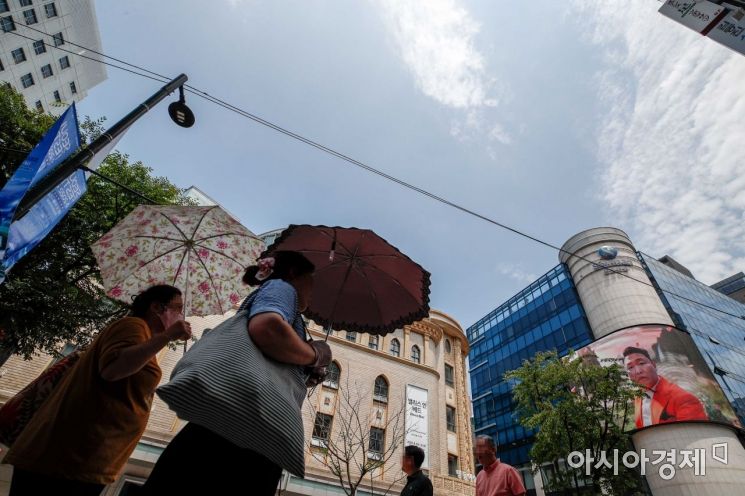 On the 28th, as the daytime temperature in Seoul rose to 34 degrees Celsius, the scorching heat continued. Citizens in Myeongdong, Jung-gu, Seoul, are shading themselves from the sun with parasols. Photo by Kang Jin-hyung aymsdream@
The government advanced the measure period earlier than initially expected based on recent temperature trends and weather forecasts, judging that the summer power peak is likely to occur in July. This is more than a month earlier than the previous peak power demand, which occurred in the second week of August when temperatures peaked and industrial workers returned from summer vacations. The Korea Meteorological Administration forecasted that average temperatures this summer will be higher and more humid than usual over the next three months. Following last summer’s tropical nights in June for the first time in 118 years, this year Seoul’s highest temperature reached 31.2 degrees Celsius on May 16, surpassing 30 degrees a week earlier than last year.
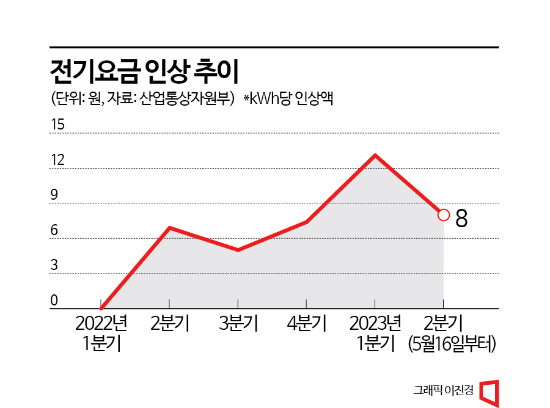
The problem is that early summer heatwaves could cause a surge in electricity demand. Moreover, with electricity rates having risen by more than 40% compared to last year, the burden of cooling costs is inevitably increasing. According to Korea Electric Power Corporation, electricity rates were raised by 19.3 won per kWh last year, followed by additional increases of 13.1 won in the first quarter and 8.0 won in the second quarter of this year. This means the electricity bill burden has increased by 39.6% in one year. Based on the average consumption of a four-person household (332 kWh), electricity bills are expected to rise from about 51,300 won last year to 65,000 won this year.
Concerns are also emerging that the bill burden will concentrate on low-income households. This is because the government’s summer energy support measures focus on vulnerable groups such as basic livelihood security recipients and near-poverty groups. The government has postponed the application of electricity and gas rate increases for these groups by one year and expanded the scope of energy vouchers, but aside from raising the progressive rate brackets in July and August, there are no special measures for ordinary citizens. The scope of the progressive rate bracket adjustments is also criticized as insufficient. The summer progressive rate brackets were adjusted as follows: the first stage from 200 to 300 kWh, the second stage from 400 to 450 kWh, and the third stage from 401 to 451 kWh. However, considering the increasing electricity consumption, the billing method is criticized as excessive.
According to the International Energy Agency (IEA), Korea ranks 24th out of 33 OECD member countries in per capita residential electricity consumption. Korea’s per capita residential electricity consumption is only 64% of the OECD average. This is because electricity consumption in the industrial sector accounts for an absolutely high proportion. When excluding usage categories, Korea ranks 7th worldwide in per capita electricity consumption.
Accordingly, the government plans to promote a nationwide energy-saving campaign. It urged households to reduce daily energy use and raise indoor temperatures to participate. The Ministry of Trade, Industry and Energy stated, "Keeping in mind that power peaks may occur in July as well, we will do our best to secure fuel for power generation in advance, conduct special inspections of power facilities, and make active efforts to save energy to ensure stable power supply during the summer."
© The Asia Business Daily(www.asiae.co.kr). All rights reserved.
![User Who Sold Erroneously Deposited Bitcoins to Repay Debt and Fund Entertainment... What Did the Supreme Court Decide in 2021? [Legal Issue Check]](https://cwcontent.asiae.co.kr/asiaresize/183/2026020910431234020_1770601391.png)

















