Converting Brain Signals into Electronic Device Signals
Delivered via Neurostimulator Connected to Spinal Cord
"Regaining the Joy of Drinking Beer at the Bar"
A device that restores communication between damaged spinal cord and brain has been developed.
On the 24th (local time), Professor Gr?goire Courtine and his research team from the Department of Neurology at ?cole Polytechnique F?d?rale de Lausanne (EPFL), Switzerland, announced in the international journal Nature that they developed a "digital bridge" that wirelessly transmits signals between the brain and spinal cord, and confirmed that a patient with paralysis of all four limbs was able to walk like a healthy person using this device.
The research team reported that the patient implanted with this device was able to walk with crutches even after the device was powered off, suggesting that this device can be used to restore natural movement after paralysis.
Connecting Brain and Spinal Cord to Transmit Electrical Signals Generated by the Thought "I Want to Walk"
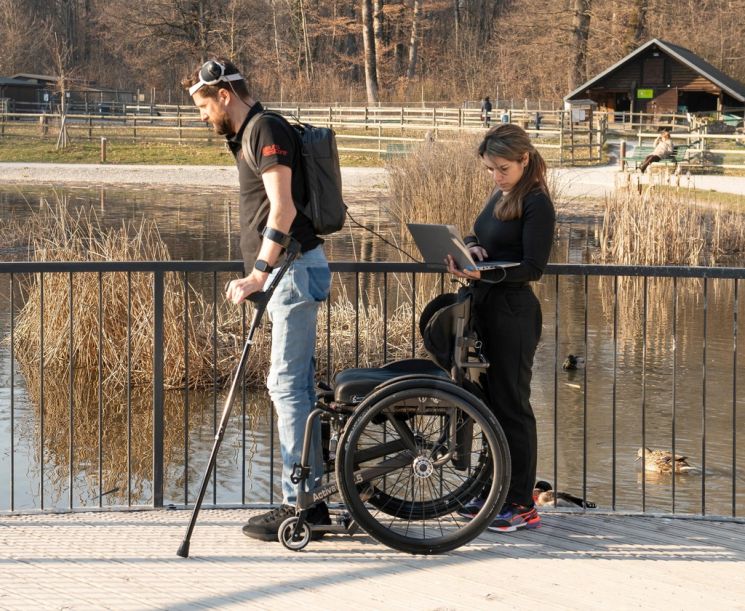 A spinal cord injury patient undergoing walking training using a 'Brain-Spinal Interface' (BSI).
 [Photo by CHUV / Gilles Weber·Yonhap News]
Quadriplegia is a condition where the arms and legs cannot move properly due to damage to the spinal cord, which disrupts communication between the brain and the spinal cord that controls walking. It mainly occurs when the spinal cord is severely injured in traffic accidents or falls.
Previously, the medical community actively conducted research to restore movement in such paralysis patients.
Some researchers succeeded in enabling patients to stand or walk by inserting electrodes into the spinal cord area and applying electrical stimulation; however, this method required patients to wear motion sensors and had limitations in moving legs according to changing terrains such as sandy beaches or mountain trails.
However, this study focused on an approach that helps communication between the brain and spinal cord rather than electrically stimulating the brain. They strengthened the electrical signals generated in the brain through electrical stimulation and sought a way to transmit these brain signals as fully as possible to the spinal cord.
The research team created a "brain-spinal interface (BSI)" composed of an implantable recording and stimulation system that directly connects the brain and spinal cord regions involved in walking.
This system distinguishes the electrical signals generated in the brain when the patient thinks "I want to walk" and converts them into signals usable by electronic devices. These signals are transmitted to a neural stimulator connected to the spinal cord, which sends electrical currents to the spinal cord upon receiving the brain signals, enabling the movements commanded by the brain.
Professor Courtine explained, "Digitally connecting the brain and spinal cord allows for more delicate control of the timing and amplitude of muscle activity, helping patients perform standing and walking movements more naturally."
"Regained the Joy of Drinking Beer While Standing"... Also Shows Neurological Recovery
This device was applied to Sert-Jan Oskam (40), a Dutchman who became paralyzed in the lower body due to spinal cord injury from a bicycle accident 12 years ago. As a result, Oskam was able to control the movement of his paralyzed legs, stand up, walk, and climb stairs. He was also able to walk naturally on complex terrains.
Oskam said, "I regained the joy of drinking beer standing at the bar with my friends. This simple pleasure has brought a great change to my life."
The research team stated, "The BSI can be calibrated within minutes of operation and maintained high reliability and stability for over a year without separate management."
Furthermore, through neural rehabilitation using the BSI, Oskam showed neurological recovery such as the development of new neural connections, enabling him to walk with crutches even when the BSI was powered off. Therefore, it is expected that the BSI will also be helpful in treating motor deficits caused by stroke or neurological disorders.
© The Asia Business Daily(www.asiae.co.kr). All rights reserved.
![Clutching a Stolen Dior Bag, Saying "I Hate Being Poor but Real"... The Grotesque Con of a "Human Knockoff" [Slate]](https://cwcontent.asiae.co.kr/asiaresize/183/2026021902243444107_1771435474.jpg)











