On the 24th, National Assembly Members' Office Building Hosts Parliamentary Forum on Training Physician-Scientists and Establishing Research-Oriented Medical Schools
Training Physician-Scientists to Lead the Bio Era... "Engineering and Medicine Mus
Pohang City, together with Gyeongbuk Province and POSTECH, is accelerating efforts to establish a ‘research-oriented medical school’ by fostering a nationwide consensus on the necessity of training physician-scientists.
On the 24th, the city held a ‘National Assembly Policy Forum on the Establishment of a Research-Oriented Medical School for Physician-Scientist Training’ at the National Assembly Members’ Office Building, Conference Room 1, in collaboration with Gyeongbuk Province and POSTECH.
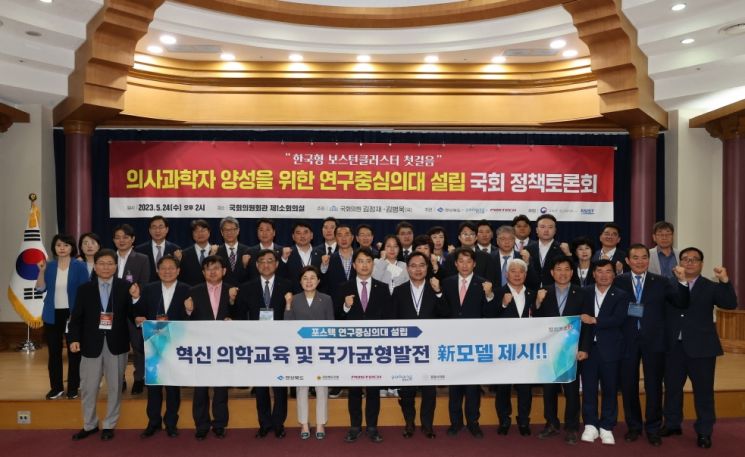 On the 24th, Pohang City held the "National Assembly Policy Forum on Establishing Research-Oriented Medical Schools for Training Physician-Scientists" at the National Assembly Members' Office Building in collaboration with Gyeongbuk Province and POSTECH.
The forum was hosted by National Assembly members Kim Jeong-jae and Kim Byeong-wook, and attended by over 200 participants including lawmakers, officials from related government ministries, local government heads, city and provincial council members, the president of POSTECH, medical education experts, the POSTECH Research-Oriented Medical School Establishment Promotion Committee, and hospital directors from the Pohang area, creating a platform for public discourse on innovation in medical education in South Korea.
The first presenter, Lee Min-gu, head of the Yonsei University Physician-Scientist Training Project Group, introduced physician-scientist training programs operated in the United States and at Yonsei University with concrete examples. He particularly emphasized the need to expand policies for training physician-scientists and proposed improvements such as addressing military service issues and providing career support.
Following the presentation, Kim Cheol-hong, lead professor of the Medical Science Major at POSTECH, introduced cases from the Boston bio-cluster and Pittsburgh’s bioindustry in the United States, stating, “To foster the biohealth industry, a new growth engine for South Korea, it is absolutely necessary to train ‘doctors who do science’ as well as ‘engineers who understand medicine,’” underscoring the necessity of establishing the school.
In the subsequent designated discussion, Kang Dae-hee, chair of the Future Development Committee at Seoul National University College of Medicine, served as moderator. Panelists included Shin Chan-soo, chairman of the Korean Association of Medical Colleges and Medical Schools; Jang In-jin, co-chair of the Ministry of Science and ICT’s Bio Special Committee; Cha Yoo-jin, professor at KAIST Medical Science Research Center; Han Dong-seon, director of Pohang Semyung Christian Hospital; Kang Jeong-ja, director of Talent Development Policy at the Ministry of Education; and Hong Seung-ryeong, director of Health and Medical Technology Development at the Ministry of Health and Welfare, who engaged in lively discussions.
Chairman Shin Chan-soo emphasized the need for a cross-ministerial system to maintain competitiveness alongside various physician-scientist support projects, including the establishment of research-oriented medical schools. Co-chair Jang In-jin introduced the physician-scientist training plans included in the government’s third Basic Plan for Health and Medical Technology Development (draft), explaining the necessity of nurturing multidisciplinary talents in health and medical fields.
Professor Cha Yoo-jin highlighted the advantages of science and technology medical graduate schools over general medical schools in terms of autonomy, diversity, and encouraging problem identification in medical education. Director Han Dong-seon raised the possibility and necessity of a regional hospital network linked by physician-scientists. Alongside, directors Kang Jeong-ja and Hong Seung-ryeong emphasized the need for innovation in medical education and the cultivation of convergence-type physician-scientists based on advanced engineering.
National Assembly member Kim Jeong-jae stated, “In the post-COVID era, the training of physician-scientists is urgently needed. Establishing a research-oriented medical school at a research and development specialized university like POSTECH will provide greater competitiveness.” He added, “The bioindustry is a core industry that will lead future national development, and we will strive to prepare policies so that the state can lead the training of physician-scientists.”
National Assembly member Kim Byeong-wook said, “Fostering bio talents is an urgent task that cannot be delayed to secure national competitiveness and future growth engines. The government and medical community must make an immediate decision to establish a new form of research-oriented medical school to train physician-scientists at South Korea’s top research-oriented engineering universities like POSTECH and KAIST.” He added, “Going forward, all sectors including industry, academia, research, and government will unite their capabilities to make Pohang a biohealth cluster comparable to the Boston model.”
POSTECH President Kim Muhwan said, “It is time to deeply consider not only increasing the number of physician-scientists but also what kind of physician-scientists to train.” He added, “Engineers who deeply understand medicine, trained through innovative educational programs based on engineering and science, will contribute to the development of South Korea’s bioindustry, and POSTECH will contribute to regional development as a hub for building a regional bio-cluster.”
Deputy Mayor Kim Nam-il emphasized, “Pohang is a prepared city for training physician-scientists, possessing three key conditions: world-class bio research infrastructure, close ties with the local medical community, and a leading strategy for balanced national development.” He stressed, “We will complete the Pohang-type bio-cluster by training engineering-based physician-scientists who will work as industrial doctors and successfully lead the local era.”
The ‘POSTECH Research-Oriented Medical School’ plans to introduce the world’s first engineering-based University of Illinois medical curriculum and operate as an MD-PhD 8-year combined degree program (2+4+2) in the form of a medical science graduate school. It is being promoted as a key project of Pohang City along with the construction of a smart hospital (500 beds) and a medical science convergence research center.
© The Asia Business Daily(www.asiae.co.kr). All rights reserved.
![Clutching a Stolen Dior Bag, Saying "I Hate Being Poor but Real"... The Grotesque Con of a "Human Knockoff" [Slate]](https://cwcontent.asiae.co.kr/asiaresize/183/2026021902243444107_1771435474.jpg)
















