Speaker Kim Jin-pyo "Must be completed by the first half of this year"
Political circles expect discussions to be difficult
Discussions on the electoral system reform to be applied in the National Assembly general election next April have been at a standstill for over a month. The National Assembly held a plenary committee meeting for four days starting from the 10th of last month, aiming to change the electoral system, but the ruling and opposition parties failed to narrow their differences over the methodology. Each party and even individual lawmakers have different calculations, resulting in a "same bed, different dreams" situation. Speaker Kim Jin-pyo insists that the electoral system reform must be completed by the first half of this year. However, with less than a year left until next year's general election, there are expectations that the reform discussions will not be easy.
Single-member District System VS Multi-member District System
The core issue of the electoral system reform is the method of electing constituency and proportional representation members. First, regarding constituencies, lawmakers from the ruling and opposition parties have differing opinions on the single-member district system and the multi-member district system.
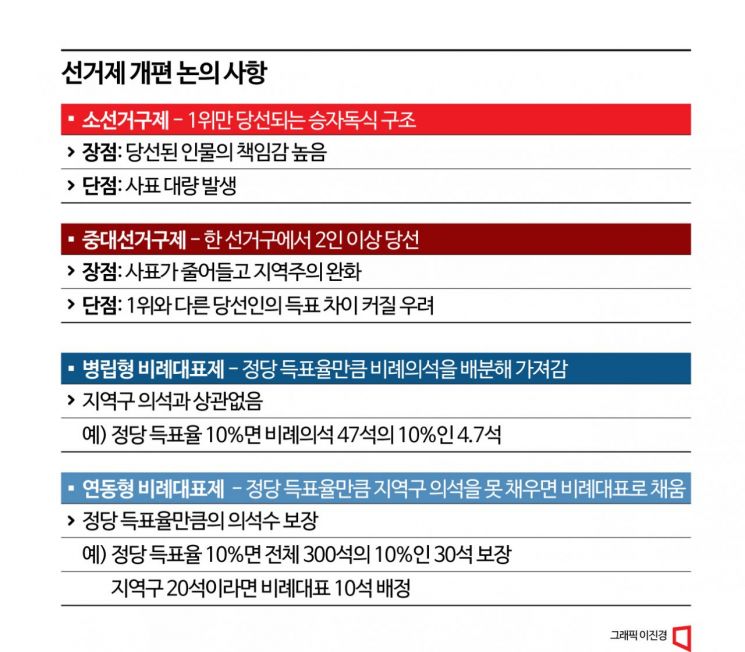
When divided by the size of the electoral district, the single-member district system currently applied in the National Assembly general election is a winner-takes-all structure where only the first place wins. It has the advantage of high accountability for the elected individual but has the disadvantage of generating a large number of wasted votes.
The multi-member district system, mentioned by President Yoon Seok-yeol earlier this year, expands the electoral district to elect two or more members. For example, six existing single-member districts are combined into two districts of three each, and three members are elected from each district. This system has the advantage of reducing wasted votes and alleviating regionalism. The Democratic Party could place within the top three in Yeongnam, a stronghold of the People Power Party, and the People Power Party could win in Honam, a Democratic Party stronghold. However, the expanded constituencies weaken accountability, and there could be a large vote difference between the first-place and other elected candidates.
One of the most frequently mentioned reforms is the urban-rural mixed multi-member district system, which introduces the multi-member district system in urban areas and the single-member district system in rural areas. This compensates for the fact that rural areas have smaller populations, preventing constituencies from becoming excessively large.
Compensatory Proportional Representation vs Parallel Proportional Representation
Proportional representation, which allocates seats according to party vote shares, is divided into parallel and compensatory types. Parallel proportional representation is independent of constituency seats. For example, if a party's vote share is 10%, it receives 10% of the 47 proportional seats, i.e., 4.7 seats. Compensatory proportional representation fills the gap in seats not secured in constituencies according to the party vote share. If a party's vote share is 10%, it is guaranteed 10% of the total 300 seats, i.e., 30 seats. If it wins 20 constituency seats, it is allocated 10 proportional seats.
The semi-compensatory system applied in the 21st general election calculated the number of seats based on each party's vote share and then allocated only 50% of those seats, capping 30 of the 47 proportional seats. Due to the complexity of the system, it was criticized as a "patchwork" and led to satellite parties, making it likely to be excluded from this electoral reform discussion.
Strong Public Support for Electoral Reform... But Lawmakers Have 'Same Bed, Different Dreams'
A survey conducted by the National Assembly's Special Committee on Political Reform among 469 members of a public deliberation citizen participation group found that 8 out of 10 people saw the need for electoral reform.
Although calls for electoral reform are strong, politicians have differing positions based on their interests. Senior lawmakers generally show a favorable response to the multi-member district system. This is because they have already been elected more than twice and have built recognition and local organizational strength. Considering that if constituencies are merged, it will ultimately become a battle of recognition, senior lawmakers naturally prefer the multi-member district system.
On the other hand, first-term and political newcomers, who relatively lack local organizational strength or recognition, mostly have a negative view of the multi-member district system. They lack the absolute time to cover the expanded constituencies. One senior lawmaker said, "I have already built a base in my original constituency for over 10 years, so I won't fall behind in organizational strength," adding, "Even if it changes to a multi-member district system, I am confident I will be elected." In contrast, a first-term lawmaker from the same party said, "Honestly, if I have to compete with senior lawmakers from other parties in a multi-member district system, I think I might be somewhat lacking in recognition."
Because first-term lawmakers overwhelmingly outnumber others among the current 299 National Assembly members, there is a forecast that the single-member district system is more likely to be maintained. Professor Kim Hyung-jun of Myongji University's Department of Political Science and Diplomacy analyzed, "Rather than a revolutionary change like the multi-member district system, it is more likely to go with the single-member district system while abolishing the semi-compensatory proportional representation system. Since the stakeholders themselves discuss and decide, it is inevitable."
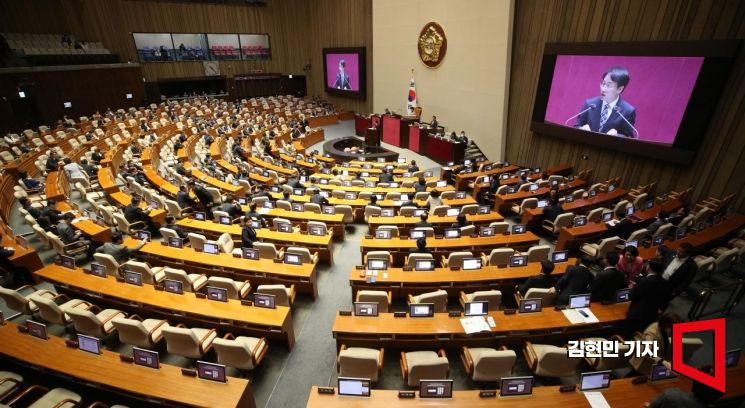 On April 13, the 4th plenary committee meeting for the review of the resolution on the improvement of the electoral system for members of the 405th National Assembly (extraordinary session) was held at the National Assembly. Photo by Hyunmin Kim kimhyun81@
There are diverse opinions on the proportional representation system. During the electoral reform plenary committee, Democratic Party lawmaker Kim Young-bae emphasized the need to increase the number of proportional seats and introduce regional proportional representation. Justice Party lawmaker Shim Sang-jung advocated for an open-list proportional representation system to better reflect the people's will. The open-list proportional representation system allows voters to directly select the proportional candidates they want, whereas the closed-list system determines elected candidates according to the order set by the party.
Also, People Power Party lawmaker Lee Heon-seung argued for the parallel proportional representation system or its abolition. People Power Party lawmaker Jeon Ju-hye strongly called for the abolition of the semi-compensatory proportional representation system. One senior lawmaker said, "Honestly, I think we could do without the proportional representation system," adding, "If you look at the candidates running in constituencies, they are all experts in their respective fields." However, a current proportional representative lawmaker explained, "Looking at the composition of the National Assembly, there is a severe concentration of certain professions such as legal professionals," and added, "Since representation of the people is still insufficient, the proportional representation system should be strengthened to compensate for this and respect diversity in various fields."
Speaker Sets 'End of June' Deadline but Difficulties Expected
On the 22nd, Speaker Kim Jin-pyo attended the "Public Debate on Electoral System Reform" held by the bipartisan political reform lawmakers' group at the National Assembly Members' Office Building in Yeouido, Seoul, and firmly stated that the electoral system reform must be completed by the end of next month. Speaker Kim emphasized, "Negotiations on the election law must be completed in the first half of the year so that the framework can be sent to the plenary session for approval and then to the Special Committee on Political Reform (Jeonggae Teukwi). After that, practical electoral district delineation must be done in consultation with the National Election Commission," adding, "It is challenging to reflect specific issues in the election law within two months."
However, the political circle expects that reaching an agreement by the end of June will be difficult. Kim Yong-tae, former Supreme Council member of the People Power Party and leader of the youth politicians' group "Political Reform 2050," said, "Since it is about changing the rules of the playing field, all players must agree, but there is not enough time to lead this, and the political situation is being sucked into a black hole due to the 'coin' allegations against Democratic Party lawmaker Kim Nam-guk," adding, "I think it will likely be dragged out until the end of the year."
Professor Shin Yul of Myongji University's Department of Political Science and Diplomacy also said, "Lawmakers probably have different thoughts internally, so finding a consensus is difficult, making electoral reform challenging," and added, "Legally, the deadline has passed, but as before, it seems it will happen early next year." According to the Public Official Election Act, electoral reform must be completed at least one year before the election. However, the amendment to introduce the semi-compensatory proportional representation system passed the plenary session on December 27, 2019, just over four months before the 21st general election (April 15, 2020).
© The Asia Business Daily(www.asiae.co.kr). All rights reserved.
![Clutching a Stolen Dior Bag, Saying "I Hate Being Poor but Real"... The Grotesque Con of a "Human Knockoff" [Slate]](https://cwcontent.asiae.co.kr/asiaresize/183/2026021902243444107_1771435474.jpg)

















