On the 31st in Jeju, participation of four countries' patrol vessels
Controversy grows over Japan Maritime Self-Defense Force raising its flag on Self-Defense Ship
On the 31st, the multinational maritime interdiction exercise "Eastern Endeavor 23" will be held in Jeju.
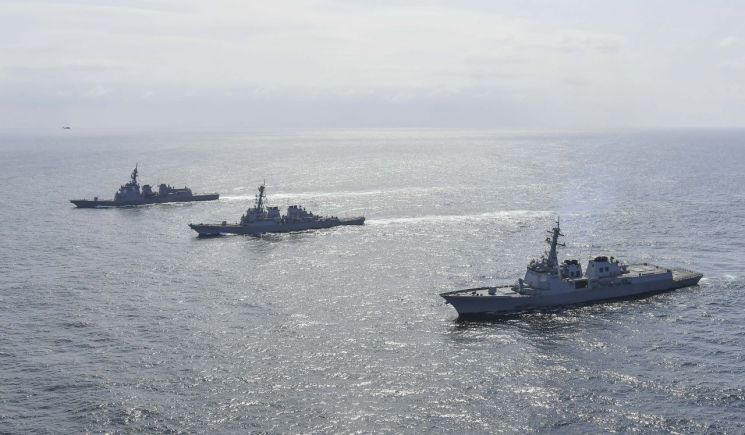
According to the Ministry of National Defense on the 24th, the exercise is scheduled to take place under the auspices of our military, with participation from the United States, Japan, Australia, and others, coinciding with the 20th anniversary high-level meeting of the Proliferation Security Initiative (PSI).
The exercise, commanded by the commander of the 7th Naval Mobile Group of our Navy, involves 7 surface vessels and 6 aircraft from four countries?Korea, the U.S., Japan, and Australia?as well as 6 special boarding teams conducting ship searches and about 20 personnel from the multinational coordination headquarters.
The PSI maritime interdiction exercises began in December 2002 following the incident where the North Korean cargo ship Seosan-ho was caught by the Spanish Navy attempting to smuggle Scud missiles and chemical materials. Although PSI officially states it is not targeted at any specific country, it is inherently closely related to North Korea. The exercise mainly focuses on blocking the illegal maritime transport of weapons of mass destruction.
This exercise starts with the dissemination of information about a suspicious vessel suspected of carrying weapons of mass destruction. Subsequently, surface vessels from each country begin maneuvers to intercept the suspicious ship, while our Navy’s P-3 maritime patrol aircraft conducts route search and tracking missions. Then, using high-speed boats, the suspicious vessel undergoes boarding inspections: the first inspection is conducted by the Korea-U.S. Coast Guard special forces, the second by Korea-U.S. Navy and Japan Maritime Self-Defense Force special teams, and the third by the Korean Chemical, Biological, Radiological, and Nuclear (CBRN) Defense Command special team.
The CBRN Defense Command special team identifies and decontaminates suspected weapons of mass destruction materials, after which the suspicious vessel is allowed to enter a nearby port, marking the conclusion of the maritime interdiction exercise.
After the exercise, Defense Minister Lee Jong-seop will board the Marado ship and review the participating surface vessels in the order of our Navy’s Wang Geon ship, the U.S. Millius ship, Japan’s Hamagiri ship, Australia’s Anzac ship, and the Korean Coast Guard’s 5002 ship. Among these, the Japan Maritime Self-Defense Force escort ship Hamagiri is expected to fly the Self-Defense Force flag, which resembles the Rising Sun flag, potentially sparking controversy.
© The Asia Business Daily(www.asiae.co.kr). All rights reserved.
![Clutching a Stolen Dior Bag, Saying "I Hate Being Poor but Real"... The Grotesque Con of a "Human Knockoff" [Slate]](https://cwcontent.asiae.co.kr/asiaresize/183/2026021902243444107_1771435474.jpg)
















