Announcement of the 'Garden City, Seoul' Plan on the 24th
Transforming Yongsan Park and Songhyeon Site into Gardens
Expanding Seoul Greenways and Segmenting Dulle-gil Trails
Yongsan Park and the Songhyeon-dong site will be reborn as gardens within the city. A park will be created above the underground section of the Gyeongbu Expressway. The Seoul Dulle-gil trail will be maintained as an easy and short course, and a pine shade forest will be established in Seoul Plaza.
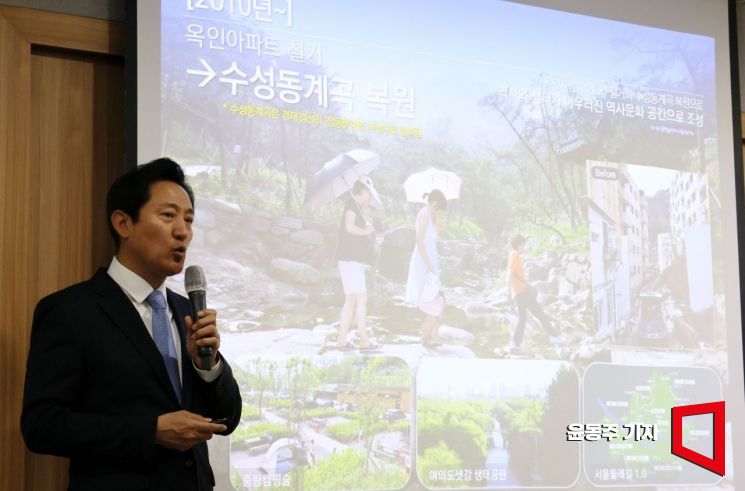 Seoul Mayor Oh Se-hoon holds a press briefing on the 'Garden City Seoul' promotion plan at Seoul City Hall on the 24th. Photo by Dongju Yoon doso7@
On the 24th, Seoul Mayor Oh Se-hoon held a press briefing at Seoul City Hall and announced the ‘Garden City, Seoul’ plan containing these details. Mayor Oh stated, "We will erase the dense gray structures in the city center and transform the city so that gardens can be found anywhere in Seoul 365 days a year." While his previously announced ‘Great Hangang Project’ and ‘Seoulling’ were plans aimed at attracting 30 million overseas tourists, this plan is intended to enhance the daily enjoyment of citizens.
Seoul City has been working on transitioning to a green city by renovating Boramae Park and creating Noeul Park and Bokseoul Dream Forest. Through these efforts, Seoul’s park area increased from 168.16㎢ in 2009 to 172.68㎢ last year. In particular, urban forests in residential areas, created through restoration of damaged sites, grew from 31.1㎢ in 2009 to 47.3㎢ in 2021. Seoul’s park ratio (28.53% as of last year) and per capita urban park area (17.74㎡) have also expanded.
However, excluding outer forests such as national parks, the area of ‘walkable residential parks’ is only 5.65㎡ per person, so parks that citizens can actually feel are still insufficient. Mayor Oh pointed out, "Because there are not enough places to rest in nature, Seoul citizens have to break through congested roads and leave Seoul on weekends," adding, "Due to transportation costs and considerable expenses, it is difficult to enjoy leisure activities."
Accordingly, Seoul plans to realize the Garden City Seoul vision based on four strategies: emptying gray structures in the city center (Empty), connecting fragmented green spaces (Connect), creating ecological parks that coexist with nature (Ecology), and establishing cultural facilities with emotional appeal (Emotion).
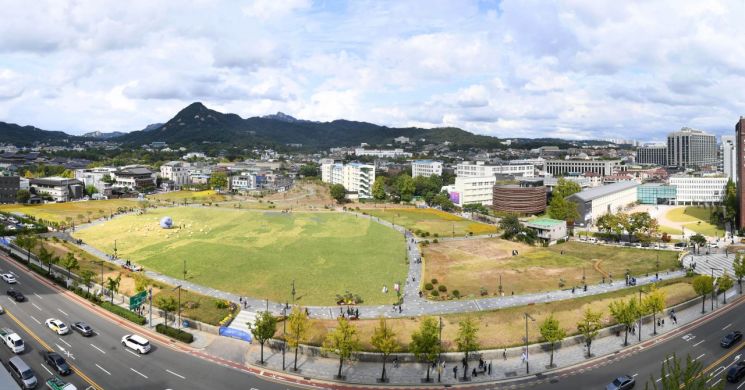
First, the Songhyeon-dong Cultural Park site will be developed into a garden in the city center that many citizens can enjoy. Mayor Oh decided to maintain the principle that no facilities other than the Lee Kun-hee Museum of Art can be introduced despite numerous development demands. Yongsan Park will be transformed into a world garden showcasing representative gardens from various countries. Seoul City plans to propose to the government to develop it as a garden that citizens directly cultivate and participate in. The idle site of Magok 3 District’s cultural facilities will be transformed into a seasonal flower garden and citizen rest garden in connection with the landscaping of Seoul Botanic Park. The upper spaces of existing roads such as National Assembly Boulevard, Yeongdong Boulevard, and the three-dimensional section of the Gyeongbu Expressway, which have been undergrounded, will not be filled with buildings but will be reborn as parks and gardens.
Mayor Oh said, "We are also considering installing ‘Green Poles,’ climbing plants like climbing roses in narrow alleys where it is difficult to plant trees, inspired by the French Green Pole alley gardens, based on ideas from staff," adding, "If neighborhood alleys are beautifully and well maintained, illegal dumping and various crimes will decrease."
Seoul plans to connect partially scattered resting spaces to create uninterrupted green spaces from near homes to distant outer mountains. First, the Seoul Green Road project, which connects fragmented green spaces throughout Seoul, will be completed at 2,063 km by 2026. The existing Seoul Dulle-gil trail, which was divided into eight courses with sections that were too long and difficult to access, will be divided into 21 courses, making it shorter and more diverse.
Seoul Plaza, where citizens found it difficult to stay long due to lack of shade, will be planted with pine trees to create a shade forest. The ‘Greenway Project,’ which creates grassy paths and landscaping/rest facilities on one side of Deoksugung-gil sidewalk, will also be promoted.
Large and small three-dimensional gardens will be created according to the characteristics of spaces such as rooftops, walls, under overpasses, and underground interiors. The ‘Seoul Under Forest Trail,’ targeting barren underground station spaces, will be created in three locations by 2026, and the number of private rooftop garden creation and opening projects will be expanded from 12 sites this year to 48 sites by 2026.
Mayor Oh stated, "In building-dense areas where it is difficult to see blue skies, we plan to increase building heights and secure open green spaces by raising floor area ratio and height incentives for private development projects." He introduced Japan’s Miyashita Park and Meguro Sky Garden, urban rooftop gardens, saying, "We are looking for pilot project sites by referring to Japanese cases with urban environments similar to Seoul. We will create high-quality gardens on large rooftops."
Mayor Oh also mentioned the Seun Sangga green park creation project, saying, "If green spaces 50 to 70 meters wide are connected in front of Changgyeonggung Palace and Jongmyo Shrine while allowing buildings to be built higher, cultural assets will stand out more." He had previously requested the Cultural Heritage Administration to relax regulations to allow high-rise buildings near cultural assets if necessary.
Additionally, a forest museum will be built around the Namsan outdoor botanical garden, damaged vegetation will be restored, and seasonal flowers will be planted. Furthermore, the ‘Water Garden’ project, which creates natural experience spaces by establishing flower paths and flower beds in Hangang Park, will be piloted at four locations including Bulgwangcheon and Mokdongcheon. The Seoul Garden Expo, which used to be held for one week, will be held for two months at Haneul Park starting this year, and next year the Seoul International Garden Expo will be held for six months from spring to autumn at Ttukseom Hangang Park.
Mayor Oh emphasized, "We declare a ‘green-first city’ where parks and green spaces take priority in urban planning," adding, "By 2026, we will invest about 680 billion won to plant tens of millions of flowers and millions of trees so that every citizen can find green spaces within a five-minute distance from where they live."
© The Asia Business Daily(www.asiae.co.kr). All rights reserved.
![Clutching a Stolen Dior Bag, Saying "I Hate Being Poor but Real"... The Grotesque Con of a "Human Knockoff" [Slate]](https://cwcontent.asiae.co.kr/asiaresize/183/2026021902243444107_1771435474.jpg)

















