Fair Trade Commission imposes second-largest fine ever on three mobile carriers for violating the Act on Labeling and Advertising
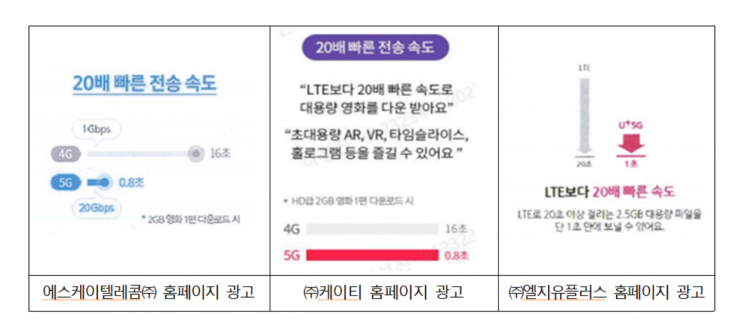
The Fair Trade Commission (FTC) has imposed the second-largest fine in history for exaggerated advertising related to 5th generation mobile communication (5G) by the three major mobile carriers. The FTC found that the carriers engaged in misleading advertising by exaggerating the 5G service speed as reaching 20Gbps, with claims such as "maximum speed of 20Gbps" and "20 times faster than LTE," thereby causing consumer misunderstanding and obtaining unfair profits.
On the 24th, the FTC announced that it would impose a total provisional fine of 33.6 billion KRW on the three mobile carriers (SK Telecom, KT, and LG Uplus) for falsely exaggerating the speed of their 5G services. This is the second-largest fine ever imposed for violations of the Act on Labeling and Advertising. The largest fine was 37.3 billion KRW imposed on German Audi Volkswagen in 2017 for violations related to the emissions scandal. The FTC viewed that the three carriers unfairly induced consumers to subscribe to 5G services through deceptive advertising and forced subscriptions to expensive plans, thereby gaining unfair profits.
According to the FTC, the three mobile carriers advertised the 5G technology standard's target speed of 20Gbps, which cannot be realized in actual usage environments, as if consumers could actually use it. They also advertised the maximum supported speed, calculated under strict preconditions of the allocated frequency bands, as if consumers could actually experience it. Additionally, they advertised their 5G service speeds as faster than competitors without objective evidence. Chairman Han emphasized, "Simply adding formal disclaimers that actual speeds may vary depending on usage environments does not sufficiently eliminate the possibility of consumer misunderstanding."
Chairman Han stated, "When advertising theoretical maximum speeds, specific conditions under which the theoretical figures are derived must be included so that consumers can understand how much the actual speed differs in real usage environments." He added, "Alternatively, approximate speeds, averages, or a range consisting of minimum and maximum speeds in actual usage environments, along with substantial disclaimers, should be provided."
The FTC emphasized, "This measure eradicates the unfair advertising practices that have been repeatedly observed during each transition of communication technology generations in the mobile communication market, where there is significant information asymmetry between operators and consumers." It also highlighted that this is the first case recognizing the illegality of advertising related to the core performance indicator of communication services, speed. Furthermore, the FTC stated, "By imposing the second-largest fine ever in a labeling and advertising case and strictly sanctioning the carriers, we clarified that even if operators follow administrative guidance in advertising, if consumer misunderstanding cannot be resolved, such advertising is illegal," underscoring the significance of this decision.
© The Asia Business Daily(www.asiae.co.kr). All rights reserved.

















