KCCI Survey of 300 Young Job Seekers
Preference for Large Corporations Remains... "Urgent Need to Improve Working Conditions in SMEs"
The top job preference among young people in South Korea remains large corporations. Despite severe employment difficulties, the reasons why young people avoid small and medium-sized enterprises (SMEs) include low compensation, lack of guaranteed work-life balance, and uncertain future growth prospects.
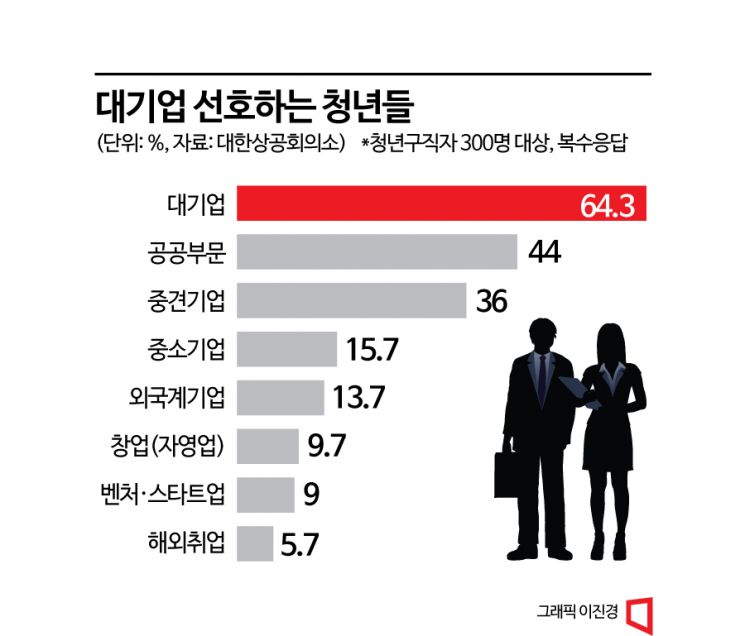
The Korea Chamber of Commerce and Industry announced on the 24th that, according to the recent "Youth Generation Workplace Preference Survey" conducted with 300 young job seekers, the preferred workplaces for youth are still large corporations (64.3%, multiple responses allowed), public sector (public institutions, government officials, etc.) (44.0%), and mid-sized companies (36.0%) in that order. Only 15.7% responded that they preferred SMEs.
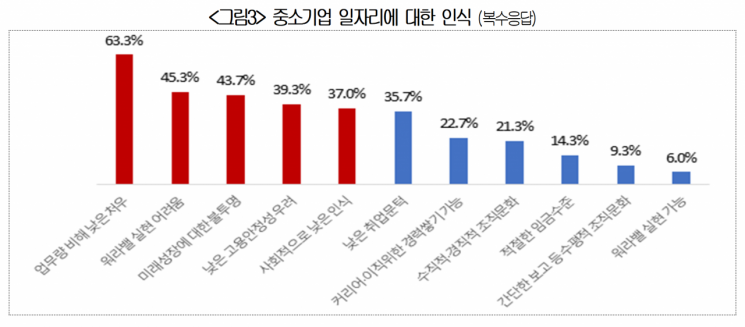
The low preference for SMEs appears to reflect young people's negative perceptions of jobs at SMEs. When asked about their thoughts on jobs at SMEs, the responses were in order: "low compensation relative to workload" (63.3%), "difficulty in realizing work-life balance" (45.3%), "uncertain future growth" (43.7%), "concerns about low employment stability" (39.3%), and "low social recognition" (37.0%).
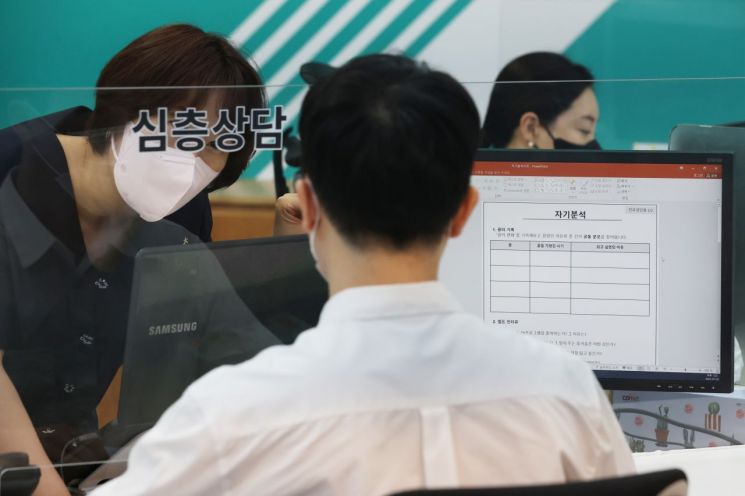
The preference of young people for large corporations and the public sector may solidify the 'job mismatch.' According to the "Workforce Survey by Occupation" conducted by the Ministry of Employment and Labor, as of the third quarter of last year, despite active recruitment efforts by companies, the number of unfilled positions reached a record high of 185,000, most of which occurred in SMEs with fewer than 300 employees (173,000, 93.7%). On the other hand, according to the "April Employment Trends" (Statistics Korea), the number of employed youth decreased by 52,000 compared to the previous year, even considering the decline in the youth population.
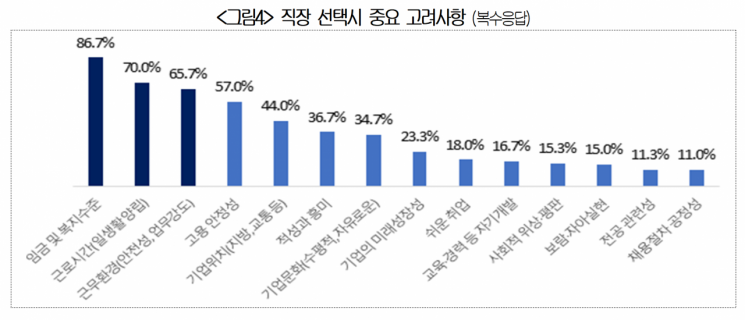
When choosing a workplace, young job seekers considered "wage and welfare level" (86.7%) as the most important factor. This was followed by "working hours (work-life balance)" (70.0%), "working environment (stability, workload)" (65.7%), "employment stability" (57.0%), and "company location" (44.0%). Regarding the desired starting salary for new employees, the highest percentage (39.0%) responded "between 30 million and 35 million KRW." This was followed by "under 30 million KRW" (20.0%) and "between 35 million and 40 million KRW" (19.0%).
The reason why tens of thousands of young applicants flocked to recent large corporation production worker recruitment was also most commonly cited as "high wages and welfare benefits" (71.7%), followed by "reputation of being a large corporation employee" (44.3%), "employment stability" (37.3%), and "excellent working conditions such as working hours" (31.7%).
To resolve the youth employment issue, young people believe that "improving working conditions at SMEs" (46.7%) should be prioritized. This was followed by "economic revitalization policies" (40.7%) and "labor market reform" (33.3%). Other responses included "promoting corporate investment" (24.7%), "resolving job mismatch" (23.0%), "education reform such as addressing college graduate oversupply" (18.3%), and "retraining to meet the demand for manpower in the 4th Industrial Revolution" (12.7%).
When asked specifically what is needed to improve working conditions at SMEs, 78.0% of respondents cited "improving wage levels," followed by "guaranteeing work-life balance" (62.0%), "creating a horizontal organizational culture" (42.0%), and "establishing a safe workplace" (39.0%). A Korea Chamber of Commerce and Industry official emphasized, "Since SMEs struggling to recruit young talent could have opportunities, it is an important time to change young people's perceptions of SMEs and implement measures to improve job quality."
Only 15.0% of the young respondents had applied for and participated in government youth employment support policies. 77.7% of respondents did not apply. Some youth (7.3%) applied but were rejected. The main reasons for not participating in support policies were "difficulty finding information" (29.2%) and "feeling that applying would be futile" (29.2%). This was followed by "lack of interest" (24.9%) and "feeling it would not be helpful" (15.9%). The Korea Chamber of Commerce and Industry suggested that it is necessary to check whether information about support policies is being adequately conveyed to young people.
Yuilho, head of the Employment and Labor Policy Team at the Korea Chamber of Commerce and Industry, said, "Exports have been declining for seven consecutive months, and with global economic slowdown and weakening trade with China, there seems to be no improvement in export conditions, so the youth employment market may remain frozen for some time." He added, "To increase youth employment, promoting corporate investment is key, and through active regulation and labor market reforms, companies should be given more capacity to provide quality jobs."
© The Asia Business Daily(www.asiae.co.kr). All rights reserved.
![Clutching a Stolen Dior Bag, Saying "I Hate Being Poor but Real"... The Grotesque Con of a "Human Knockoff" [Slate]](https://cwcontent.asiae.co.kr/asiaresize/183/2026021902243444107_1771435474.jpg)


















