Scheduled for launch around 6:24 PM
First operational mission... Korea-type space launch vehicle's first challenge for practical use
This afternoon marks the dawn of the 'Korean New Space' era.
On the 24th, Korea's first independently developed space launch vehicle, Nuriho, will undergo another critical test. This is the first actual mission to deploy a commercial satellite worth hundreds of millions of won into orbit. Success is essential to achieving the goal of practical use of space launch vehicles. The onboard satellites are also attracting attention as advanced scientific experiment platforms. This marks the first step in transferring space launch vehicle technology to the private sector.
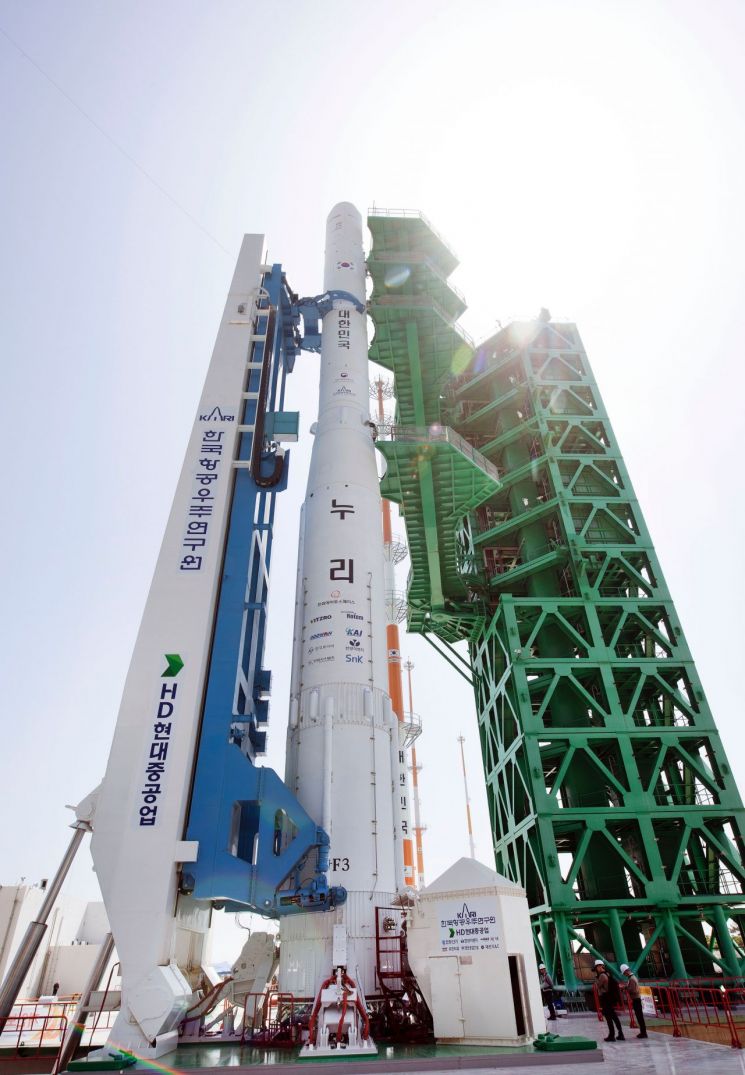
The Ministry of Science and ICT and the Korea Aerospace Research Institute (KARI) will conduct the third launch of Nuriho at around 6:24 PM (±30 minutes) at the Naro Space Center in Goheung-gun, Jeollanam-do. Preparations have been completed, including moving the launch vehicle to the launch pad, erecting and securing it, and attaching the umbilical cable the previous morning. The umbilical cable, meaning "umbilical cord," is a connector used to supply electricity and propellant. The Ministry of Science and ICT will hold a launch management committee meeting in the morning to conduct a final check of technical conditions and weather status, and decide on propellant (fuel + oxidizer) loading, whether to proceed with the launch, and the launch time.
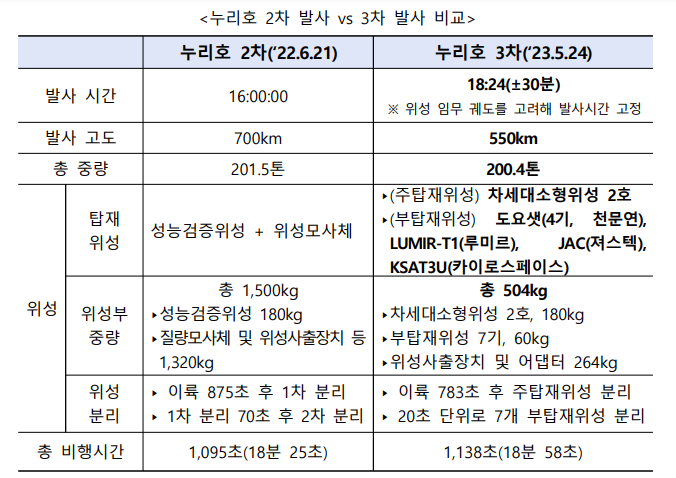
This third launch is Nuriho's first actual mission deployment. Korea has invested about 1.957 trillion won over 13 years since 2009 to develop Nuriho. The first launch in October 2021 flew normally but failed to place the satellite mock-up into orbit. The second launch successfully placed a performance verification satellite and four CubeSats into orbit, marking a final success. However, that was at the level of performance testing. This third launch is the first real mission, carrying several 'guests' worth hundreds of millions of won, which must be safely placed into a 550 km orbit. It is an opportunity for Nuriho to verify its reliability and stability and establish itself as a true 'space launch vehicle.' Professor Changjin Lee of Konkuk University's Department of Aerospace Engineering said, "While the second launch focused on functional checks, this time, according to customer requirements, the target orbit will be set and satellites will be deployed, verifying performance as a full-fledged commercial launch vehicle. If the fourth launch, involving a newly manufactured rocket, also succeeds following this launch, reliability can be secured."
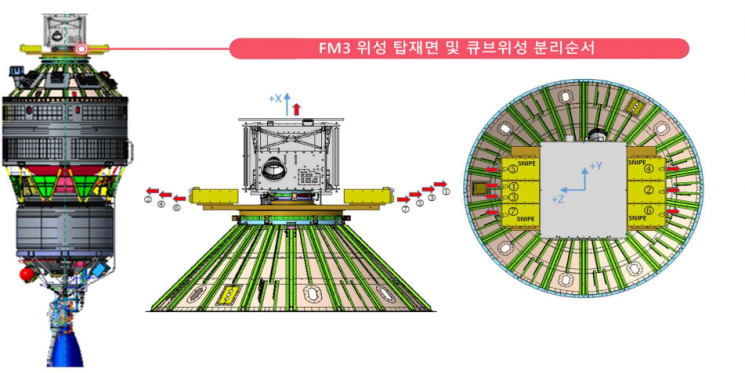
There is also high interest in the satellites onboard for the third Nuriho launch. The main payload, the Next-Generation Small Satellite No. 2, was developed by KAIST's Satellite Research Center with an investment of 24 billion won. It is a national satellite operating an advanced Synthetic Aperture Radar (SAR) capable of ground observation during day, night, and adverse weather conditions. Using an X-band SAR with 5m resolution and 40km observation width, it will monitor Arctic sea ice changes that directly affect abnormal climate conditions on the Korean Peninsula. It will also be used for forest ecosystem changes and marine environmental pollution monitoring. It carries near-Earth orbit space radiation observation equipment to monitor solar activity. To verify core space technologies, it is equipped with a thermal control device using phase change materials, an X-band GaN-based power amplifier, a combined navigation receiver for the U.S. GPS and Europe's Galileo systems, and solar array panels.
The Korea Astronomy and Space Science Institute (KASI) developed the SNIPE satellites (4 units) with an investment of about 10 billion won. These are Korea's first satellites to apply small satellite swarm operation technology and carry out near-Earth space weather observation missions. They are equipped with instruments such as a particle detector (SST), Langmuir probe (LP), and magnetometer (MAG). Originally planned to be launched using a Russian launch vehicle with 65% of the launch cost already paid, the launch was delayed due to the Russia-Ukraine war in February last year but secured a launch slot on the third Nuriho launch. Additionally, three CubeSats are included: 'Lumir-T1,' developed by private company Lumir for demonstrating space radiation measurement technology; 'JAC,' a 4m resolution Earth observation optical satellite by Justec; and 'KSAT3U' by Kairospace for weather observation through ground surface polarization identification and space debris mitigation technology demonstration.
As seen in the case of SpaceX in the United States, space development has entered an era led by the private sector. Korea is also following suit by transferring Nuriho production, launch, and operation technologies to the private sector to foster the space industry. To this end, last October, Hanwha Aerospace was selected as the system integrator for the 'Korean Launch Vehicle Advancement Project' to receive technology transfer. Hanwha Aerospace, which actually developed the 75-ton liquid engine for Nuriho, is taking charge of overall production, assembly management, and joint launch operations starting from this third launch, acquiring know-how and technology. Through the fourth to sixth launches, it is expected to gain technical capabilities and develop private space launch vehicles in the future, potentially growing into Korea's version of SpaceX.
Meanwhile, unlike the first and second launches which took place at 4 PM, this third launch will occur around sunset. This timing is suitable for the Next-Generation Small Satellite No. 2 to reach its target orbit, the dawn-dusk orbit, which faces the sun. The dawn-dusk orbit means the satellite passes over the equator at 6 AM (dawn) and 6 PM (dusk). Since the SAR, the core payload of the Next-Generation Small Satellite No. 2, consumes a lot of power, this orbit was chosen to maximize solar exposure.
© The Asia Business Daily(www.asiae.co.kr). All rights reserved.



















