Loaded together on export shipment
All headed to North America that day
"After domestic testing, send overseas"
On the morning of the 18th at Hyundai Motor Company's Ulsan Plant. About a 10-minute drive from the main gate leads to an underground tunnel. Passing through here, thousands of vehicles are lined up. In front of them, two 60,000-ton car carriers can be seen. Dozens of vehicles enter in a row every 5 minutes. The most common models were the Avante (export name Elantra), Kona, and Staria, which we often see.
About 20 meters away from the thousands of vehicles, 10 cars gathered together that I had never seen before. Two Ioniq 5s, commonly seen on the road, had cameras attached to the roof and front of the vehicle. A Hyundai official explained that these vehicles are not regular Ioniq 5s but ‘autonomous driving’ test cars. There was also a Kia EV9, recently unveiled at the Seoul Mobility Show. Next to it was a completely redesigned Santa Fe model covered in camouflage, scheduled for release later this year. This is a confidential model not yet seen on the road. All the front windshields had white papers with the word ‘USA’ written on them.
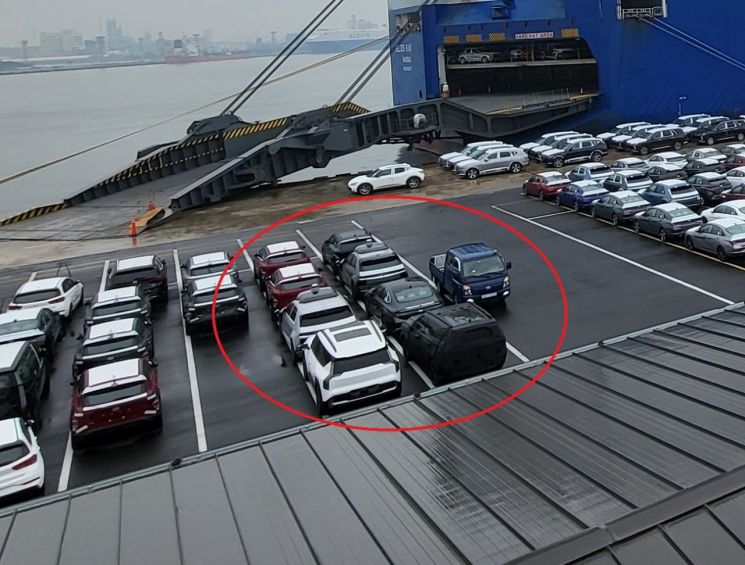 On the 18th, you can see a vehicle never seen before in the world at Hyundai Motor Company's Ulsan plant export dock. The black vehicle at the bottom right inside the red circle is the completely redesigned Santa Fe model to be released in the second half of this year. On the left is the Kia EV9. In front is the Ioniq 5 autonomous vehicle.
 [Photo by Oh Gyumin]
With an annual production volume of 1.5 million units, about 920,000 of which are exported, this plant is the largest single factory in the world (500ha) and is adjacent to an export pier. At Hyundai Motor Company's Ulsan Plant, thousands of ‘present’ vehicles seen on the road go out into the world every day, but ‘future’ vehicles that do not yet exist in the world also cross the sea together.
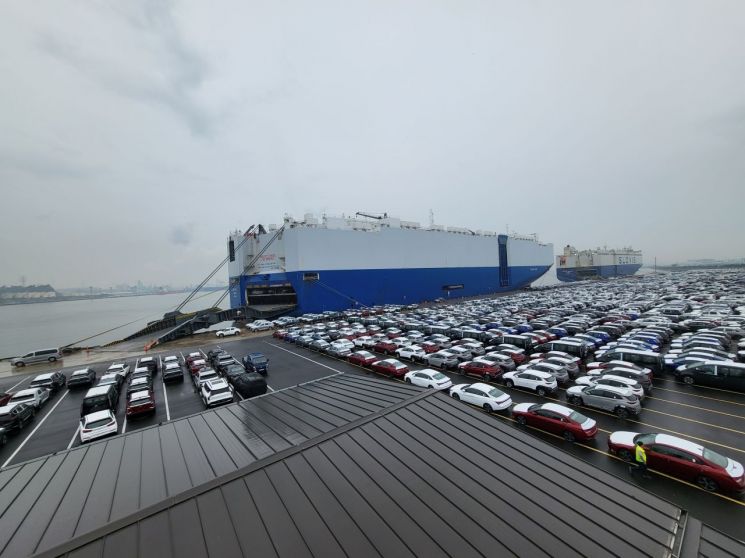 At Hyundai Motor Company's Ulsan plant, thousands of 'Hyundai' vehicles seen on the road every day are shipped out to the world, but the 'future' that does not yet exist also crosses the sea together.
 [Photo by Oh Gyumin]
Cars that are still under development or soon to be released mainly gather at the Ulsan Plant pier. This is because they can be transported most quickly to local markets by car carriers. Vehicles produced here undergo a pre-delivery inspection (PDI), and if there are no issues, they are immediately moved to the export pier. Waiting at the pier, they are loaded onto car carriers and leave the world 1 to 2 days later. It takes only 13 days to reach the U.S. West Coast (based on San Diego). Europe takes 4 weeks, and the U.S. East Coast takes 29 days. The longest export destination is Russia (43 days). Of the two car carriers docked that day, one was headed to North America, and the other was bound for Europe via the Middle East. All the vehicles not yet available in the world were loaded onto the ship heading to North America.
These transported vehicles are immediately tested locally. Although they have undergone road tests in Korea, local conditions may differ. Usually, these cars were test-driven at Hyundai’s Namyang Research Center and other locations, but the headquarters sends them to overseas branches without additional costs.
© The Asia Business Daily(www.asiae.co.kr). All rights reserved.


















