The three major indices of the U.S. New York stock market showed a decline in the early session on the 23rd (local time) as the meeting between President Joe Biden and House Speaker Kevin McCarthy regarding the debt ceiling ended again without any progress.
As of 10:15 a.m. on the day at the New York Stock Exchange (NYSE), the Dow Jones Industrial Average was down 33.57 points (0.10%) from the previous close, trading around the 33,224 level. The S&P 500, which focuses on large-cap stocks, fell 16.23 points (0.39%) to 4,176, while the tech-heavy Nasdaq index dropped 35.30 points (0.28%) to 12,685.
Currently, seven sectors of the S&P 500, excluding energy, utilities, real estate, and consumer discretionary stocks, are all declining. The energy sector is showing a notable rise, supported by the increase in international oil prices. Chevron rose more than 2% after HSBC upgraded its investment rating. APA, ExxonMobil, Marathon Oil, and others also rose more than 1% each.
Broadcom rose about 1.3% on news that Apple signed a multi-billion-dollar contract for 5G wireless frequency components with Broadcom, while Apple showed a slight decline. Yelp jumped more than 9% after activist investor TCS Capital Management sent an open letter to the board urging the exploration of strategic alternatives, including a sale. PacWest Bancorp also rose more than 6% after announcing the sale of a $2.6 billion real estate loan portfolio the previous day.
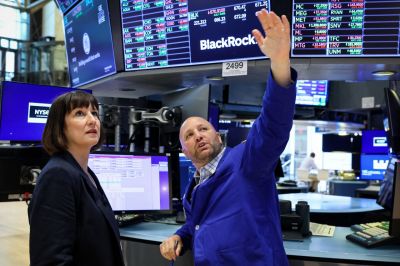
Investors are closely watching political discussions on raising the debt ceiling and the Federal Reserve's monetary policy direction amid warnings that a default could occur as early as June 1. President Biden and Speaker McCarthy met again yesterday afternoon but failed to reach an agreement. The Republican Party, which holds the majority in the House, opposes raising the debt ceiling unless there are significant government spending cuts, while President Biden insists that tax reform through increased taxes on the wealthy should be considered.
However, Speaker McCarthy emphasized, "The President and I know the deadline, so we will discuss it every day," indicating ongoing efforts to prevent a default. Economic media CNBC reported, "The one-hour conversation ended without a resolution but with a more positive atmosphere."
The market currently believes that the worst-case scenario of a default will not materialize but remains concerned about the uncertainty and its repercussions until the last moment. Mohamed El-Erian, chief economic advisor at Allianz, appeared on CNBC's Squawk Box and said, "We are sending very negative signals about our ability to manage the economy." Philip Colmar, global strategist at MRB Partners, said, "The debt ceiling issue is weighing on investor sentiment," adding, "If an agreement is reached earlier than expected, it would be good news for the market."
Opinions are divided on whether the Federal Open Market Committee (FOMC) in June will hold rates steady or raise them further. Earlier, James Bullard, president of the St. Louis Federal Reserve Bank and a known hawk, emphasized the need for two more hikes this year, and other Fed officials have also expressed support for tightening, leading the market to lower expectations for rate cuts. CNBC reported that federal funds futures had been betting on up to three rate cuts this year in recent weeks but now see at most one cut as likely.
However, a rate hold is the prevailing expectation for the June FOMC. According to the CME FedWatch tool, as of this morning, federal funds futures reflect about a 70% probability that the Fed will keep rates unchanged in June. Although slightly lowered by recent hawkish Fed comments, this remains a high level. The probability of an additional "baby step" (a 0.25 percentage point rate hike) stands in the 29% range.
This week, in addition to the May FOMC minutes, several economic indicators closely watched by the Fed will be released, including the April PCE price index and the revised first-quarter GDP growth rate. Investors are expected to look for hints about further rate hikes or the possibility of rate cuts later this year from the FOMC minutes released on the 24th. The core PCE for April, scheduled for release on the 26th, is forecasted to rise 4.5% year-over-year and 0.3% month-over-month. Speeches by Fed officials such as Dallas Fed President Lori Logan and Boston Fed President Susan Collins during the week will also be closely watched for continued hawkish remarks.
The economic data released today were mixed. The S&P Global U.S. Services Purchasing Managers' Index (PMI) for May was preliminarily reported at 55.1, the highest in 13 months. In contrast, the May Manufacturing PMI was 48.5, below the 50 threshold. The Philadelphia Fed's non-manufacturing index was -16, marking the third consecutive month in negative territory. April new home sales rose 4.1% to 683,000 units, exceeding the Dow Jones estimate of 668,000 units.
In the New York bond market, Treasury yields rose amid concerns over debt ceiling negotiations and uncertainty about Fed monetary policy. The 10-year U.S. Treasury yield rose to around 3.73%, and the 2-year Treasury yield, sensitive to monetary policy, rose to about 4.38%. At one point during the session, the 2-year yield surpassed 4.4%, reaching its highest level since March. The dollar index, which measures the value of the dollar against six major currencies, rose slightly to around 103.3.
International oil prices are rising. The July West Texas Intermediate (WTI) crude oil price is trading around $73.34 per barrel, up 1.75% from the previous close.
European stock markets are all declining. Germany's DAX index fell 0.33%, the UK's FTSE index dropped 0.07%, and France's CAC index is down 1.15%.
© The Asia Business Daily(www.asiae.co.kr). All rights reserved.
![Clutching a Stolen Dior Bag, Saying "I Hate Being Poor but Real"... The Grotesque Con of a "Human Knockoff" [Slate]](https://cwcontent.asiae.co.kr/asiaresize/183/2026021902243444107_1771435474.jpg)
















