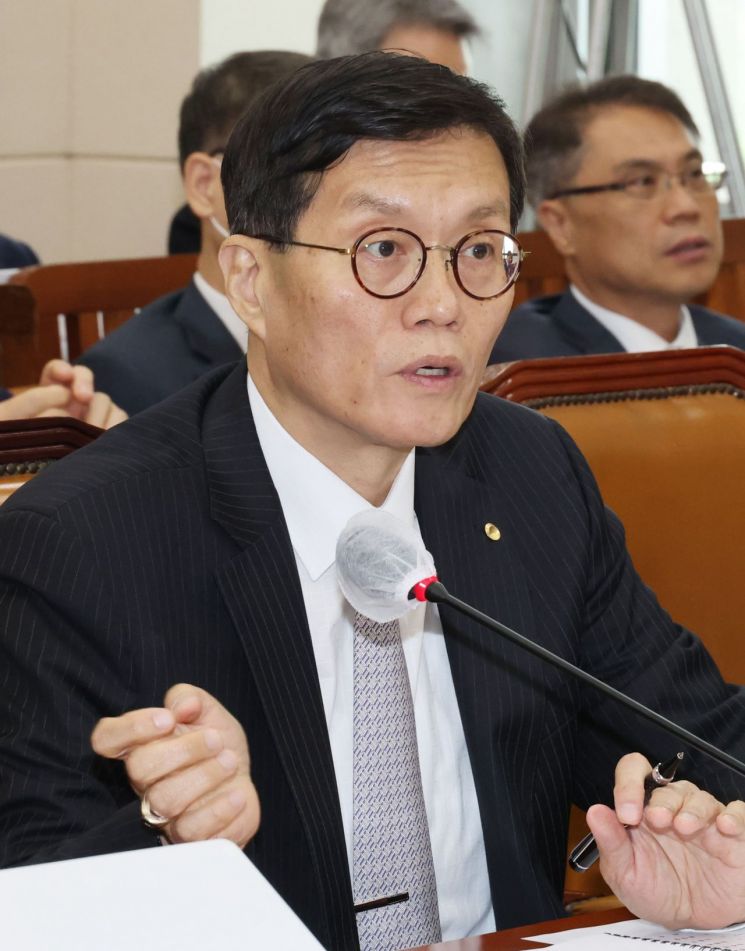
 Bank of Korea Governor Lee Chang-yong is responding to lawmakers' questions at the Planning and Finance Committee plenary session held at the National Assembly in Yeouido, Seoul, on the morning of the 22nd.
 [Image source=Yonhap News]
Lee Chang-yong, Governor of the Bank of Korea, stated that the inflation rate will remain in the 3% range until the end of this year, emphasizing, "We will continue to operate monetary policy with a focus on inflation going forward."
Governor Lee made these remarks on the 22nd during a current issues inquiry at the National Assembly's Planning and Finance Committee.
He said, "There is a possibility that the inflation rate will briefly be in the 2% range until the end of this year, but it seems it will remain in the 3% range by year-end."
He explained, "Since the current inflation is higher than the target level, we will continue to operate monetary policy with a focus on inflation."
Governor Lee forecasted that the Bank of Korea's initial projection for South Korea's economic growth rate this year will be slightly lowered from 1.6%, but the 'low in the first half, high in the second half' growth pattern will continue.
He said, "The Bank of Korea previously expected 1.6%, but (in the revised economic outlook on the 25th) it will be slightly lowered. Nevertheless, it is difficult to say that the 'low in the first half, high in the second half' pattern will not occur at all."
He added, "Basically, our consumption level is not satisfactory, but it is showing a consumption trend that can be seen within a growth rate range of 1.5% to 2%. The problem is that exports are worse than expected."
Governor Lee also expressed the view that "the benefits gained from the China boom over the past decade or so have disappeared," stating, "It is time to strengthen competitiveness again."
He emphasized, "The biggest reason for the decline in exports to China is intermediate goods exports. Chinese companies have started producing a lot, which has significantly eroded (South Korea's) competitiveness. This is not a diplomatic issue, but a serious problem of how to secure competitiveness against China in the mid to long term."
He further projected, "This year, the trade balance will show a deficit of 30 billion dollars, and the current account balance will show a surplus of about 24 to 26 billion dollars due to the development of tourism and other sectors." This suggests that the Bank of Korea's initial current account surplus forecast of 26 billion dollars may be slightly lowered.
© The Asia Business Daily(www.asiae.co.kr). All rights reserved.
![Clutching a Stolen Dior Bag, Saying "I Hate Being Poor but Real"... The Grotesque Con of a "Human Knockoff" [Slate]](https://cwcontent.asiae.co.kr/asiaresize/183/2026021902243444107_1771435474.jpg)
















