Responding to Workforce Shortages in the Organic Light-Emitting Display Sector
The Korea Display Industry Association announced on the 22nd that it will promote the 'Industry-Transition Type Inorganic Light-Emitting Display Specialist Training Project,' supported by the Ministry of Trade, Industry and Energy and exclusively managed by the Korea Institute for Advancement of Technology, to cultivate and secure industry-demand-tailored master's and doctoral-level talent in the field of inorganic light-emitting displays.
Inorganic light-emitting displays are a new self-luminous display technology with inorganic characteristics developed to overcome the limitations of organic light-emitting displays (OLEDs). This includes MicroLED, nano-scale LED, and Quantum Dot (QD) technologies. They are characterized by high definition, long lifespan, and the ability to realize ultra-large screens.
In anticipation of the preliminary feasibility study for the 'Inorganic Light-Emitting Display and Ecosystem Construction Project,' aimed at securing future technology leadership in the display industry’s super-gap, scheduled for the second half of the year, the association is proactively responding to research and talent cultivation demands in the inorganic light-emitting field. Specifically, it will establish specialized educational courses such as ▲Inorganic Light-Emitting Devices and Design (Korea University) ▲Inorganic Light-Emitting DX Process and Equipment (Chung-Ang University) ▲Inorganic Light-Emitting Materials and Components (Hanyang University ERICA Campus) to nurture next-generation master's and doctoral-level talent.
To this end, the association will receive a total project budget of 5 billion KRW over the next five years to develop and operate an industry-demand-based specialized curriculum for inorganic light-emitting displays. Through industry-academia projects, it plans to cultivate personnel equipped with practical research and development (R&D) capabilities and supply them to related industries.
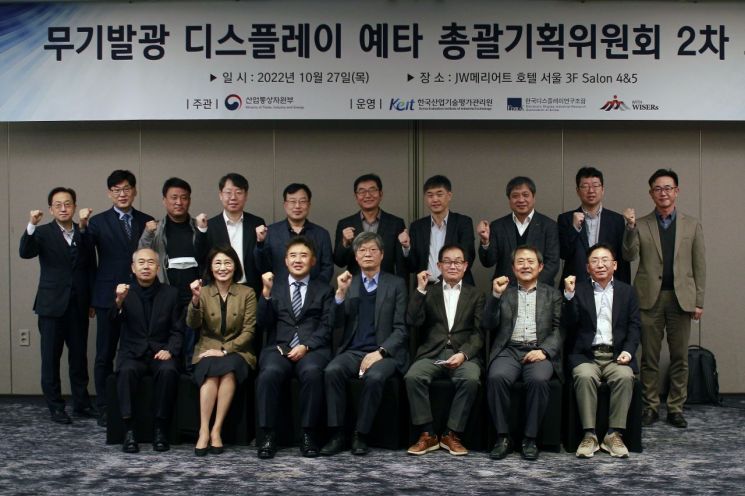 Participants of the 2nd General Planning Committee for the OLED Display Preliminary Feasibility Study Project are taking a photo. /
 [Photo by Korea Display Industry Association]
This inorganic light-emitting display specialist training project is being promoted as a follow-up measure to the Ministry of Trade, Industry and Energy’s 'Display Industry Innovation Strategy' announced on the 18th. The ministry set a goal in this strategy to cultivate 9,000 outstanding talents who will lead next-generation display technologies over the next 10 years. This will be achieved by actively supporting the establishment of specialized graduate schools to nurture master's and doctoral-level talent.
According to the association, although projects to cultivate display specialists in equipment, components, materials, and next-generation display processes, equipment, and materials have been underway since 2015, there is still a shortage of specialized personnel for future high value-added and new technology displays such as OLED and inorganic light-emitting displays. Consequently, there is growing demand from the industry for government-led talent cultivation support linked with excellent domestic universities.
According to the 'Promising New Industry Industrial Technology Workforce Outlook' announced by the Korea Institute for Advancement of Technology last month, the number of technical personnel in the next-generation display industry was 42,624 as of the end of 2021. The shortage of personnel was 1,955, with the shortage rate for master's and doctoral-level personnel (6%) higher than the overall average (4.4%). The absence of high-level R&D personnel is greater than in other mature key industries. Over the next 10 years, the number of technical personnel in the next-generation display industry is expected to increase by 59,813, of which 9,399 will be required to be master's and doctoral-level personnel.
Lee Dong-wook, Vice Chairman of the Korea Display Industry Association, said, "Amid severe manpower shortages in next-generation display fields such as OLED and extended reality (XR) devices, the number of talents produced annually through government-supported master's and doctoral-level talent cultivation programs is less than 100, which remains insufficient." He added, "Since there is a large gap between the industry's expected demand for talent and the actual supply, more budget support is needed to produce a large number of master's and doctoral-level personnel in this field."
He also pointed out, "Inorganic light-emitting displays are a core field where we must surpass China and secure independent technology," adding, "As future-oriented technology development support led by the government is necessary, the cultivation of high-level personnel for next-generation displays and innovative technology development must precede." The association views that a systematic industry-academia cooperation system will be necessary to maintain the display industry's super-gap and global market leadership, and plans to support the creation of a virtuous cycle of talent cultivation through cooperation among the government, academia, and industry.
© The Asia Business Daily(www.asiae.co.kr). All rights reserved.
![Clutching a Stolen Dior Bag, Saying "I Hate Being Poor but Real"... The Grotesque Con of a "Human Knockoff" [Slate]](https://cwcontent.asiae.co.kr/asiaresize/183/2026021902243444107_1771435474.jpg)
















