President Yoon Suk-yeol's expansive diplomatic activities at the Group of Seven (G7) summit have elicited mixed reactions from both the ruling and opposition parties. While the ruling party views it positively, saying "the day South Korea joins the G8 is not far off," opposition figures have expressed concerns that the country may be overly inclined toward the United States and Japan.
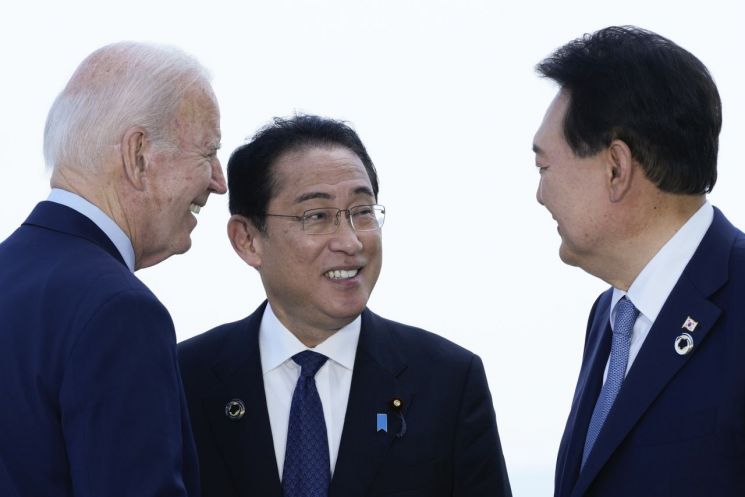
On the 22nd, Yoon Sang-hyun, a member of the People Power Party and former chairman of the National Assembly's Foreign Affairs and Unification Committee, said on YTN's "News King Park Ji-hoon" that "South Korea's economic and diplomatic power is indeed sufficient to be part of the G7 or G8 countries," adding, "If we continue to participate in international meetings like this, the day we join the G8 is not far away." His remarks align with the ruling party's stance, which described President Yoon's G7 summit activities as a "psychological G8."
He also highly praised the Korea-Japan and Korea-US-Japan summits held during the G7 as a "restoration of the trilateral summit among South Korea, the US, and Japan." Yoon said, "The Korea-US-Japan summit was held at the NATO summit in June last year after President Yoon took office, again at the ASEAN meeting in Phnom Penh last November, and once more at the G7 meeting this time. During the Moon Jae-in administration, the trilateral summit did not function due to North Korean issues, but now the trilateral summit has been fully restored. This seems to have significant meaning."
On the other hand, diplomatic figures from the Moon Jae-in administration, while acknowledging the significance, warned against excessive "inclination toward the US and Japan." Choi Jong-geon, former First Vice Minister of Foreign Affairs, said on MBC's "Kim Jong-bae's Focus" that regarding the ruling party's description of a "psychological G8," "Is there really a need to use such an exaggerated term as psychological G8?" He added, "If we ourselves say psychological G8, I wonder how people from other countries will feel about it." It remains uncertain whether this sentiment is shared internationally.
He emphasized that being included in the G8 is not necessarily beneficial for South Korea. Professor Choi said, "G8, G9, G10 sound good, but what benefits do we gain by joining? If we get swept up in the atmosphere, we might be dragged in directions we do not want or expect."
Hong Hyun-ik, former president of the Korea National Diplomatic Academy, also said on KBS's "Choi Kyung-young's Strong Current Affairs," "The main content of the Korea-US-Japan summit is to strengthen cooperation on the North Korean nuclear issue, and what makes me somewhat uneasy is the cooperation within the Indo-Pacific strategy, whose main purpose is to check China, Russia, and North Korea and to foster closer ties among the three countries. There is a saying that 'too much is as bad as too little.' Excess is worse than deficiency."
He added, "If a major crisis occurs in North Korea leading to a sudden change, managing it well and achieving peaceful unification would be almost impossible without China's cooperation. Now is the time to also consider China and Russia. That time has come."
Meanwhile, at this Korea-US-Japan summit, President Biden mentioned "a new level of cooperation" and proposed a Korea-US-Japan summit in Washington. In political circles, concerns were raised that this might involve Japan's participation in the Nuclear Consultative Group (NCG). In response to a question from the host on CBS's "Kim Hyun-jung's News Show," Shin Beom-cheol, Deputy Minister of Defense, dismissed these concerns, saying, "It seems unlikely that Japan will suddenly be included in the NCG at the next summit."
© The Asia Business Daily(www.asiae.co.kr). All rights reserved.

















