The Best SME Policy Identified as 'Establishing Principles for Labor Reform Including Flexible Working Hours'
It has been found that domestic small and medium-sized enterprises (SMEs) are generally satisfied with the SME policies of the Yoon Suk-yeol administration.
The Korea Federation of SMEs announced on the 22nd the results of the "Satisfaction Survey on SME Policies and Policy Tasks under the Yoon Suk-yeol Administration," conducted over three days from the 15th to the 18th, targeting 303 domestic SMEs. Regarding satisfaction with SME policies since the launch of the Yoon Suk-yeol administration, about 8 out of 10 respondent companies (77.6%) expressed 'satisfaction' (26.4% very satisfied, 51.2% satisfied).
The SME policy that the Yoon Suk-yeol administration was most praised for (multiple responses allowed) was the "Establishment of labor reform principles such as flexible working hours" (57.8%). This was followed by "Legislation of the delivery price linkage system and creation of an environment for fair pricing" (54.5%), and "Expansion of inheritance and gift tax limits to revitalize business succession" (31.4%).
Regarding President Yoon Suk-yeol’s role as "Korea’s No. 1 Salesperson," strengthening economic cooperation among Korea, the U.S., and Japan, 84.8% of SMEs evaluated it positively (50.5% very positive, 34.3% positive). The reasons for positive evaluation (multiple responses allowed) were "Strengthening global status" (66.1%), "Expansion of export opportunities" (44.7%), and "Facilitation of imports of materials, parts, equipment, and raw materials" (27.6%).
The top priority issue facing the Korean economy was identified as the "rigid labor market" (40.3%). This was followed by "polarization between large and small-medium enterprises" (18.5%) and "excessive regulation" (18.2%).
The biggest difficulties faced by SMEs (multiple responses allowed) were "intensifying labor shortages" (48.5%). "Rising labor costs" (45.9%) and "increasing raw material prices" (42.6%) were also cited.
Regarding SME policies that should be prioritized in the second year of the Yoon Suk-yeol administration, 6 out of 10 respondent companies (59.7%) chose "labor reforms such as the 52-hour workweek and the Serious Accidents Punishment Act." Other mentioned policies included "improving the foreign workforce system to resolve labor shortages" (34.3%), "resolving polarization between large and small-medium enterprises" (30.0%), and "supporting revitalization of business succession" (19.5%).
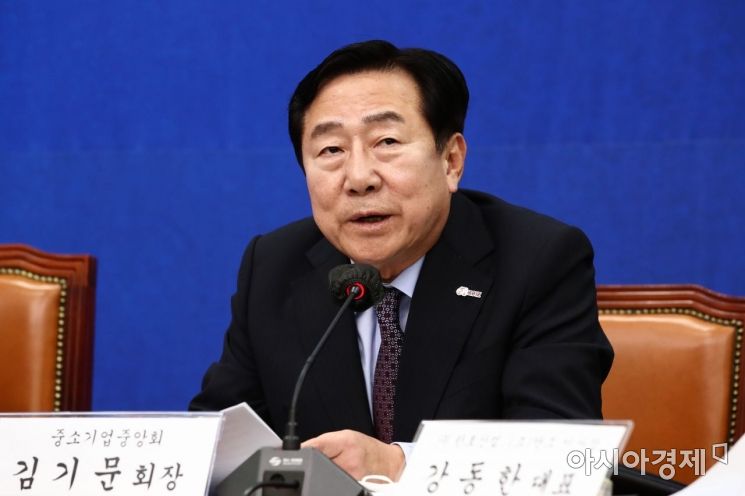
Kim Ki-moon, Chairman of the Korea Federation of SMEs, said, "The results of this survey seem to reflect the consensus in the SME community that, over the past year since the launch of the Yoon Suk-yeol administration, policies overly focused on labor have been corrected, and a business-friendly policy environment has been created through the introduction of the delivery price linkage system and improvements to the business succession system." He added, "The government and businesses must unite as one team to overcome the complex economic crisis at hand and enhance Korea’s competitiveness in the global market."
© The Asia Business Daily(www.asiae.co.kr). All rights reserved.

















