Mainichi Poll Shows Approval Rating Rising to 45%
Coordination on Timing of Lower House Dissolution for Reelection Expected to Intensify
Following the G7 summit, Japanese Prime Minister Fumio Kishida's approval rating has significantly increased. His approval rating, which had plummeted last year due to issues related to the Unification Church, began to rebound around the time of the Japan-South Korea summit and the G7 meeting. Within Japanese political circles, there is speculation that Prime Minister Kishida will leverage this rising approval rating to coordinate the dissolution of the House of Representatives and the timing of the general election as a stepping stone for re-election.
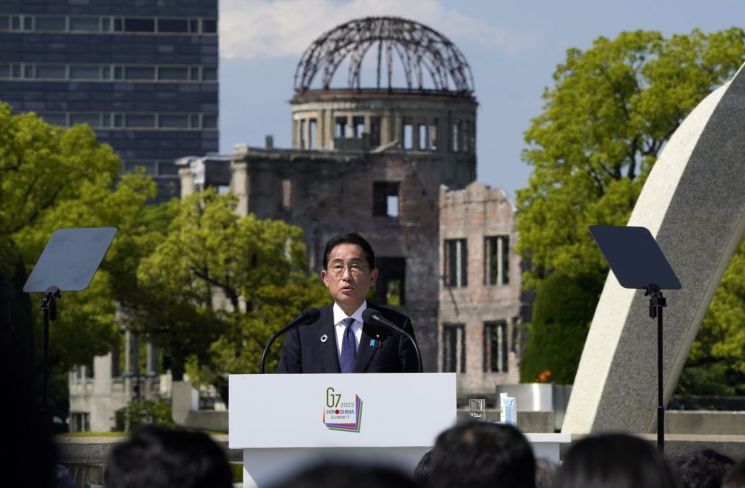
On the 22nd, the Mainichi Shimbun reported that a nationwide opinion poll conducted over two days on the 20th and 21st showed the Kishida Cabinet's approval rating at 45%, a 9 percentage point increase compared to the previous survey conducted on the 15th and 16th of last month (36%). Conversely, the percentage of respondents who said they "do not support" the cabinet dropped by 10 percentage points to 46% from 56% in the previous survey, resulting in a tight race between approval and disapproval ratings.
Mainichi analyzed, "It appears that the diplomatic achievements of the G7 held from the 19th to the 21st were well received," adding, "This is the highest approval rating since August last year, when negative evaluations surpassed positive ones."
Previously, Prime Minister Kishida struggled after his approval rating fell to the 20-30% range following controversies last August related to the former Unification Church and its ties with the ruling Liberal Democratic Party (LDP). In December last year, his approval rating dropped to the mid-20% range, prompting voices within the party questioning his leadership.
The G7 summit appears to have had a significant impact on the recent recovery in approval ratings. In the poll, 85% of respondents positively evaluated Kishida's visit to the Hiroshima Peace Memorial Park with other world leaders, where they toured the museum and related facilities. Nine percent did not approve, and 6% were unsure.
At this G7 summit, Prime Minister Kishida toured the park alongside leaders of nuclear-armed countries including the United States, the United Kingdom, and France, and subsequently announced the "Hiroshima Vision," the first G7 leaders' document focused on nuclear disarmament. Mainichi stated, "Amid escalating crises such as Russia's invasion of Ukraine and North Korea's nuclear missile development, these efforts appear to have been favorably received."
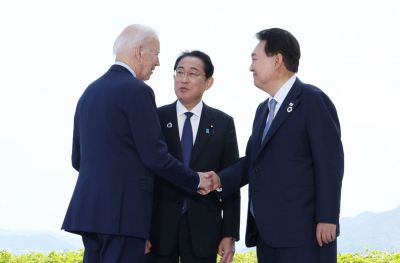
As Prime Minister Kishida shows a clear rise in approval ratings, attention in Japanese political circles is already turning to his path to re-election. The LDP won the recent by-elections last month, and with Kishida effectively holding strong public support and control over government affairs, the possibility of dissolving the House of Representatives has increased. In Japan's parliamentary system, it is common for the prime minister and ruling party to dissolve the Diet and hold general elections when politically advantageous, often to secure continued governance.
Kishida's term as LDP president runs until September next year, and to maintain long-term rule, he must dissolve the House of Representatives at a time during the remaining 1 year and 4 months of his term when re-election seems assured. Mainichi analyzed that the timing could be around the regular Diet session's closure on the 21st of next month, this fall, or sometime after next year, dividing opinions into three scenarios.
However, following the approval rating boost from the G7, Kishida faces significant challenges that could provoke negative public opinion, such as deciding the timing for tax increases to strengthen defense capabilities and securing funds for measures addressing Japan's declining birthrate. For this reason, the LDP reportedly views an early dissolution next month as risky. The most likely timing is considered to be this fall, coinciding with the end of the House of Representatives' term, which would facilitate internal party personnel changes and cabinet reshuffles to strengthen the party's foundation ahead of the election.
Nonetheless, Prime Minister Kishida has refrained from commenting on this matter. At a press conference held in Hiroshima the previous day, he stated, "My top priority is to achieve results on important policy issues. At this time, I am not considering dissolution or a general election," dismissing the speculation.
© The Asia Business Daily(www.asiae.co.kr). All rights reserved.
![Clutching a Stolen Dior Bag, Saying "I Hate Being Poor but Real"... The Grotesque Con of a "Human Knockoff" [Slate]](https://cwcontent.asiae.co.kr/asiaresize/183/2026021902243444107_1771435474.jpg)

















