Biden Mentions Proposal for South Korea-US-Japan Trilateral Meeting
"Proxy War Could Start in This Region"
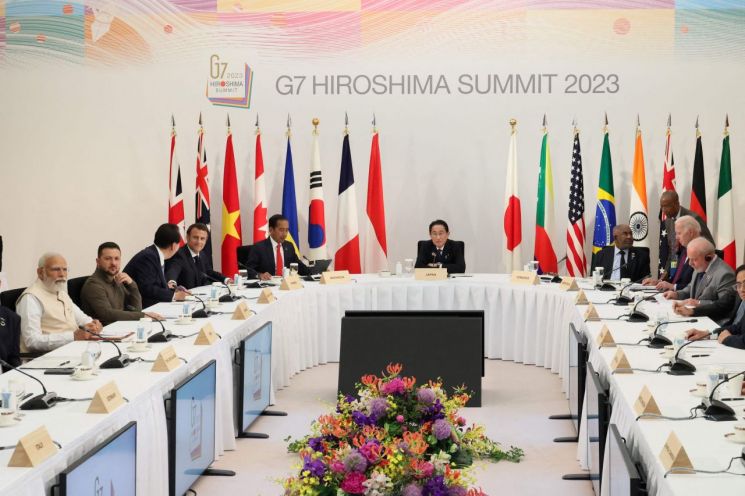
China protested the joint statement of the Group of Seven (G7) summit and strongly criticized the host country, Japan. Local media also mentioned U.S. President Joe Biden's proposal for a trilateral meeting among South Korea, the U.S., and Japan, indirectly putting pressure on South Korea.
On the 21st, the Chinese Ministry of Foreign Affairs announced that Sun Weidong, Vice Foreign Minister, summoned Darumi Hideo, the Japanese ambassador to China, and lodged a "stern representation" regarding the G7 summit's exaggeration of China-related issues. A "stern representation" is a diplomatic term used to formally protest a specific matter through diplomatic channels. Earlier, on the 20th, the day before the G7 summit concluded, the leaders issued a joint statement declaring their intention to strengthen supply chains for critical minerals and materials against China and Russia, while also criticizing China on human rights, the Taiwan Strait issue, censorship of public media, and internet control.
According to the Ministry of Foreign Affairs, Vice Minister Sun stated at the meeting, "The G7's actions, hardened by bloc confrontation and Cold War mentality, run counter to historical trends, objective facts, and international morality," adding, "As the chair country, Japan has slandered and attacked China in a series of activities and in the G7 summit joint statement, seriously interfering in internal affairs and violating fundamental principles." He further said, "This violates international law and the spirit of the four political documents between China and Japan, harming China's sovereignty, security, and development interests."
The Chinese Embassy in Japan also strongly opposed the G7's irresponsible remarks on the 20th and called for restraint from confrontation and division. The Chinese embassies in the United Kingdom and Canada expressed similar positions, warning that they would respond firmly and strongly to any actions or statements harming China's interests.
Local media reacted strongly. The Chinese state-run Global Times (GT) cited Li Haidong, a professor at the China Foreign Affairs University, who said, "Japan envies China's expanding regional influence and acts as a vassal of the United States," criticizing, "Japan has an unhealthy mindset of flattering the U.S." The GT further accused, "Looking at the G7 summit, Japan seems concerned about a lack of loyalty to the U.S. or insufficient dedication to the U.S.'s Asia-Pacific strategy." The GT emphasized, "Japan already caused enormous damage to regional countries during World War II," and warned, "The expansion of militarism and acting as a vassal of the U.S. is a serious warning to regional countries."
Additionally, the GT indirectly pressured South Korea by mentioning President Biden's invitation to President Yoon Suk-yeol and Prime Minister Kishida Fumio of Japan to Washington, D.C., proposing a trilateral meeting among South Korea, the U.S., and Japan. Citing an anonymous "observer," the GT reported, "This reveals the U.S.'s intention to recreate the 'Ukraine crisis' in the Asia-Pacific region and deepen divisions among regional countries," adding, "It could start a proxy war in this region."
© The Asia Business Daily(www.asiae.co.kr). All rights reserved.

















